
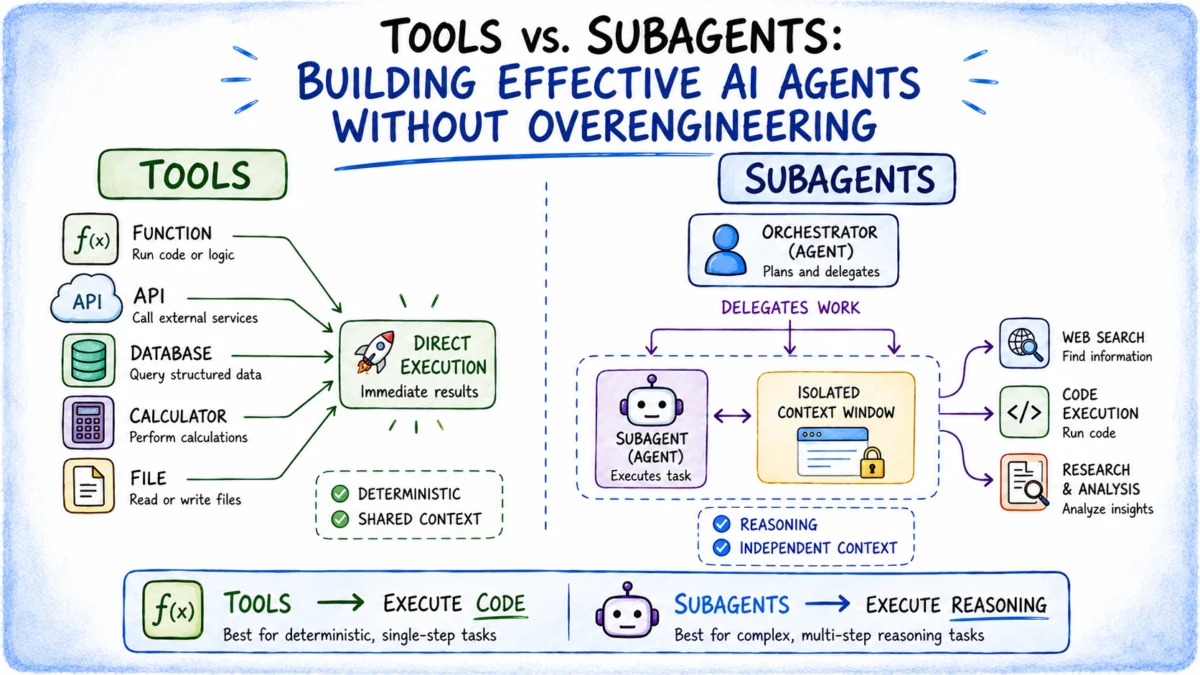

The burgeoning field of artificial intelligence agents presents developers with a critical architectural dilemma: determining whether a specific piece of agent functionality should be integrated as a direct tool or delegated to a separate, independent subagent. This fundamental decision profoundly impacts an agent’s efficiency, scalability, cost, and overall performance, making a nuanced understanding of each approach indispensable for avoiding common pitfalls like overengineering and bloated system contexts.
The Evolution of AI Agents and Architectural Complexity
The rapid advancement of AI, particularly in large language models (LLMs), has propelled the development of sophisticated autonomous agents capable of performing complex tasks. These agents move beyond simple question-answering, exhibiting capabilities for planning, memory, and interaction with external environments. As their functionalities expand, so does the complexity of their internal architecture. Developers frequently encounter a crossroads: a task needs execution – perhaps calling an API, querying a database, or performing a calculation. The choice between embedding this task as a direct tool or entrusting it to a specialized subagent becomes paramount. An erroneous decision can lead to either an unwieldy, monolithic agent burdened by an excessive context window, or an unnecessarily complex, multi-layered system plagued by coordination overhead, increased LLM calls, and debugging challenges. This article delves into the core definitions, distinctions, and strategic considerations for making this vital architectural choice, ensuring robust and efficient AI agent deployment.
Understanding AI Agent Tools: Precision and Execution
At its core, an AI agent tool represents a discrete capability that allows an agent to interact with external systems and execute actions beyond the inherent knowledge of its foundational model. In practical terms, tools are typically manifested as functions, API calls, database queries, search operations, file manipulations, or other executable code exposed to the LLM through a precisely defined interface. These interfaces often leverage structured schemas, such as JSON, to delineate expected inputs and outputs, enabling the LLM to invoke them with accuracy.
Consider a financial agent tasked with analyzing market trends. A tool might be a function designed to fetch_real_time_stock_price(symbol: str) which interacts with a live stock market API from a provider like Bloomberg or Refinitiv. Another could be query_historical_financial_data(ticker: str, start_date: str, end_date: str) to retrieve historical data from a proprietary database. The critical characteristic of a tool is its deterministic nature: it performs a predefined operation and returns data. The tool itself does not engage in reasoning; rather, it executes a specific instruction. The orchestrating LLM retains full responsibility for planning when to use the tool, how to interpret its results, and what subsequent actions to take.
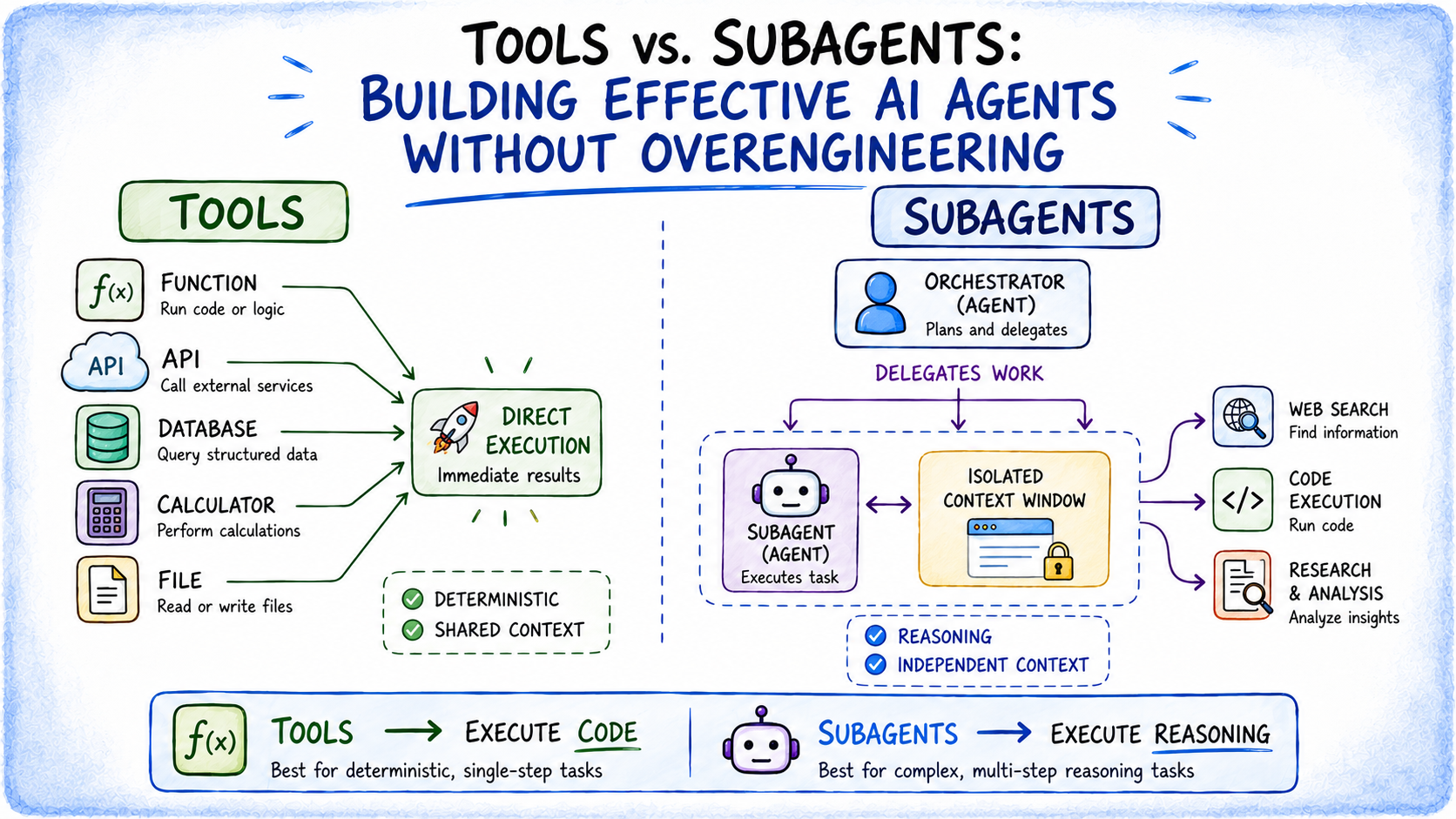
Tools serve as the primary conduits through which agents interact with the outside world. They can perform actions ranging from sending emails via an SMTP client, updating CRM records in Salesforce, generating reports using a document automation API, to controlling IoT devices through a smart home API. Because tools execute pre-written code rather than initiating another LLM inference cycle, they are generally fast, predictable, and comparatively inexpensive. This makes them ideal for tasks that are well-defined, require specific external interactions, and do not inherently demand multi-step cognitive processing. According to recent industry benchmarks, a typical API call through a tool can be executed in milliseconds, costing fractions of a cent, whereas an LLM inference can range from hundreds of milliseconds to several seconds, with costs escalating based on token count.
Deconstructing Subagents: Independent Reasoning Units
In contrast to tools, a subagent represents a more autonomous entity within a larger AI system. It is fundamentally a separate LLM invocation—often a distinct agent instance equipped with its own system prompt, an isolated context window, and frequently its own specialized set of tools. When an orchestrating agent delegates a task to a subagent, the subagent receives this task, processes it independently through its own multi-step reasoning loop, potentially utilizing its own toolset, and ultimately returns a concise result to the orchestrator.
From the orchestrator’s vantage point, initiating a subagent might superficially resemble calling a tool: a task is sent, and a result is received. However, the internal mechanics diverge significantly. A subagent embarks on its own independent problem-solving journey. This journey can involve iterative thought processes, multiple tool calls, internal state management, and complex decision-making, all abstracted away from the orchestrating agent. The orchestrator receives only the final summary or outcome, lacking direct visibility into the subagent’s intermediate steps. This architectural pattern is increasingly prevalent in sophisticated multi-agent frameworks like Microsoft’s AutoGen, LangChain’s agentic workflows, or CrewAI, which facilitate the coordination of specialized agents to tackle complex problems. For instance, AutoGen allows developers to define multiple agents (e.g., a "researcher" agent, a "coder" agent, a "reviewer" agent) that communicate and collaborate to solve a problem, each operating as a distinct subagent.
Subagents are particularly suited for tasks that demand significant cognitive load, internal deliberation, or the synthesis of information from various sources. They encapsulate complexity, allowing the main orchestrator to maintain a streamlined focus on higher-level objectives while delegating intricate sub-problems to dedicated, intelligent modules.
Tools vs. Subagents: A Comparative Analysis of Key Architectural Differences
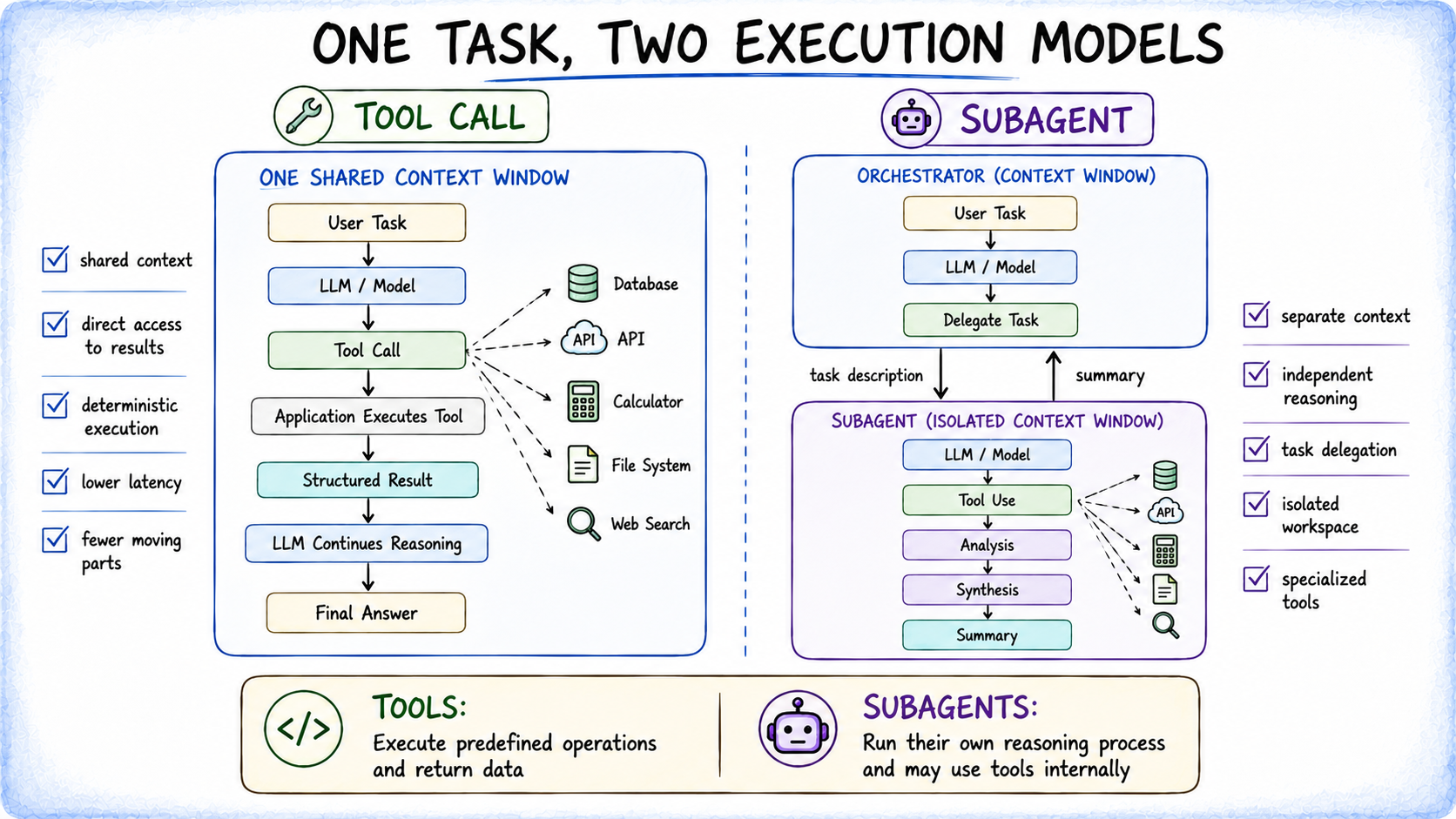
The distinction between tools and subagents is pivotal for designing efficient and scalable AI architectures. While both extend an agent’s capabilities, their operational models, resource implications, and suitability for different tasks vary considerably. The following table, expanded with deeper analysis, highlights these critical differentiations:
| Aspect | Tools | Subagents |
|---|---|---|
| Execution Core | Your pre-written, deterministic code. | Another Large Language Model (LLM) instance with its own inference cycle. |
| Context Window | Shared directly with the orchestrating agent. | Separate, isolated, and managed independently. |
| Reasoning Model | None; purely deterministic execution of code. | Full, multi-step reasoning loop, often involving iterative thought processes. |
| Error Handling | Structured returns, enabling immediate retry within the same orchestrator loop; predictable failure modes. | Subagent handles errors internally, potentially retrying or surfacing a summary of the issue to the orchestrator. |
| Cost Implications | Primarily execution cost of the underlying function/API. | Significant; incurs one or more additional LLM calls, leading to higher token consumption and API expenses. |
| Latency Profile | Low; typically a single function call or API roundtrip. | Higher; involves a full LLM inference cycle, potentially multiple steps, and inter-agent communication overhead. |
| Visibility for Orchestrator | Full; the result is directly injected into the orchestrator’s active context for immediate interpretation. | Partial; orchestrator receives only a summarized conclusion, abstracting away intermediate steps. |
| Typical Failure Modes | Issues with schema, API failures, incorrect arguments, network problems. | Hallucination within the subagent, loss of context in complex reasoning, communication failures, misinterpretation of tasks. |
The context window difference is particularly impactful. When an agent calls a tool, the outcome is seamlessly integrated back into the orchestrator’s ongoing thought process. The orchestrator retains full awareness of its prior reasoning, the tool’s input, and its output, enabling cohesive, continuous decision-making. Conversely, when an orchestrator dispatches a task to a subagent, the subagent commences with a fresh, isolated context, informed only by the task it received. This isolation is a double-edged sword: it prevents distraction but necessitates meticulous task definition and clear communication protocols. This also aligns with findings in AI research that demonstrate how "context window management is crucial for agent performance and cost-efficiency," as noted by researchers at Google DeepMind.
Strategic Applications: When to Leverage Tools
The decision to employ a tool is driven by the nature of the task: it must be well-defined, exhibit deterministic behavior, and not require complex, multi-step reasoning to achieve its objective.
- External API Interactions: Tasks such as fetching a specific user record from an authentication service (e.g., Okta, Auth0), posting an update to a communication platform like Slack or Microsoft Teams, or retrieving data from a proprietary enterprise API (e.g., ERP, CRM) are archetypal execution tasks. The LLM’s role is to decide when and with what parameters to call these APIs; the actual execution is handled by robust, pre-written code.
- Data Transformation and Validation: Operations like applying a regular expression to extract specific information (e.g., email addresses from text), standardizing date formats across different locales, calculating cryptographic hashes for data integrity, or converting units (e.g., Celsius to Fahrenheit) are inherently deterministic. These belong in efficient functions rather than incurring the overhead of LLM calls, which are prone to subtle variations in output.
- File System Operations: Reading the contents of a file, writing new output to storage, or verifying the existence of a directory are predictable and fast when implemented as direct tool calls. These are I/O operations, not reasoning tasks.
- Information Retrieval (Search): Whether it’s performing a semantic search over a vector database (e.g., Pinecone, Weaviate), executing a SQL query against a relational database, or conducting a web search via a search engine API (e.g., Google Search API, Bing API), the search mechanism itself runs deterministically. The tool returns a set of results, which the orchestrating LLM then interprets and synthesizes. The search engine’s role is to find relevant information, not to reason about it.
The litmus test for tool suitability is straightforward: if the behavior can be encapsulated reliably within a Python function (or equivalent code module) with clearly defined, typed inputs and outputs, and if it doesn’t necessitate iterative, multi-step deliberation, it is unequivocally a candidate for a tool. Tools prioritize efficiency, reliability, and cost-effectiveness for routine, well-understood operations.
Strategic Applications: When to Employ Subagents
Subagents become indispensable when tasks transcend simple execution, demanding complex reasoning, parallel processing, or when their intermediate outputs would otherwise clutter the orchestrator’s context.
- Tasks Requiring Multi-Step Reasoning and Iteration: Consider a task like "Research the competitive landscape for X product and provide a strategic summary, identifying key risks and opportunities." This isn’t a single API call. It involves an intricate process: deciding initial search queries, analyzing search results, formulating follow-up queries, synthesizing information across disparate sources, identifying gaps, and iteratively refining the understanding before producing a structured summary. Each step informs the next, making it a quintessential reasoning process best handled in an isolated context by a dedicated subagent.
- Parallelization of Independent Workflows: When a larger task can be decomposed into several independent subtasks that can run concurrently, subagents offer significant advantages. For instance, processing
kdocuments for key information can be exponentially faster ifksubagents work in parallel, each responsible for one document, rather than a single agent processing them sequentially. This pattern is a cornerstone of frameworks designed for collaborative AI, where specialized agents can tackle different facets of a problem simultaneously. Microsoft’s AutoGen, for example, heavily leverages this pattern for tasks like code generation and complex data analysis, where multiple agents collaborate asynchronously. - Specialized Tool Sets and Context Isolation: A general-purpose orchestrator might have access to a broad but limited set of tools. However, a specialized task, such as code generation, might require a specific code executor, debugging tools, and file system access. A research subagent, conversely, would need robust web search, document parsing, and summarization tools. Giving the orchestrator access to an ever-growing array of tools leads to "tool overload," where the LLM’s accuracy degrades as the number of available tools increases, making tool selection a non-trivial reasoning task in itself. Research published in 2023 by Google AI on agent tool-calling confirmed that "accuracy degrades as tool count grows beyond a certain threshold," reinforcing the need for specialized toolsets. Scoping tools per subagent keeps each agent’s decision space manageable and focused.
- Managing Intermediate Output Noise: While a single API response or database record is concise and useful within the orchestrator’s context, a multi-step research synthesis involving dozens of retrieved documents, internal deliberations, and iterative analyses generates substantial intermediate data. Injecting all this into the orchestrator’s context window would create "noise," potentially leading to context overflow, distraction, and degraded reasoning. Subagents effectively encapsulate this mess, surfacing only the distilled conclusion, thereby preserving the orchestrator’s clarity of thought.
- Enhanced Reliability Through Context Isolation: A subagent operating in a pristine, focused context is less susceptible to distractions from the orchestrator’s accumulated conversational history or extraneous information. For tasks demanding high precision and focus, such as complex code generation, structured data extraction, or detailed multi-step analysis, this isolation tends to yield more consistent and reliable outputs, reducing the likelihood of "hallucinations" or off-topic tangents.
The Decision Framework: Three Guiding Questions
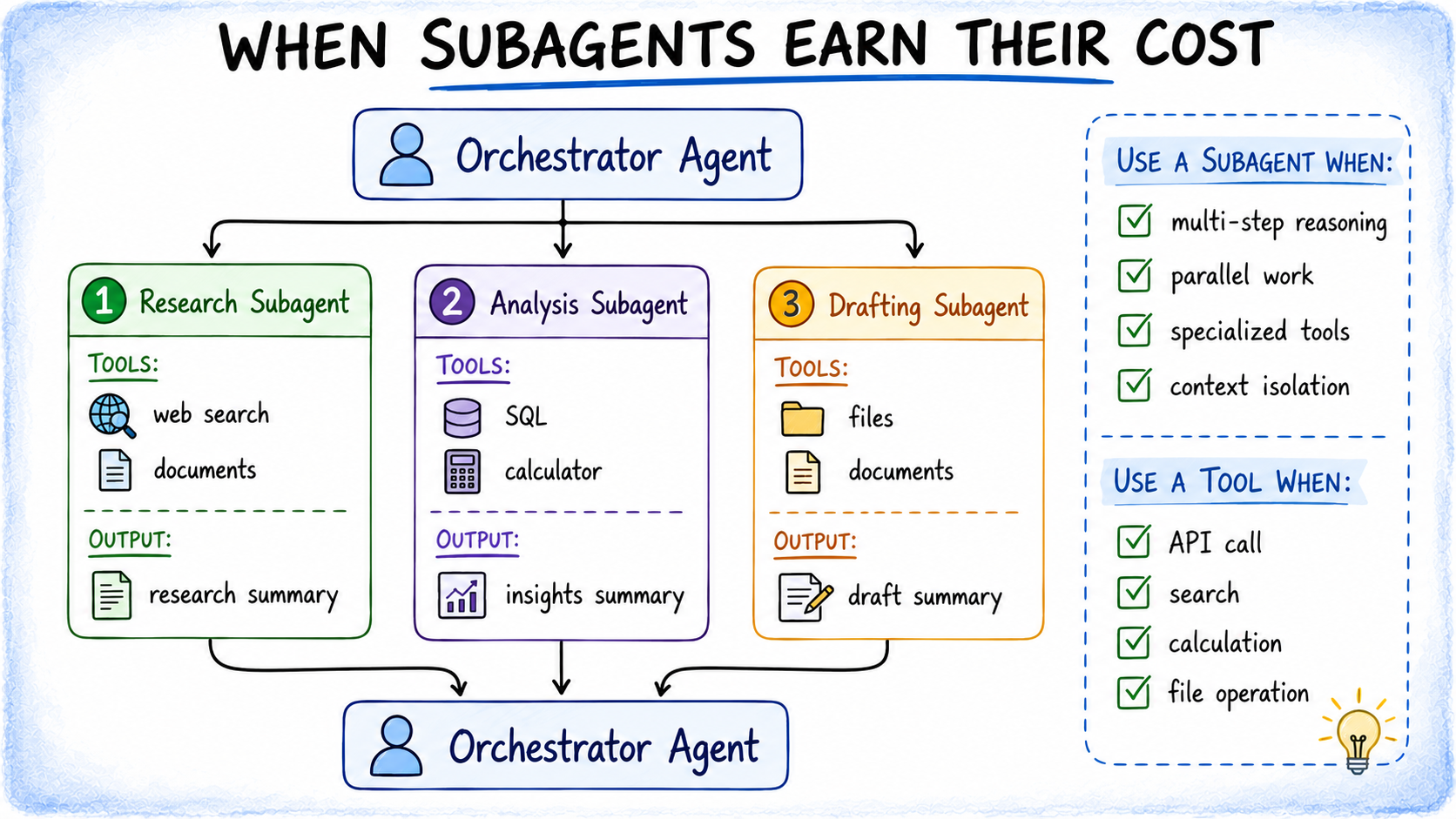
Most architectural decisions regarding tools versus subagents can be distilled into three fundamental questions, serving as a robust decision framework:
-
Is the task primarily execution or reasoning?
- If the task involves a well-defined operation with predictable inputs and outputs—like a database query, an API call, a calculation, or a file operation—a tool is almost always the superior choice. It’s about performing an action.
- If the task necessitates exploration, analysis, synthesis, or a sequence of decisions where each step is contingent on the previous one, it invariably aligns better with a subagent’s capabilities. It’s about thinking and strategizing.
-
Does the intermediate work generated by the task matter to the orchestrator?
- If the results are compact and directly actionable within the orchestrator’s context (e.g., a single data record, a search result snippet, an API status code), a tool suffices.
- If the task produces a large volume of intermediate data—multiple search queries, document reviews, iterative analyses, or internal thought processes—a subagent can contain this "noise," returning only the final, summarized conclusion, thus maintaining the orchestrator’s focus.
-
Can the task run independently or in parallel?
- A tool executes as an integral part of the orchestrator’s workflow
