

Amazon Web Services (AWS) has unveiled a groundbreaking capability within its AWS WAF (Web Application Firewall) service, designed to enable digital content owners and publishers to monetize access to their protected web content by AI bots and agents directly at the network edge. This innovative feature addresses a burgeoning challenge for content providers grappling with the escalating volume of AI-driven web traffic, offering a granular, per-request pricing model based on content path, bot category, or verification tier, all without requiring modifications to origin infrastructure or the development of custom application code. Publishers can now define sophisticated access policies for various agent types, collect payments in stablecoins directly into their preferred digital wallets, and meticulously monitor both revenue streams and bot activity from a unified dashboard.
The digital landscape has undergone a profound transformation with the rapid proliferation of artificial intelligence, leading to a significant shift in web traffic dynamics. Historically, web crawlers from traditional search engines like Google and Bing indexed content, playing a crucial role in directing measurable referral traffic back to publisher websites through search results. This symbiotic relationship helped publishers offset the infrastructure costs associated with serving content through increased page views, advertising impressions, and subscription conversions. However, the advent of sophisticated AI bots, particularly those powering large language models (LLMs) and generative AI applications, has disrupted this model. These AI agents consume vast quantities of web content to generate summaries, answers, and creative outputs directly within their own interfaces, often without providing any discernible referral traffic back to the original source. This paradigm creates a significant economic imbalance, as publishers bear the full burden of infrastructure costs for serving content that yields little to no direct return in terms of traditional monetization metrics.
Recent data underscores the urgency of this issue, with AI bot traffic now accounting for over 50% of total web traffic for numerous content providers. Furthermore, the growth rate of AI-specific crawlers has surged by more than 300% year-over-year, indicating a rapid acceleration of this trend. While AWS WAF Bot Control has long provided customers with critical visibility into bot activity and the capacity to block or rate-limit unwanted traffic, the ability to implement a direct pricing and payment collection mechanism for AI agents remained elusive—until now. The new AI traffic monetization capability, integrated as an extension of Bot Control, bridges this critical gap. It allows content owners and publishers to configure precise pricing rules directly through the AWS WAF console and facilitates payment collection from AI agents via third-party integrations, thereby circumventing the need for custom payment infrastructure development or arduous individual licensing negotiations. The initial payment settlement and verification flows are powered by Coinbase’s x402 Facilitator, with future integrations planned for Stripe for direct account payments and the Machine Payments Protocol (MPP).
Addressing the Economic Imperative for Digital Publishers
The economic strain imposed by unmonetized AI bot traffic on digital publishers has been a growing concern across the industry. Content creation, hosting, and delivery involve substantial investments in infrastructure, editorial teams, and technical maintenance. When a significant portion of content consumption bypasses traditional monetization channels, the sustainability of quality online content is jeopardized. Publishers, ranging from news organizations and educational platforms to e-commerce sites and enterprise application providers, have been searching for effective strategies to reclaim value from their intellectual property in the age of AI.
This new AWS WAF feature directly confronts this challenge by allowing publishers to establish a direct financial relationship with AI consumers of their content. By enabling per-request pricing, publishers can ensure that the computational resources and creative effort invested in their content are compensated, rather than merely absorbed as an unreciprocated cost. The flexibility to set pricing based on content paths (e.g., premium articles vs. standard news), bot categories (e.g., highly trusted research bots vs. less verifiable agents), or verification tiers offers unprecedented control.
A Deep Dive into the Monetization Mechanics

Implementing AI traffic monetization begins with confirming that AWS WAF Bot Control is enabled at either the Common or Targeted level on the web ACL (Access Control List) associated with an Amazon CloudFront distribution. Bot Control is fundamental as it provides the essential agent classification data upon which monetization rules depend. For those new to Bot Control, AWS provides comprehensive documentation on integrating its managed rule group into a web ACL. The AWS Management Console, under "WAF & Shield," serves as the central hub, navigating to "Protection packs (web ACLs)" to initiate the setup.
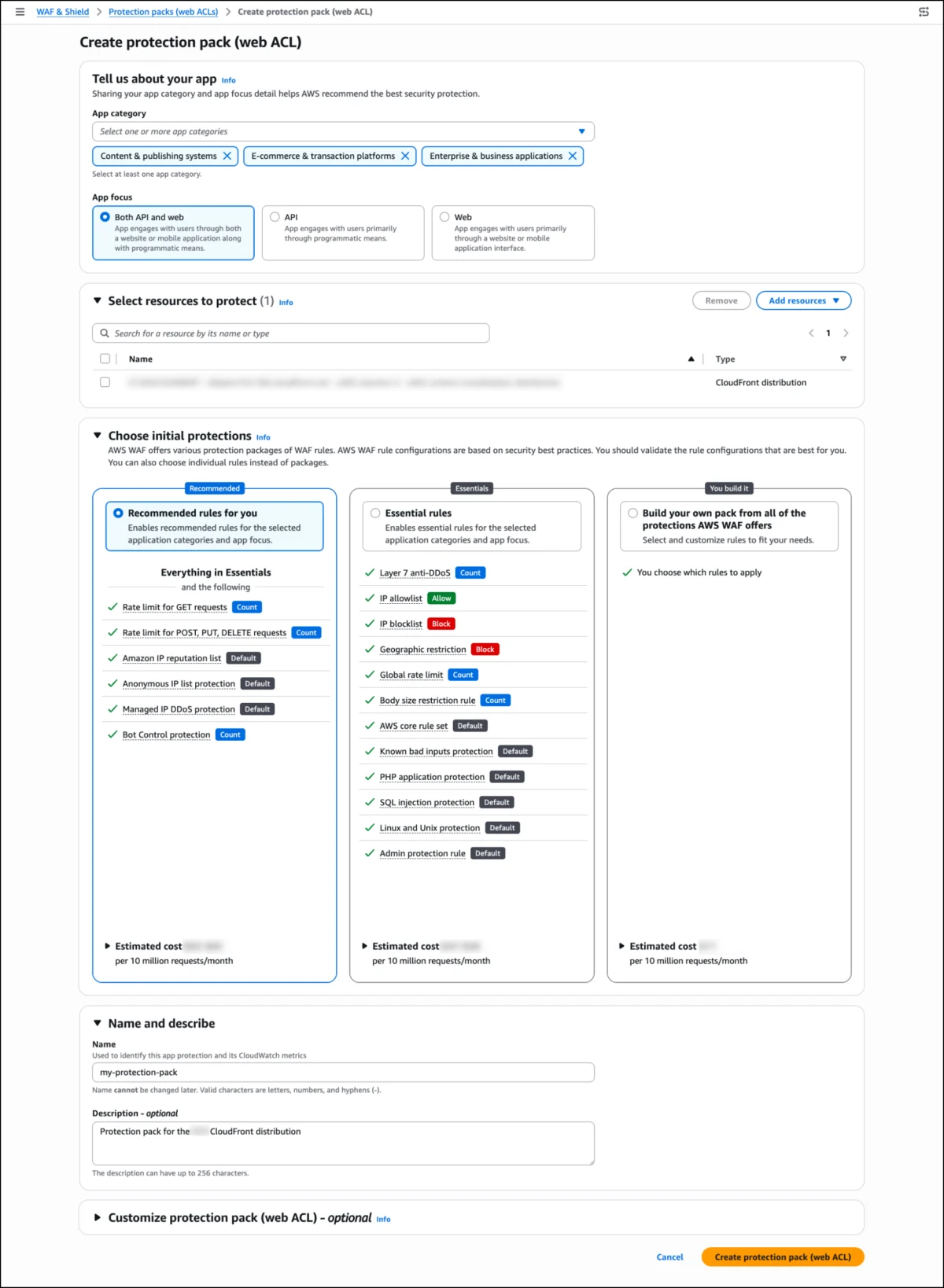
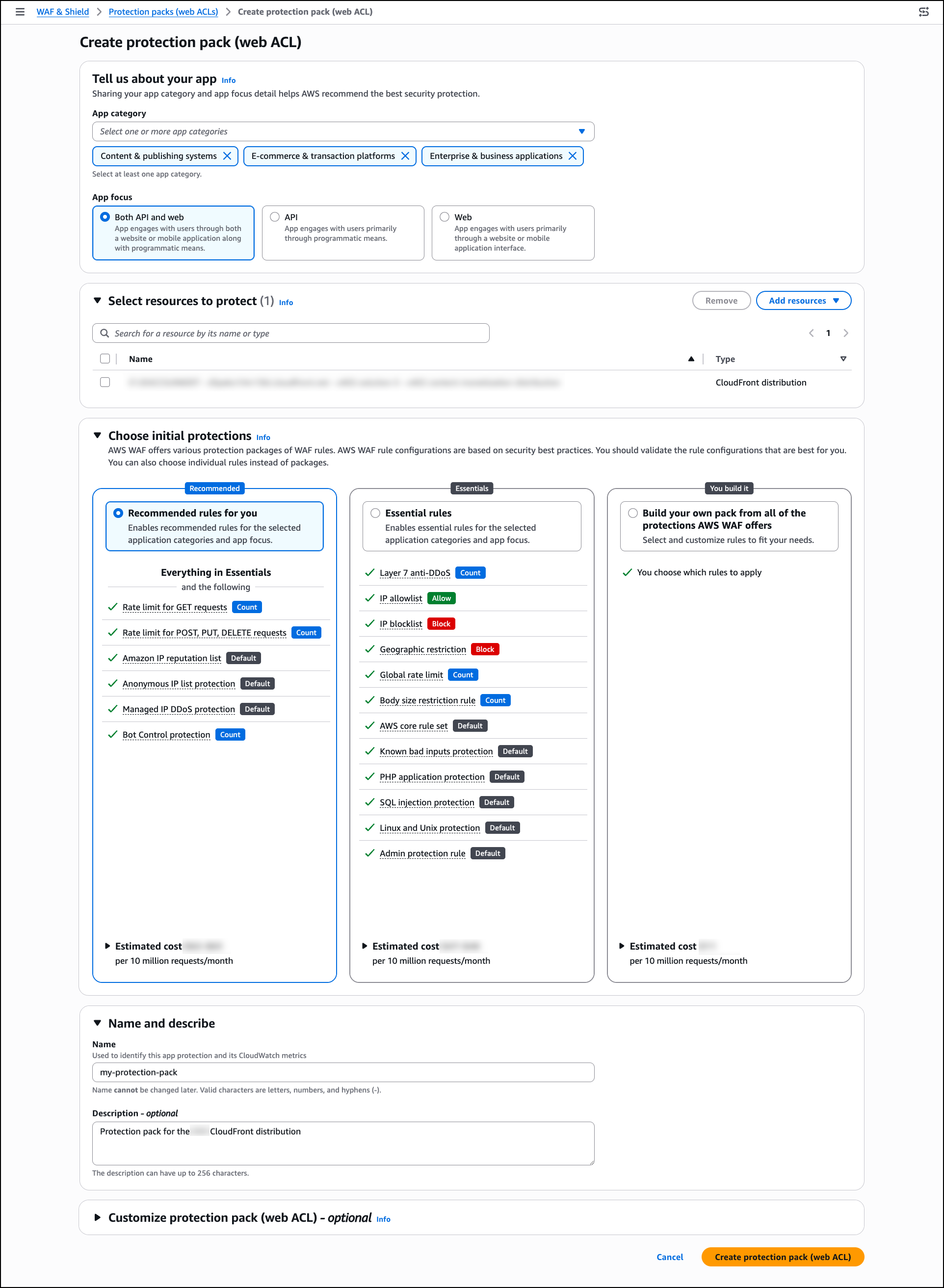
A "protection pack" forms the foundational configuration unit for AI traffic monetization. It meticulously defines which specific content paths are subject to monetization, the charges levied against each agent verification tier, the accepted payment methods, and the applicable license terms. To create a new protection pack, users select "Create protection pack (web ACL)." During this process, content owners specify app categories (e.g., Content & publishing systems, E-commerce & transaction platforms, Enterprise & business applications) and an "App focus," which AWS WAF utilizes to recommend suitable security protections. Resources, such as CloudFront distributions, are then associated with the pack, though this can be deferred. Initial protections are chosen from AWS WAF managed rule packages or individual rules. Finally, the protection pack is named and optionally described, with an option to customize advanced settings like pricing tiers, payment methods, content scope, and license terms.
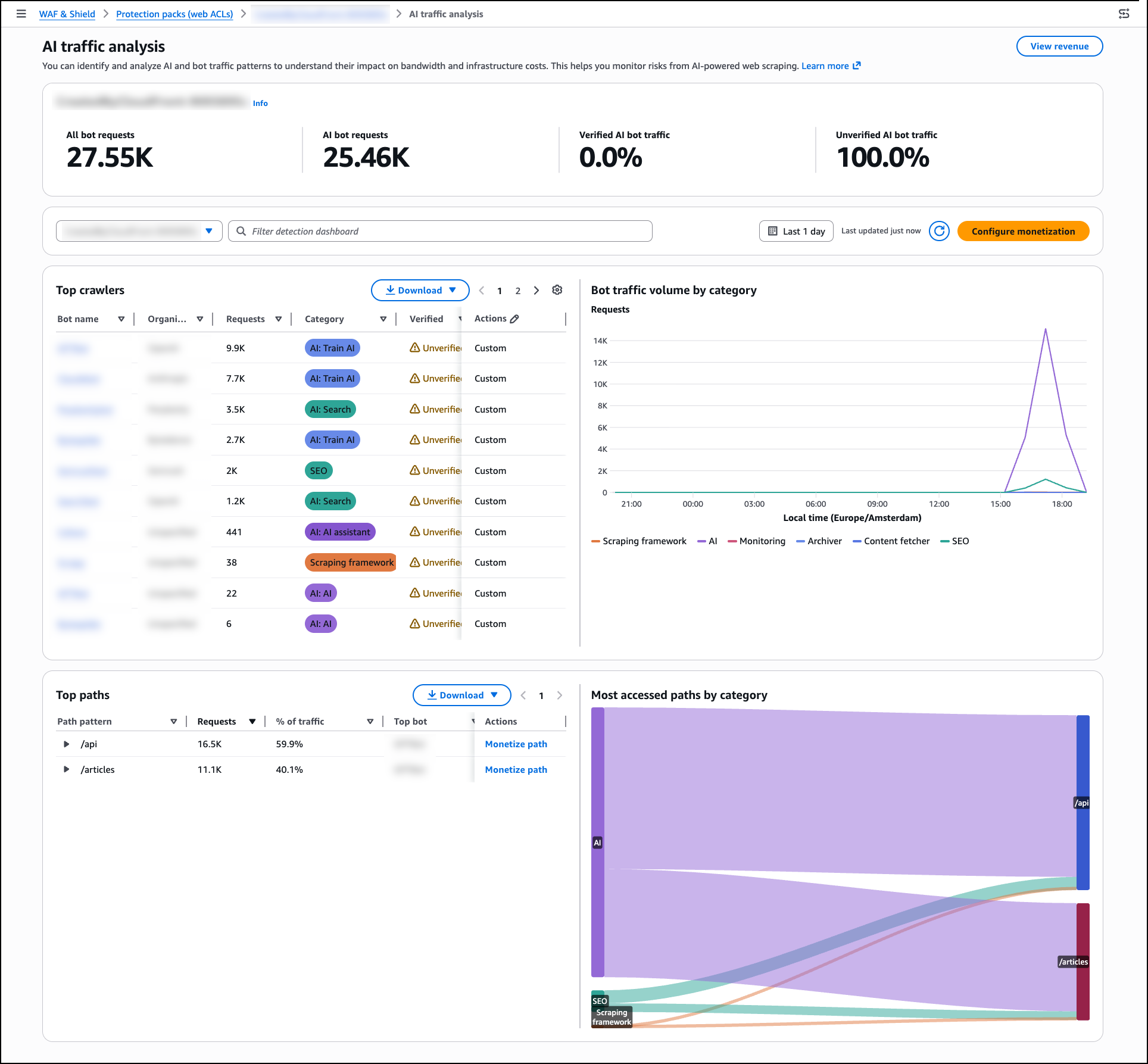
Once a protection pack is established, an initial crucial step is to analyze existing AI bot traffic patterns to inform a robust pricing strategy. The "AI traffic analysis" dashboard, accessible within the WAF & Shield console, provides invaluable insights. By selecting the relevant protection pack, users can view a detailed breakdown of traffic into "All bot requests," "AI bot requests," "Verified AI bot traffic," and "Unverified AI bot traffic." This dashboard also surfaces critical infrastructure impact metrics, including bandwidth consumed, estimated monthly cost, and peak request rates. A per-path heatmap visually highlights content areas experiencing the highest AI bot activity, hour by hour, providing data-driven foundations for pricing decisions.
AWS WAF Bot Control boasts an impressive classification capability, identifying over 650 distinct AI bot and agent types, including prominent ones like GPTBot, Claude-Web, and Perplexity-Bot. Each detected bot is assigned a verification tier, enabling granular policy application. After reviewing traffic patterns, content owners return to "Protection packs (web ACLs)," select their pack, and choose "Configure AI monetization" from the right panel. This is where pricing and access policies are meticulously set. A single protection pack encapsulates the pricing structure, agent policies, accepted payment methods, and license terms for a defined set of content paths. The system allows for the creation of multiple protection packs, enabling varied pricing strategies across different content zones within the same CloudFront distribution. Once configured, the protection pack is associated with the web ACL.
For each agent verification tier within a protection pack, content owners can assign one of six distinct actions:
- Monetize: Returns an HTTP 402 Payment Required response with pricing details.
- Allow: Grants free access to the content.
- Block: Denies access entirely.
- Count: Logs the request without charging or blocking.
- CAPTCHA: Presents a puzzle to verify a human sender.
- Challenge: Runs a silent check to verify the client is a legitimate browser, not a bot.
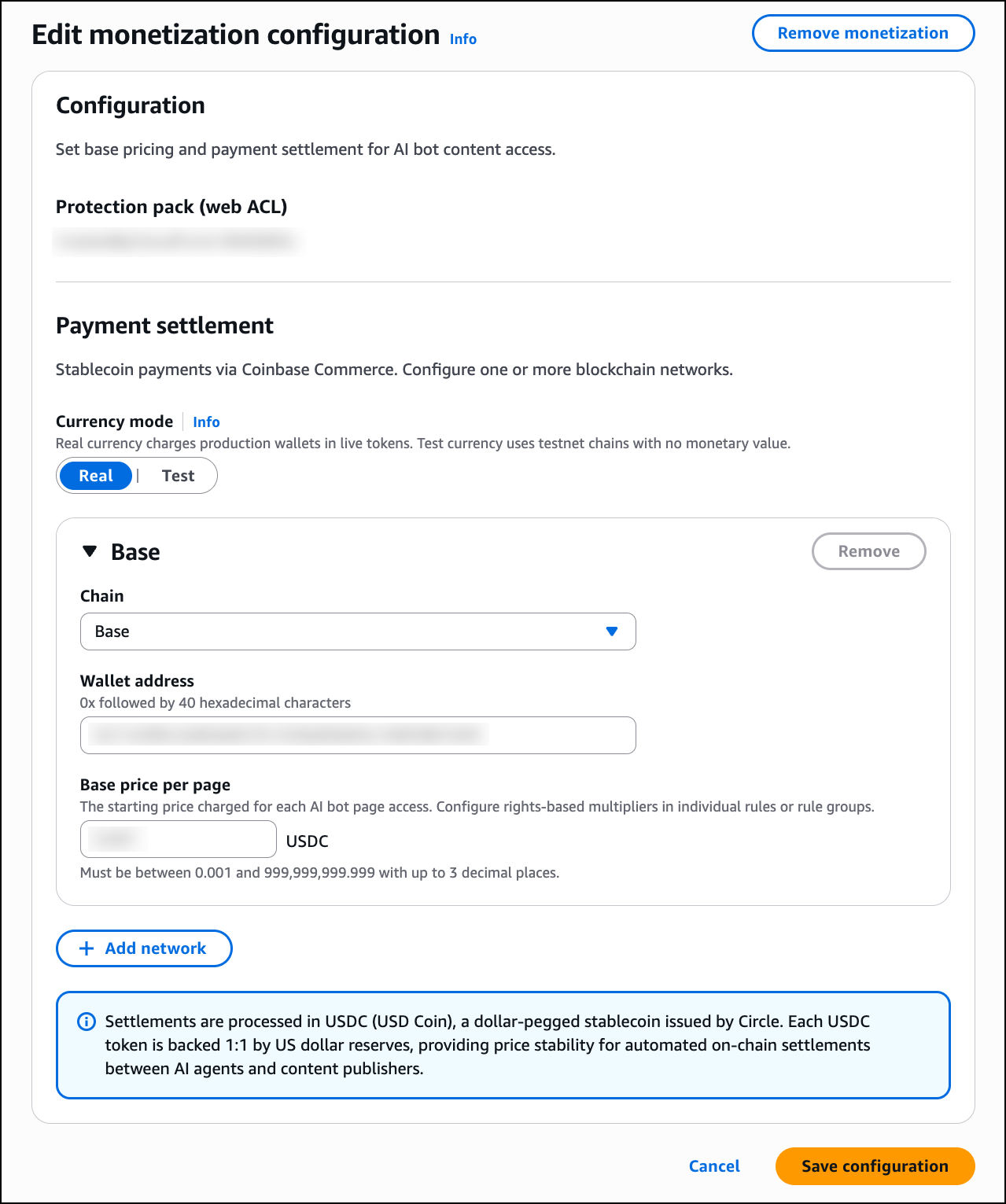
The "Edit monetization configuration" page is where payment settlement details are defined. Users select one or more blockchain networks for stablecoin payments, with support for any wallet address on supported networks, whether self-managed or provided by a service like Coinbase. For each network, a wallet address is provided, and a "Base price per page" is set in USDC (USD Coin). Multiple networks can be added. It is crucial to note that AWS itself does not process payments or levy fees on content revenue; disbursement is managed by the content owner or their wallet provider.
When a "Monetize" rule is triggered by an incoming request, AWS WAF responds with an HTTP 402 Payment Required status code. The response body contains a machine-readable price manifest in JSON format, adhering to the x402 open protocol designed for machine-to-machine payments. This manifest includes the content price in USDC, specifies accepted blockchain networks (e.g., Base, Solana), provides the destination wallet address, sets a maximum payment timeout, and outlines the payment scheme. Any x402-compatible agent runtime can autonomously complete this payment flow. The client submits a signed payment authorization on their chosen payment network. AWS WAF then verifies the authorization, retrieves the requested content, integrates with third-party facilitator services to settle the payment on-chain, and finally serves the response to the AI agent. It is important to highlight that the "Monetize" action is currently exclusively supported for web ACLs associated with Amazon CloudFront distributions, not regional web ACLs.
Testing, Monitoring, and Future Outlook
To ensure seamless integration and proper functioning, the "Currency mode" toggle within the monetization configuration page allows for switching between "Real" and "Test" modes. Before deploying live, publishers can utilize test mode on non-production traffic to validate pricing, wallet configurations, and x402 payment flows. In test mode, x402 payments are still enforced but occur on testnets (e.g., Base Sepolia, Solana Devnet) using test funds obtained from faucets. All events are logged with CurrencyMode: TEST. Once satisfied with the configuration, switching the currency mode back to "Real" initiates the processing of actual payments.
Upon activating "Real" currency mode, the "AI access monetization" dashboard, accessible in the left navigation pane, becomes the central hub for real-time tracking of monetization outcomes. This dashboard specifically reflects activity from real currency mode and does not display test transactions. It provides a comprehensive overview of "Total revenue," revenue broken down by "Verified bots" and "Unverified bots," and "Avg. per request." The "Top revenue sources" panel categorizes earnings by bot type, while the "AI access patterns" panel ranks content paths based on generated revenue. A "Settlements" tab further aids reconciliation, offering insights into payments by provider, payment method distribution, and failed payment attempts.
This new AWS WAF capability is immediately available to Amazon CloudFront customers at no additional charge beyond standard AWS WAF pricing. Its reach extends to all edge locations where AWS WAF web ACLs are associated with Amazon CloudFront distributions, ensuring broad accessibility and consistent performance.
The introduction of AI traffic monetization by AWS WAF marks a pivotal moment in the evolution of digital content economics. For years, content creators have grappled with the implications of AI’s data hunger, often feeling exploited by systems that leverage their work without direct compensation. This solution offers a concrete pathway for publishers to regain control over their intellectual property and establish a more equitable value exchange.
Industry analysts suggest that this move could catalyze a broader shift in how content is consumed and paid for by automated systems. "This is a significant step towards a more sustainable model for online publishers," commented Dr. Alistair Finch, a senior analyst at Digital Economy Insights. "By leveraging the power of stablecoins and machine-to-machine payment protocols, AWS is not just offering a technical solution; they are facilitating a new economic framework for the internet."
The integration of Coinbase’s x402 Facilitator underscores the growing importance of blockchain technology and stablecoins in facilitating efficient, transparent, and low-cost micro-payments on a global scale. The forthcoming support for Stripe and the Machine Payments Protocol (MPP) further illustrates AWS’s commitment to providing flexible and widely adopted payment options, ensuring broad compatibility for both content providers and AI developers.
This development also places new responsibilities on AI developers and bot operators. They will need to ensure their agents are x402-compatible and equipped to handle payment requests seamlessly to access premium content. This could lead to a more structured and transparent ecosystem for AI data sourcing, potentially fostering greater trust between content creators and AI innovators.
In conclusion, AWS WAF’s AI traffic monetization is more than just a new feature; it represents a strategic response to the evolving challenges of the AI era. By empowering content owners with tools to directly monetize AI bot access, AWS is helping to reshape the economics of digital publishing, ensuring that the creators of valuable online content are fairly compensated for their contributions to the global knowledge base. This initiative is poised to foster a more sustainable and equitable digital ecosystem for all stakeholders.
