
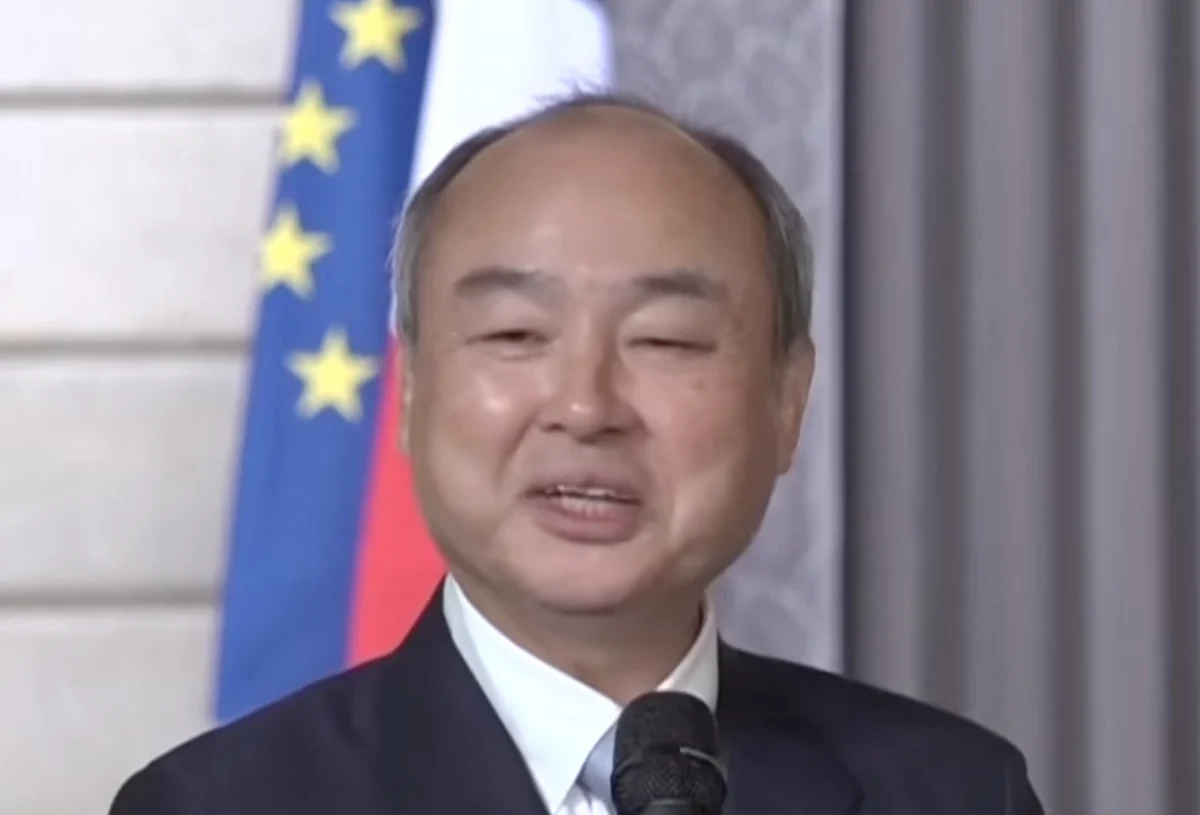

Masayoshi Son, the billionaire founder and Chief Executive Officer of SoftBank Group Corp., has dismissed Elon Musk’s ambitious proposals for space-based data centers with a blunt rhetorical question: "What’s the point?" The dismissive three-word response underscores a deepening strategic divide between the world’s most prominent tech visionaries. While Musk looks toward the stars for the future of infrastructure, Son is doubling down on a terrestrial-bound revolution centered on Artificial Super-Intelligence (ASI) and the integration of robotics into every facet of human life. At 68 years old, Son has officially revised his long-standing "50-year life plan," announcing his intention to remain at the helm of SoftBank for at least another 15 years to oversee what he describes as the most significant evolution in human history.
The pivot comes at a critical juncture for SoftBank, a conglomerate that has transitioned from a software distributor in 1981 to a global telecommunications giant, and more recently, the world’s most aggressive—and occasionally controversial—tech investor. Son’s current focus is no longer merely on digital platforms or the mobile internet, but on "Agentic AI," a shift from passive generative tools like ChatGPT to autonomous systems capable of independent reasoning and execution. By extending his leadership into his early 80s, Son signals that he views the current AI boom not as a market bubble, but as the foundational stage of a 300-year "intelligence revolution."
The Shift to Agentic AI and Artificial Super-Intelligence
Son’s contemporary philosophy is rooted in the transition from Artificial General Intelligence (AGI) to Artificial Super-Intelligence (ASI). While AGI is typically defined as AI that matches human intellectual capabilities across all domains, Son views ASI as a tier of intelligence that exceeds the collective capabilities of humanity by a factor of 10,000. He characterizes current tools, such as Large Language Models (LLMs), as mere "consultants" or "assistants." He admits to using ChatGPT dozens of times daily to stress-test his own ideas, yet he views this interaction as a primitive precursor to what is coming.
The next phase, according to Son, is "Agentic AI." Unlike current iterations that require specific prompts to generate text or images, Agentic AI functions as an autonomous agent. These systems are designed to understand high-level goals and take independent actions to achieve them without constant human intervention. "AI itself autonomously thinks and takes an action by itself so we don’t have to ask it to do this, do that in detail," Son explained during a recent series of strategy briefings. This evolution represents a move from AI as a software tool to AI as a proactive workforce that operates 24/7.
Historical Context: From 1981 to the Vision Fund Era
To understand Son’s current trajectory, one must look at the chronology of SoftBank’s evolution. Founded in 1981 as a computer software distributor, SoftBank became a cornerstone of the Japanese tech sector. Son gained international notoriety during the dot-com boom, briefly becoming the world’s richest man before losing 99% of his net worth in the subsequent crash. Undeterred, he rebuilt his empire through savvy bets, most notably a $20 million investment in Alibaba in 2000, which eventually turned into a stake worth over $60 years billion.
In 2017, Son launched the $100 billion Vision Fund, the largest venture capital fund in history. While the fund saw massive successes, it also faced significant setbacks with high-profile failures like WeWork and Katerra. These losses led to a period of "defense" for SoftBank, where the company slowed its investment pace to shore up its balance sheet. However, the successful 2023 initial public offering (IPO) of Arm Holdings, the UK-based chip designer in which SoftBank maintains a majority stake, has provided Son with a massive "war chest." Arm is now the linchpin of Son’s AI strategy, as its energy-efficient architecture powers the processors required for both mobile AI and massive data center operations.
The Physical AI Component: Robotics and Execution
Son argues that intelligence without execution is incomplete. This has led SoftBank to consolidate a massive portfolio of robotics companies. While the public may best remember SoftBank for "Pepper," the humanoid robot launched a decade ago, the company’s current holdings are far more industrial and strategically aligned. SoftBank holds significant stakes in firms like ABB Robotics, a global leader in industrial automation, and has previously owned or invested in Boston Dynamics and Berkshire Grey.
The goal is to merge ASI with "Physical AI." Son envisions a future where super-intelligent brains are paired with highly capable robotic bodies. This synergy is intended to solve labor shortages and revolutionize sectors like healthcare. Son predicts the rise of "super-intelligence doctors" who possess the totality of medical knowledge and can provide personalized care that exceeds the capacity of any human practitioner. Crucially, Son emphasizes that this is not a replacement of the human element but an augmentation. "Human needs to connect to human and try to aim for the happiness for each other," he stated, framing his technological pursuits as a humanitarian mission.
Market Analysis: Addressing the "AI Bubble" Concerns
Financial analysts and skeptics have frequently drawn parallels between the current AI investment frenzy and the 1990s dot-com bubble. Son, however, views these comparisons as fundamentally flawed. He argues that we are only in the "third year" of the AI revolution, equating it to the state of the internet in the mid-1990s when companies like Google, Amazon, and Meta (then Facebook) were either in their infancy or had not yet been founded.
"It’s an insult to AI if you say it’s an AI bubble because it’s just the beginning," Son remarked. From a data-driven perspective, SoftBank’s conviction is backed by the massive capital expenditure (CapEx) being deployed by "Hyperscalers" like Microsoft, Google, and Meta. Industry data suggests that global investment in AI hardware and data centers will exceed $1 trillion in the coming years. Son believes that those who hesitate now will regret not buying into the sector, just as investors who exited the market in the late 90s missed the greatest wealth creation event in modern history.
The Revised 50-Year Plan and Leadership Longevity
One of the most significant personal revelations from Son is the revision of his "50-year life plan." Drafted when he was 19, the plan dictated that he would spend his 20s establishing his name, his 30s building a financial war chest, and his 60s handing the business over to a successor. Son had previously toyed with retirement, famously appointing Nikesh Arora as his heir apparent in 2014 before ultimately reclaiming total control and seeing Arora depart in 2016.
Now, at 68, Son admits he has become "more greedy" for the future. Citing improved longevity and his own robust health, he has pushed his retirement horizon back by 15 years. His new objective is to ensure SoftBank becomes the primary provider and architect of ASI. This extension of tenure provides SoftBank with a rare level of leadership continuity but also centralizes the company’s massive risks and rewards around a single individual’s vision.
Broader Implications and Official Responses
The reaction from the broader tech community to Son’s renewed aggression is a mix of awe and caution. While competitors like Sam Altman of OpenAI have praised Son’s "unmatched" long-term thinking, some institutional investors remain wary of SoftBank’s volatility. However, the market has largely responded positively to the "Arm-centric" AI strategy, which has seen SoftBank’s stock price recover significantly from its 2022 lows.
The implications of Son’s vision extend beyond finance into global ethics and policy. Son acknowledges the risks of ASI, suggesting that ethical frameworks must be "built into" these models to prevent them from making moves that contradict human values. He posits that if AI is taught to "cherish the things that we cherish," it can be steered toward a positive outcome for humanity.
As SoftBank prepares for the next decade, the company’s focus is clear: total concentration on the "Intelligence Revolution." Son believes this era will last for at least 300 years, dwarfing the impact of the Industrial Revolution. By dismissing Musk’s space-faring data centers, Son is signaling that the most important frontier isn’t found in the vacuum of space, but in the silicon and neural networks that will soon define the limits of human potential. "I will make it happen, count on me," Son concluded, a statement that serves as both a promise to his shareholders and a challenge to his rivals in the race for the future of intelligence.
