

Amazon Web Services (AWS) has announced a significant enhancement to its AWS WAF (Web Application Firewall) service, introducing an AI traffic monetization capability designed to allow digital content owners and publishers to directly charge AI bots and agents for accessing protected web content at the network edge. This new feature addresses a growing challenge for content providers who have seen AI bot traffic surge, often consuming valuable content without generating reciprocal benefits like referral traffic or ad impressions. The capability enables content owners to establish granular, per-request pricing based on content path, bot category, or verification tier, all without requiring modifications to their origin infrastructure or the development of custom application code. Payments can be collected in stablecoins to a preferred wallet, with revenue and bot activity monitored through a unified dashboard.
The digital landscape has undergone a profound transformation with the proliferation of artificial intelligence. AI bot traffic now constitutes over 50% of overall web traffic for many content providers, with AI-specific crawlers demonstrating an astounding growth rate exceeding 300% year-over-year. This rapid ascent presents a unique dilemma: unlike traditional search engine crawlers, which index content to deliver measurable referral traffic back to publisher websites, AI bots typically consume content to generate summaries, answers, or training data for AI interfaces. This process often yields little to no traffic directed back to the original source, leaving publishers to shoulder the substantial infrastructure costs of serving this traffic without the customary page views, ad impressions, or subscription conversions that traditionally offset such expenses. The previously available AWS WAF Bot Control provided essential visibility into bot activity and the capacity to block or rate-limit traffic, but the crucial ability to set pricing and collect payment from AI agents remained elusive—until now. AI traffic monetization is a novel Bot Control extension engineered to bridge this gap, offering content owners and publishers an integrated mechanism to configure pricing rules directly via the AWS WAF console and collect payments from AI agents through seamless third-party payment integrations, thereby circumventing the need for bespoke payment infrastructure or intricate, individual licensing negotiations. The initial payment settlement and verification flows are facilitated by Coinbase’s x402 Facilitator, with future integrations planned for Stripe direct account payments and support for the Machine Payments Protocol (MPP).
The Evolving Web Landscape and the AI Bot Challenge
The rise of generative AI models has fundamentally altered how digital content is consumed and valued. Content, which forms the bedrock of these models, is increasingly being scraped and processed by sophisticated AI agents. While the accessibility of information is a cornerstone of the internet, the economic model supporting content creation is under stress. Publishers invest heavily in producing high-quality articles, research, and multimedia, relying on advertising, subscriptions, or direct sales for revenue. When AI bots consume this content en masse without attribution or financial contribution, it creates an unsustainable imbalance. The infrastructural burden alone, encompassing bandwidth, server capacity, and data storage, can be substantial, leading to increased operational costs for publishers already navigating a challenging economic environment. The 300% year-over-year growth in AI-specific crawlers is a stark indicator of this intensifying challenge, prompting an urgent need for solutions that allow content creators to be fairly compensated for their digital assets.
A Chronology of Innovation and Industry Response
The development of AWS WAF’s AI traffic monetization capability is not an isolated event but rather a response to a discernible shift in the digital economy. For years, web security services like AWS WAF have focused on protecting websites from malicious bots, DDoS attacks, and other cyber threats. AWS WAF Bot Control, launched previously, marked a significant step in identifying and managing automated traffic, differentiating between legitimate and malicious bots. However, the emergence of AI crawlers that are neither inherently malicious nor beneficial in the traditional sense necessitated a new category of management.
The concept of machine-to-machine payments, particularly for digital content, has gained traction in recent years, propelled by advancements in blockchain technology and stablecoins. Protocols like x402, an open protocol for machine-to-machine payments, represent an industry effort to standardize how machines can request and execute payments for digital services or content. AWS’s integration of this protocol, specifically through Coinbase’s x402 Facilitator, positions it at the forefront of this emerging payment paradigm. The announcement signals a broader industry recognition of the need for new monetization strategies in an AI-driven world, where the value exchange for digital content must evolve beyond traditional advertising and subscription models. This move by AWS also reflects a proactive stance in helping its customers adapt to the economic implications of pervasive AI.
Unpacking the Features: Granular Control and Seamless Integration
The AI traffic monetization feature is designed for granular control and ease of integration. Content owners can define specific access policies for various agent types, ensuring a tailored approach. The ability to collect payments in stablecoins, particularly USDC, directly to a preferred wallet, simplifies the financial transaction process, leveraging the efficiency and transparency of blockchain networks. The centralized dashboard offers a comprehensive view of revenue streams and bot activity, providing crucial data for strategic decision-making.
At its core, the system relies on the robust classification capabilities of AWS WAF Bot Control. Before enabling monetization, users must confirm that Bot Control is active at either the Common or Targeted level on the web ACL (Access Control List) linked to their CloudFront distribution. Bot Control is indispensable for its precise agent classification, which forms the foundation for monetization rules. For those new to this setup, AWS provides extensive documentation on adding the AWS WAF Bot Control managed rule group to a web ACL. The process begins in the AWS Management Console, under "WAF & Shield," navigating to "Protection packs (web ACLs)."
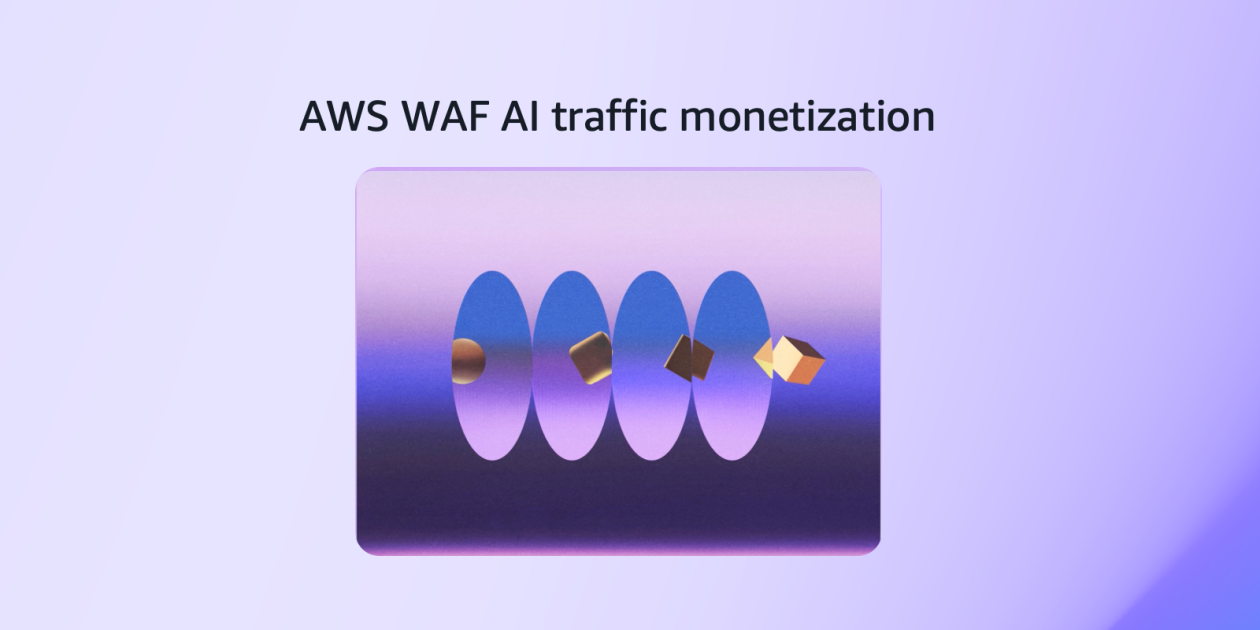
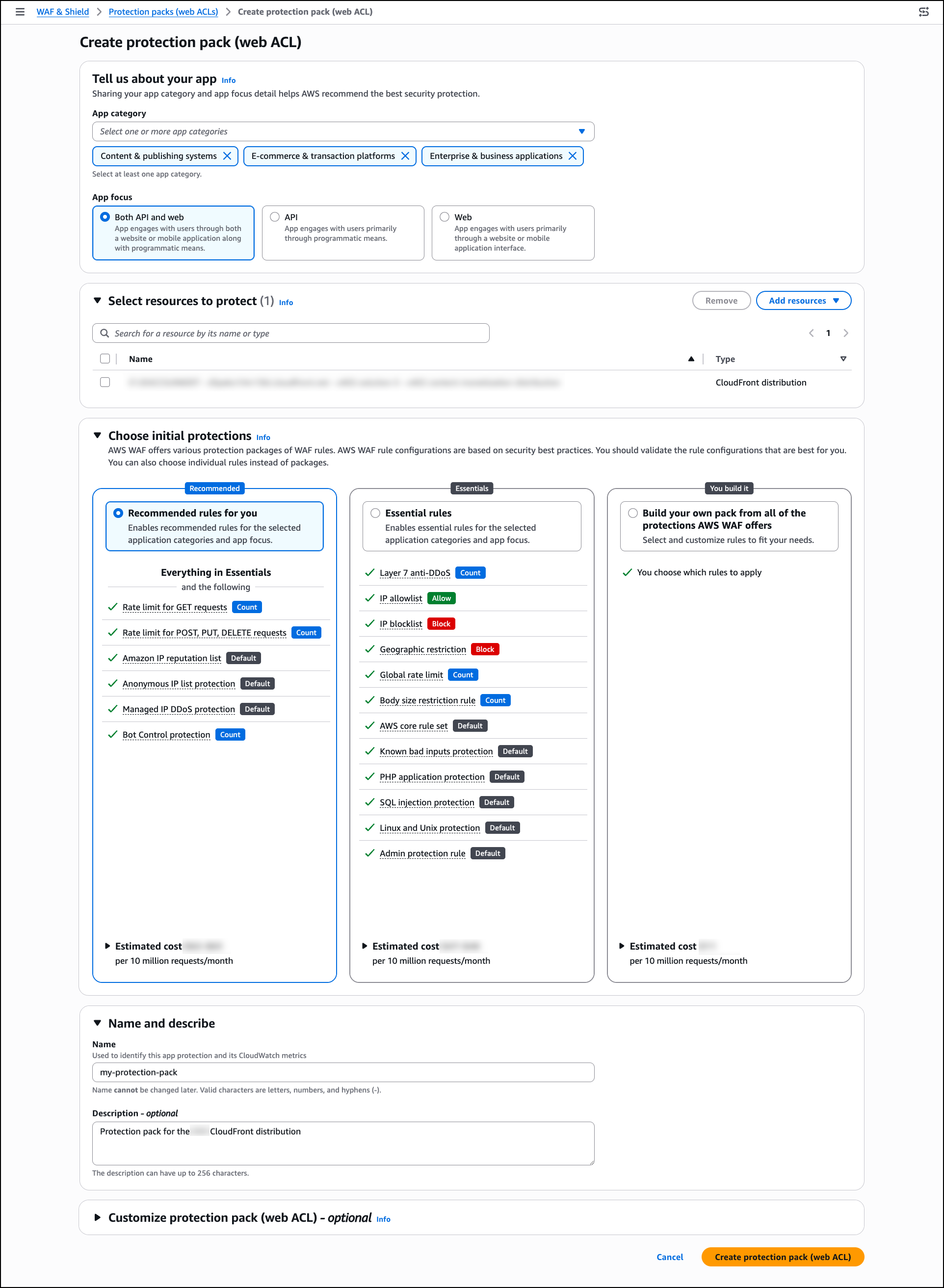
A "protection pack" serves as the central configuration unit for AI traffic monetization. It meticulously defines which content paths are subject to monetization, the per-request charges for each agent verification tier, the accepted payment methods, and the applicable license terms. To initiate this, users select "Create protection pack (web ACL)." During creation, users are prompted to specify their application categories (e.g., Content & publishing systems, E-commerce & transaction platforms, or Enterprise & business applications) and an "App focus." These selections guide AWS WAF in recommending optimal security protections. Resources to be protected, such as CloudFront distributions, can be associated during this step or added later. Subsequently, users choose from AWS WAF managed rule packages or individual rules, based on their app category and resource selections. The protection pack is then named and described. An optional step allows for customization of additional settings, including pricing tiers, payment methods, content scope, and license terms.

Strategic Insights from AI Traffic Analysis
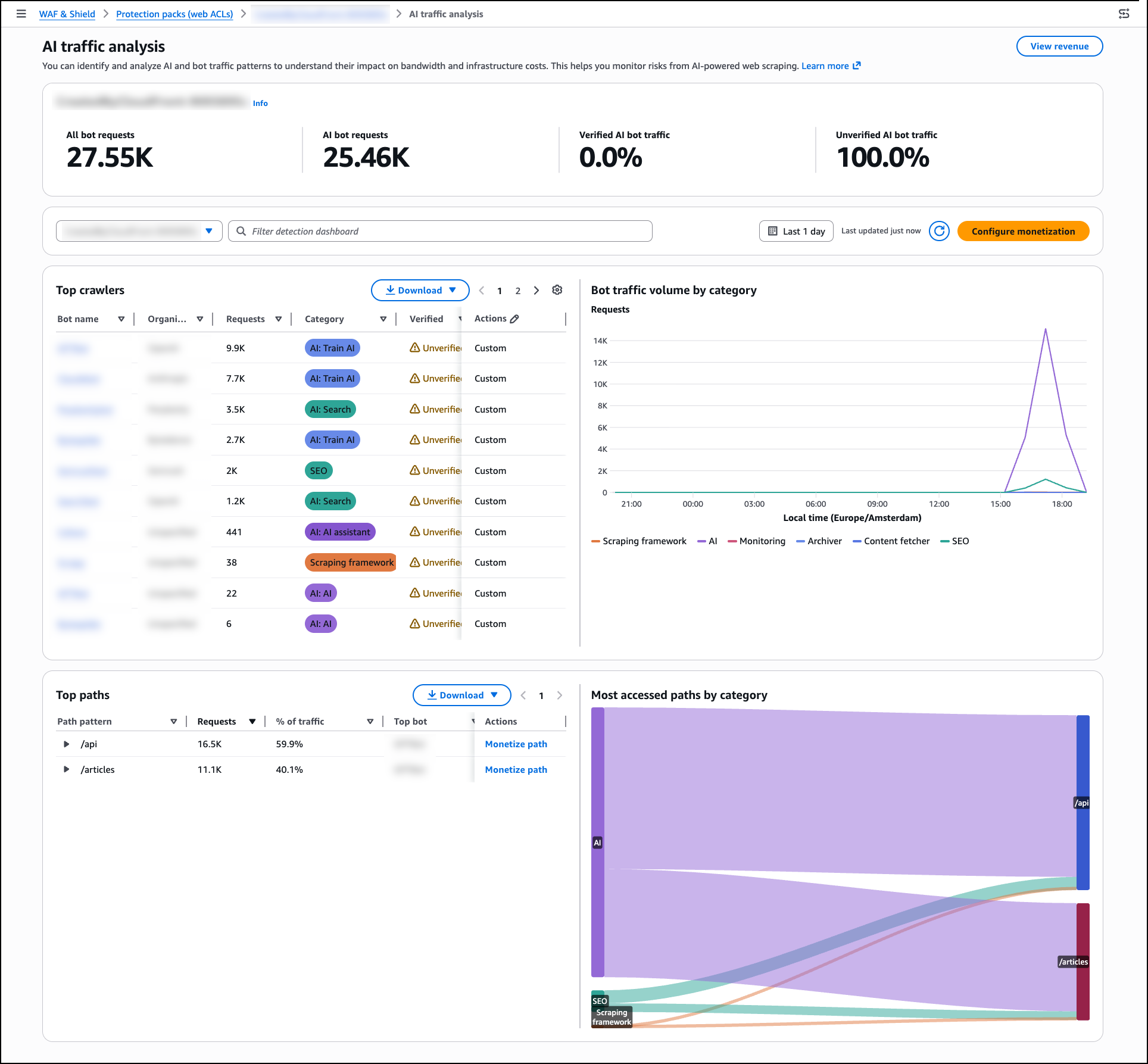
Once a protection pack is established, content owners are encouraged to first leverage the AI traffic analysis dashboard to gain a comprehensive understanding of AI bot traffic’s impact on their content before finalizing a pricing strategy. Accessible via "AI traffic analysis" in the WAF & Shield console, this dashboard, populated by selecting the relevant protection pack, dissects traffic into four key categories: "All bot requests," "AI bot requests," "Verified AI bot traffic," and "Unverified AI bot traffic." It provides critical infrastructure impact metrics, including bandwidth consumption, estimated monthly costs, and peak request rates. A granular per-path heatmap visually represents content paths experiencing the highest AI bot activity by hour, furnishing the data necessary for informed pricing decisions.
AWS WAF Bot Control boasts the ability to classify over 650 distinct AI bot and agent types, including prominent examples like GPTBot, Claude-Web, and Perplexity-Bot. Each identified bot is assigned a verification tier, enabling fine-tuned policy application. After reviewing traffic patterns, users return to "Protection packs (web ACLs)," select their pack, and choose "Configure AI monetization" from the right panel to establish pricing and access policies. Each protection pack is capable of defining unique pricing, agent policies, accepted payment methods, and license terms for specific content path sets, allowing for diverse monetization strategies across different content zones within a single distribution. The pack is then associated with the web ACL.
For each agent verification tier within a protection pack, content owners can assign one of six actions: "Monetize" (triggering an HTTP 402 Payment Required response with pricing details), "Allow" (granting free access), "Block" (denying access entirely), "Count" (logging activity without charge), "CAPTCHA" (presenting a puzzle for human verification), or "Challenge" (executing a silent check to verify a browser client).
Payment Settlement and the x402 Protocol
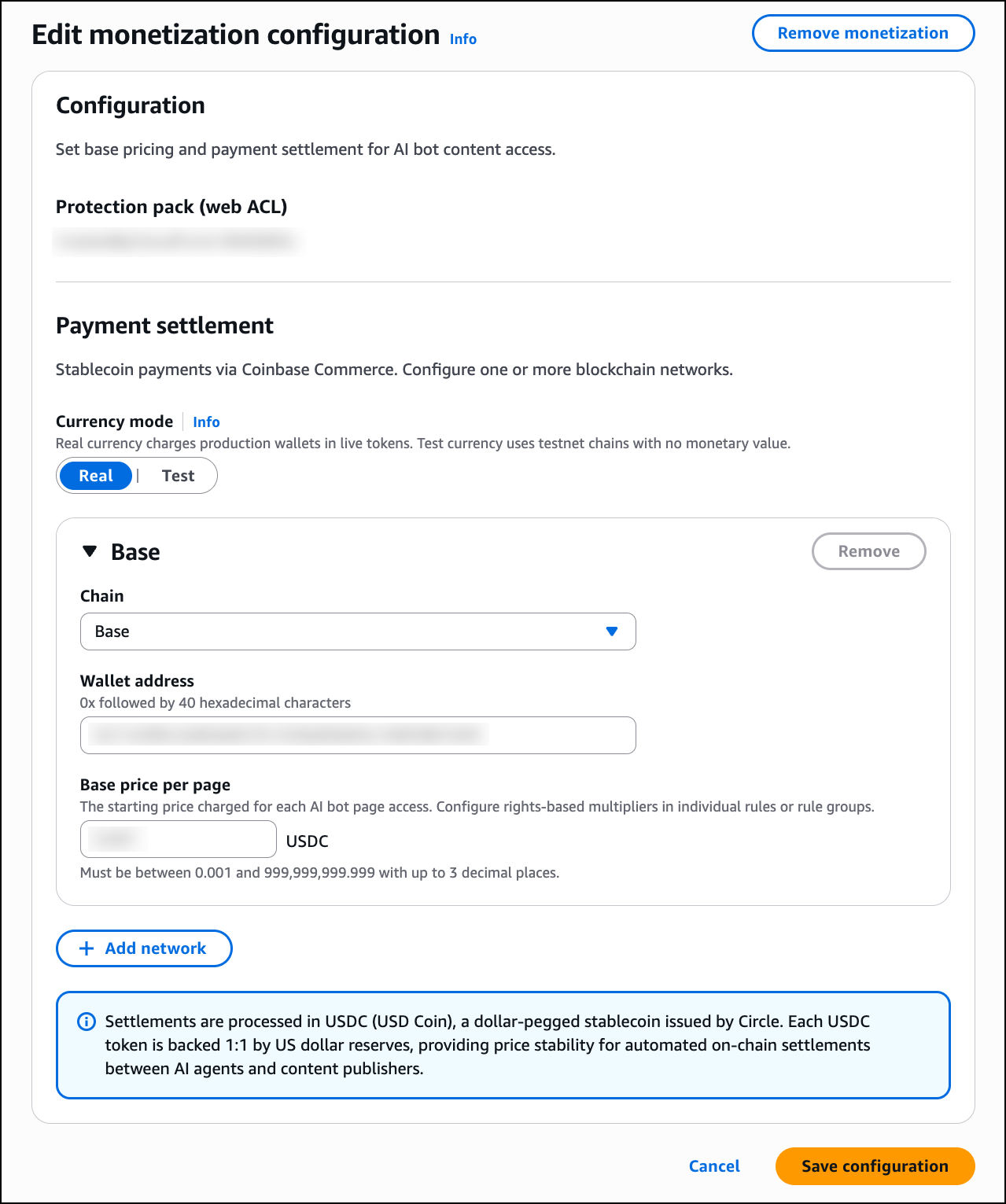
Within the "Edit monetization configuration" page, payment settlement details are configured. Users select one or more blockchain networks for stablecoin payments, with any wallet address on supported networks being accepted, whether self-managed or hosted by a provider like Coinbase. For each network, the wallet address and a "Base price per page" in USDC are specified. Multiple networks can be added. AWS explicitly states it does not process payments or collect fees on content revenue; disbursements are managed directly by the content owner or their wallet provider.
When a "Monetize" rule is triggered by an incoming request, AWS WAF returns an HTTP 402 Payment Required response. Crucially, the response body contains a machine-readable price manifest in JSON format, adhering to the x402 open protocol for machine-to-machine payments. This manifest details the content price in USDC, lists accepted blockchain networks (e.g., Base and Solana), specifies the destination wallet address, sets a maximum payment timeout, and outlines the payment scheme. Any x402-compatible agent runtime is equipped to autonomously complete this payment flow. The client submits a signed payment authorization on their chosen payment network. AWS WAF then verifies this authorization, fetches the content, integrates with third-party facilitator services for on-chain payment settlement, and finally serves the requested response. It is important to note that the "Monetize" action is exclusively supported for web ACLs associated with Amazon CloudFront distributions, not regional web ACLs.
A "Currency mode" toggle, available directly on the monetization configuration page, allows users to switch between "Real" and "Test" modes at any time. Before going live, test mode is crucial for validating pricing, wallet configuration, and x402 payment flows using non-production traffic. While in test mode, x402 payments are still enforced but occur on testnets such as Base Sepolia or Solana Devnet, utilizing test funds obtainable from faucets like faucet.circle.com. AWS WAF returns real price manifests and executes the full payment flow identically to production, but on the configured test chain. All events are logged with a CurrencyMode: TEST tag. Once the configuration is deemed satisfactory, switching "Currency mode" back to "Real" initiates the processing of live payments.
Upon activating "Real" currency mode, content owners can navigate to "AI access monetization" in the left navigation pane to track monetization outcomes in real time. This dashboard exclusively reflects activity from real currency mode and does not display test transactions. The "Revenue" dashboard provides a clear overview, detailing "Total revenue," revenue broken down by "Verified bots" and "Unverified bots," and "Avg. per request." The "Top revenue sources" panel categorizes earnings by bot category, while the "AI access patterns" panel ranks content paths based on generated revenue. The "Settlements" tab enables reconciliation of payments by provider and offers insights into payment method distribution and failed payment attempts.
Statements and Reactions
This strategic launch by AWS is expected to resonate across various stakeholders in the digital ecosystem. An inferred statement from an AWS executive might emphasize the company’s commitment to empowering content creators. "With the explosion of AI, content publishers have been grappling with the challenge of sustaining their operations when their valuable intellectual property is consumed without direct compensation," a hypothetical AWS spokesperson might say. "This new AWS WAF capability is a game-changer, providing a robust, efficient, and transparent mechanism for fair value exchange at the edge, ensuring that content creators can thrive in the AI era."
Content publishers, who have long voiced concerns over the uncompensated use of their content by AI models, are likely to welcome this development. A representative from a major online news publisher could comment, "For too long, we’ve borne the cost of serving AI crawlers that offer no direct benefit. AWS WAF’s monetization feature provides a practical solution, allowing us to generate revenue from this traffic and reinvest in quality journalism. It’s about securing the future of digital content creation."
AI developers and companies, while potentially facing new costs, might also see the benefits of a standardized, transparent payment mechanism. An AI firm’s CTO might remark, "We recognize the imperative to fairly compensate content creators. A clear, programmatic payment system like this, integrated at the network edge, offers a more predictable and scalable way to acquire licensed data compared to negotiating individual agreements. It fosters a more ethical and sustainable AI ecosystem."
Coinbase, as a key facilitator, would likely highlight the role of blockchain technology. "The x402 protocol, powered by stablecoins on secure blockchain networks, is perfectly suited for the demands of machine-to-machine payments," a Coinbase representative could state. "Our collaboration with AWS WAF demonstrates how decentralized finance principles can enable innovative solutions for digital rights and content monetization on a global scale."
Broader Impact and Implications for the Digital Ecosystem
The introduction of AWS WAF’s AI traffic monetization capability heralds a significant shift in the economic dynamics of the internet. For content publishers, it opens entirely new revenue streams, offering a direct financial return on the content consumed by AI agents. This could be a lifeline for many digital businesses struggling with declining advertising revenues and subscription fatigue. It also provides publishers with greater control over their intellectual property, allowing them to dictate terms and pricing for AI access, potentially leading to more sustainable content creation models. The ability to implement tiered access and pricing policies means publishers can differentiate access based on the value they perceive from various AI agents.
For AI developers and companies, this presents a new cost factor but also a standardized pathway for content acquisition. Instead of relying on web scraping or complex licensing negotiations, AI models can now programmatically pay for content access. This could foster greater transparency and ethical sourcing of data for AI training and inference, potentially reducing legal and reputational risks associated with copyright infringement. However, it also introduces the challenge of navigating diverse pricing policies across numerous content providers and managing a new category of operational expenses.
The broader web ecosystem could experience profound changes. The internet, traditionally built on a model of free access for search engines and, by extension, AI, might evolve into a more transactional environment for automated agents. This shift could influence the design of future AI crawlers, pushing them to become more sophisticated in managing payment protocols. It could also lead to a more fragmented web for AI, where premium content is exclusively accessible to paying bots. The implications for open access to information, global knowledge distribution, and the digital commons will need careful consideration as this model gains traction. Economically, this reinforces the trend towards tokenized assets and machine-to-machine payments, underscoring the growing importance of stablecoins and blockchain in facilitating novel digital commerce.
Availability and Pricing
The AI traffic monetization feature is now available for Amazon CloudFront customers at no additional charge beyond standard AWS WAF pricing. This means publishers leveraging CloudFront for content delivery can integrate this powerful monetization tool without incurring extra fees specifically for the AI traffic monetization capability itself. The capability is accessible in all AWS edge locations where AWS WAF web ACLs are associated with Amazon CloudFront distributions, ensuring widespread availability and minimal latency for global content providers.
To delve deeper into the specifics of this new offering, content owners and developers are directed to the AWS WAF Developer Guide, which provides comprehensive documentation and practical instructions for configuring and managing AI traffic monetization. This development marks a pivotal moment in the ongoing evolution of web content economics, offering a concrete solution to the challenges posed by the pervasive influence of artificial intelligence on the digital publishing industry.
