
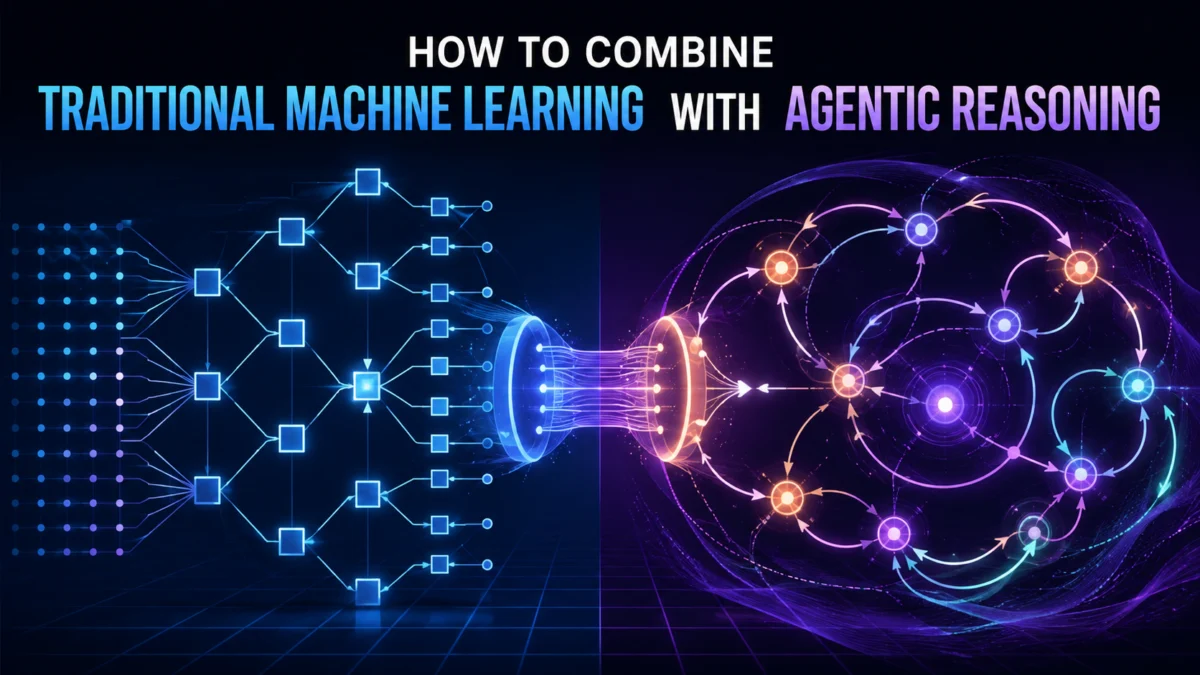

For over a decade, the enterprise AI landscape has been defined by the paradigm of predictive modeling. From financial services and healthcare to supply chain management, organizations have invested heavily in supervised learning architectures designed to ingest vast datasets and output singular, probabilistic predictions. While these systems—ranging from simple logistic regression models to sophisticated deep learning neural networks—have achieved remarkable precision in static environments, they are increasingly hitting a wall of utility. As businesses demand more autonomous, multi-step process automation, the limitations of "input-output" models are becoming a bottleneck. The emerging solution is not the abandonment of these proven models, but their integration into agentic architectures, creating a new class of hybrid AI systems capable of reasoning, planning, and executing complex workflows.
The Evolution of AI: From Static Models to Dynamic Agents
To understand the shift currently underway, one must look at the historical trajectory of machine learning (ML). The 2010s were defined by the "Big Data" revolution, where the primary objective was pattern recognition. Models were built to excel at specific, bounded tasks: identifying fraudulent credit card transactions, predicting customer churn, or forecasting retail demand. These models are essentially high-dimensional statistical functions; they operate on the assumption that the world at the time of inference mirrors the world at the time of training.
However, the reality of modern business operations is inherently non-static. According to recent industry surveys, nearly 70% of AI initiatives in the enterprise fail to reach full production scale, not because the models lack predictive accuracy, but because the models cannot bridge the "last mile" of execution. A fraud detection model may correctly identify a high-risk transaction with 99% accuracy, but it cannot independently freeze the account, initiate a customer verification process, or update internal security logs. These tasks have historically required human intervention or brittle, hard-coded rule-based scripts—the "connective tissue" that slows down digital transformation.
Chronology of the Shift: The Rise of LLMs and Reasoning Engines
The catalyst for this transition is the widespread adoption of Large Language Models (LLMs). Before the advent of transformer-based architectures, "agents" in AI research were largely limited to game environments or simplified robotics. The introduction of LLMs in the early 2020s provided the "reasoning engine" necessary to transition AI from a passive predictor to an active participant.
- 2012–2017 (The Supervised Era): The focus was on deep learning for specific classification tasks. The success of ImageNet and early neural networks solidified the "input-output" workflow as the industry standard.
- 2018–2022 (The Foundation Model Era): Models began to exhibit emergent capabilities in reasoning and generalization. Researchers began experimenting with "Chain-of-Thought" prompting, where models were prompted to "think" before answering, effectively breaking down problems into steps.
- 2023–Present (The Agentic Era): Development shifted toward "Agentic Workflows." By providing LLMs with access to tools (APIs, search engines, databases), developers turned models into agents capable of executing multi-step tasks.
Where Traditional Models Fall Short: A Technical Analysis
The fundamental limitation of traditional ML is the lack of a "stateful" feedback loop. In a supervised learning model, the system is blind to the consequences of its output. If a model predicts an equipment failure, it has no inherent awareness of whether a technician has been dispatched or if the prediction was a false positive that needs to be reconciled with real-world sensor data.
This creates three critical friction points in enterprise applications:
- The Multi-Step Deficiency: Complex business processes are sequential. Loan underwriting, for example, is not a single point of failure but a chain of verification. A model can provide a risk score, but it cannot navigate the decision tree required to verify disparate data points across various legacy databases.
- The Contextual Bottleneck: Traditional models are limited to the fixed features provided at inference. They cannot "search" for more information. If a medical diagnostic model encounters an edge case, it cannot query a clinical database to compare patient history against similar, rare case studies.
- The Execution Gap: Perhaps the most significant constraint is the inability of models to interact with the environment. Traditional ML is a read-only process. Agentic reasoning introduces write capabilities, allowing the system to update external systems, trigger alerts, or initiate workflows.
Defining Agentic Reasoning: The Orchestration Layer
Agentic reasoning is the process by which an AI system uses a reasoning engine—typically an LLM—to decompose a high-level goal into a sequence of actionable steps. Unlike a traditional model, which performs a static calculation, an agent follows a loop of observation, thought, and action.
Recent research published by the MIT Computer Science and Artificial Intelligence Laboratory (CSAIL) highlights that agentic systems exhibit "adaptive capacity." When an agent encounters a failed tool call or an unexpected data error, it does not crash. Instead, it re-evaluates the task, potentially attempting a different query or re-routing the workflow. This resilience is a departure from the "brittle" nature of classical automated systems.
The Hybrid Architecture: A Strategic Integration
The most robust AI deployments in the current market are hybrid. In this architecture, traditional ML models function as "specialized tools" within a broader agentic workflow.
For instance, in a sophisticated insurance claims processing system:
- The Orchestrator (Agent): Receives an intake form and parses the intent.
- The Specialized Tool (ML Model): The agent passes structured features to a highly tuned XGBoost model for fraud detection.
- The Synthesis (Reasoning Engine): The agent receives the probability score, retrieves historical policy documents, checks for anomalies in claimant history, and drafts an initial report for human review.
This structure allows the organization to leverage the high-performance accuracy of traditional models while benefiting from the flexibility and contextual awareness of agentic systems. It effectively optimizes for the strengths of both: statistical precision for the "heavy lifting" and logical orchestration for the "process management."
Implications for the Workforce and Enterprise Strategy
The integration of agentic reasoning into existing ML infrastructure carries profound implications for business strategy. First, it mitigates the "black box" concern. Because agents can document their reasoning trace—essentially explaining why they chose to call a specific tool or how they interpreted a piece of data—the system becomes more auditable than a stand-alone neural network.
Second, the cost-to-value ratio of AI initiatives is expected to improve. By automating the "connective tissue" of business processes, companies can reduce the reliance on manual human intervention for low-level decision-making. Analysts at Gartner have predicted that by 2026, over 50% of enterprise AI deployments will involve agentic workflows, up from less than 5% in 2023.
However, this transition is not without challenges. Integrating agentic systems requires a higher level of "AI governance." Organizations must now implement safeguards for agent behavior—ensuring that the agent does not perform unauthorized actions or drift from its operational parameters. This necessitates a shift in focus from "model monitoring" to "workflow orchestration monitoring."
Conclusion
The evolution from traditional machine learning to agentic reasoning represents a shift from "AI as a calculator" to "AI as a colleague." By wrapping established predictive models in a layer of orchestration, developers are enabling machines to handle the nuance, ambiguity, and multi-step complexity that characterize the modern business environment. This hybrid approach ensures that the billions of dollars invested in predictive modeling are not rendered obsolete, but are instead amplified, allowing organizations to finally close the gap between what an AI can predict and what an AI can actually accomplish. As this technology matures, the competitive advantage will lie with those who can effectively build and manage these hybrid architectures, creating systems that are not just accurate, but reliably autonomous.
