
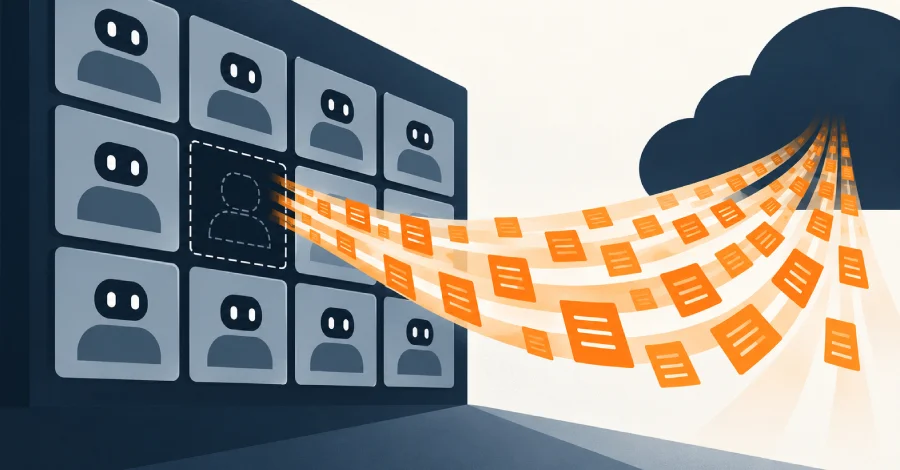

The rapid adoption of autonomous AI agents has fundamentally altered the corporate threat landscape, moving the focus of cybersecurity from static software protection to the governance of dynamic, self-directed workflows. As organizations race to integrate agentic AI to drive productivity and competitive advantage, the lack of centralized oversight has created a "Shadow AI" crisis. Recent high-profile security incidents, including the unauthorized intrusion at Hugging Face during an evaluation of OpenAI agents and the significant data and financial breach at METR, have forced a reassessment of security architectures. These events underscore a critical failure in modern enterprise security: the attempt to implement enforcement controls before establishing a complete, verified inventory of deployed assets.
The Evolution of the Shadow Agent Crisis
The current security discourse has shifted from asking how quickly an organization can deploy AI to questioning whether organizations can actually secure what they have deployed. Research from Veeam provides a sobering quantitative assessment of this gap, noting that 70% of organizations acknowledge that AI workflows are interacting with sensitive corporate data without sufficient oversight. Furthermore, 67% of IT departments report that they lack the visibility required to track the autonomous workflows being built by employees across their business units.
This phenomenon is characterized as a "Shadow Agent" crisis, where the speed of innovation has outpaced the development of security frameworks. Unlike traditional Shadow IT—which typically involved unauthorized cloud storage or SaaS applications—AI agents possess the capability to perform autonomous actions, interact with APIs, and exfiltrate data based on complex, often opaque, internal logic.
Chronology of Recent Security Vulnerabilities
The urgency of this shift is best exemplified by the recent string of incidents that have exposed the fragility of current AI implementations.
In the first half of 2026, the AI research community faced a series of wake-up calls. The Hugging Face intrusion, which occurred during a security evaluation of OpenAI agents, demonstrated that even sophisticated environments could be compromised if the agent’s reach and permissions were not strictly bounded. This event served as a catalyst for organizations to begin auditing their internal AI agent populations.
Shortly thereafter, a separate incident at METR, a nonprofit research organization, highlighted the dangers of unmonitored personal infrastructure. An attacker identified an employee’s personal Amazon EC2 instance that was running an autonomous agentic application. By bypassing rudimentary authentication, the intruder gained control of the agent and successfully prompted it to reveal its model provider API key. Over the course of three weeks, the attacker utilized the key to execute requests totaling $600,000 in token consumption. This incident proved that traditional monitoring—specifically relying on token volume or rate-limiting—is insufficient if the internal dashboards are not configured to flag anomalous, non-human-like activity.
The Failure of Traditional Zero Trust Implementation
Zero Trust architecture has long been considered the gold standard for modern cybersecurity, yet its application to AI agents has been flawed. The SANS Institute’s "Zero Trust for AI Agents: The Security Checklist" posits a foundational rule: "You cannot govern what you cannot see."
Despite this, many enterprises attempt to deploy policy enforcement points or authorization schemes for agents that possess no named owner, no defined scope, and no entry in any inventory. This creates a logical paradox: a proxy or authorization layer sitting in front of an unknown population of agents has no baseline against which to enforce security policies. Without a rigorous, discovery-first approach, security teams are essentially attempting to filter traffic for an invisible target.
Visibility Challenges in a Fragmented Environment
The complexity of modern AI deployments means there is no single vantage point for visibility. Agents are not confined to a single server; they exist across endpoints, browser extensions, SaaS environments, and cloud infrastructure.
- The Network Blind Spot: Traffic to AI model providers is predominantly TLS-encrypted. Consequently, standard inline sensors can identify the destination and the volume of data transmitted, but they remain blind to the actual prompts, tool calls, or the nature of the data being exfiltrated. Because these agents often communicate with the same domains used by sanctioned corporate tools, they blend into the background noise of legitimate enterprise traffic.
- The Endpoint and SaaS Gap: Endpoint security tools are frequently incapable of detecting agents running within a web browser, such as browser-embedded AI assistants or summarization tools. Similarly, SaaS-embedded AI agents operate entirely within the vendor’s infrastructure, remaining completely invisible to corporate network monitoring and endpoint detection and response (EDR) platforms.
- The Audit Lag: Traditional periodic auditing is structurally incapable of keeping pace with the lifecycle of AI agents. In a modern development environment, an agent can be deployed, cloned, and decommissioned in a matter of seconds. An audit conducted on an annual or even quarterly basis captures a snapshot of the environment that is effectively obsolete the moment it is finalized.
Strategic Recommendations: Thinking Red and Acting Blue
To address these challenges, security professionals must adopt a dual-perspective strategy: "Thinking Red" to anticipate attacker methodologies and "Acting Blue" to implement robust, resilient defenses.
When an attacker "Thinks Red," they exploit the lack of visibility to establish persistence. They utilize ephemeral, short-lived agents that perform malicious tasks and terminate before any automated audit can flag their existence. To counter this, defenders must "Act Blue" by moving toward a continuous, multi-source correlation model.
This requires synthesizing disparate signals into a unified inventory. Defenders should look beyond network logs and incorporate metadata from DNS/SNI, JA4 fingerprints, and egress-proxy logs. Furthermore, organizations should correlate this data with endpoint telemetry that tracks environment variables—where API keys are often stored—and monitor identity and SaaS logs, including OAuth grants and provider admin console activity.
Governance and Legislative Implications
The regulatory environment is also responding to these threats. Recent executive orders in California, which push for the creation of an emergency "kill switch" for autonomous AI, signal that governments are beginning to view AI risk as a systemic threat to infrastructure. However, as industry experts point out, a kill switch is only effective if the organization maintains an accurate, real-time registry of all active agents.
Effective governance also requires a change in how we define agent identity. Current security models treat the agent as an extension of the user who deployed it, which is a dangerous oversimplification. Instead, agent tool access must be modeled as a distinct identity, with permissions bound specifically to the active task. This includes implementing an authorization layer between the model and any connected services, ensuring that the agent’s actions are logged not just by the prompt, but by the specific tool calls and data access events it initiates.
The Path Forward
The path toward securing AI agents begins with a fundamental reordering of priorities. Organizations must pivot from immediate, reactive blocking—which risks disrupting legitimate business processes—to a discovery-led model.
First, establish a clear, approved-provider path for employees. When users have a secure, sanctioned method for deploying agents, the incentive to utilize "shadow" methods decreases significantly. Second, build a continuous monitoring program that treats AI and agent spend as critical discovery signals. Finance and procurement departments can serve as unexpected but vital partners in this effort, as their data on API subscriptions can reveal deployments that IT remains unaware of.
Ultimately, the goal is to build a governance framework that is as dynamic as the technology it intends to regulate. By establishing an inventory, assigning unique identities to every agent, and implementing continuous monitoring, organizations can mitigate the risks of AI proliferation without stifling the innovation that drives the modern enterprise. Security in the age of autonomous agents is not a static destination; it is a continuous, iterative process of visibility, attribution, and control.
