

In the contemporary landscape of enterprise IT, where remote workforces, cloud integrations, and sprawling Internet of Things (IoT) ecosystems have decentralized the traditional corporate perimeter, securing network entry points is a paramount operational challenge. As organizations face increasingly sophisticated cyberthreats targeting core servers and infrastructure, centralized network access control has transitioned from a supplementary measure to a foundational requirement of cybersecurity architecture. At the center of this defensive strategy for Windows Server environments is the Network Policy Server (NPS). By serving as Microsoft’s native implementation of a Remote Authentication Dial-In User Service (RADIUS) server and proxy, NPS empowers network administrators to formulate, deploy, and enforce granular access policies. This comprehensive examination explores the mechanics of the RADIUS protocol, the core functional roles of NPS, associated operational benefits, and critical management best practices necessary to maintain a resilient enterprise network.
The Evolution and Importance of Network Security and Policy Management
The digital transformation of global commerce has fundamentally altered the risk profile of modern enterprise networks. With businesses relying heavily on continuous internet connectivity, cloud-based data exchanges, and distributed communications, servers and network gateways have emerged as primary targets for malicious actors. Industry telemetry consistently highlights that unauthorized access resulting from compromised credentials remains a leading vector for catastrophic data breaches.
This elevated risk landscape underscores the absolute necessity of robust network security and meticulous policy management. Historically, individual network devices maintained isolated user databases, leading to administrative overhead, inconsistent security baselines, and severe vulnerabilities when employees departed or roles changed. Modern network architectures demand a unified approach—centralization that ensures every connection request is rigorously vetted against dynamic organizational policies before network resources are engaged.
Deconstructing the RADIUS Protocol: Authentication, Authorization, and Accounting
To fully appreciate the operational scope of NPS, one must examine the underlying technology that powers it: the RADIUS protocol. Established as an industry standard in the early 1990s, RADIUS provides a standardized framework for Authentication, Authorization, and Accounting (AAA) management across disparate network access servers, virtual private network (VPN) gateways, and wireless access points.
The AAA framework operates as a sequential three-pillar security checkpoint. The first pillar, Authentication, represents the mechanism of verifying a user or device’s identity. When a connection request is initiated, the requesting entity supplies credentials—such as a username, password, or digital certificate. The RADIUS infrastructure evaluates these credentials against a secure database to confirm validity, ensuring that unauthorized actors are immediately blocked at the network perimeter.
Once identity is established, the system transitions to the second pillar: Authorization. Authentication merely proves who the user is, whereas authorization dictates what that authenticated entity is permitted to do. For instance, a systems administrator requires elevated privileges across multiple subnets, while a standard contractor requires restricted access to a single file share. RADIUS servers dynamically manage these permissions, guaranteeing that users operate strictly within the boundaries of their assigned clearance level.
The final pillar is Accounting, which involves the systemic tracking and logging of resource consumption. By monitoring connection durations, accessed services, and data transfer volumes, organizations maintain the granular audit trails required for internal billing, capacity planning, and rigorous compliance mandates. Together, these three pillars form a cohesive operational loop that transforms chaotic network traffic into a managed, auditable environment.
Operational Mechanics: How RADIUS and Network Access Servers Interact
The RADIUS framework relies fundamentally on a client-server architectural model. In this ecosystem, the RADIUS client is not an end-user workstation, but rather a network access server (NAS)—such as a wireless access point, a remote-access VPN concentrator, or a switch enforcing IEEE 802.1X port-based authentication.
When a user attempts to connect, the NAS captures the credentials and packages them into a secure RADIUS request packet, transmitting it across the network to the RADIUS server over designated UDP ports. The RADIUS server processes this packet, cross-referencing internal user databases and applicable network policies. Upon completing the evaluation, the server dispatches a response packet back to the NAS, instructing it to either accept the connection (often providing specific configuration parameters like VLAN assignments) or reject it outright. This decoupled design ensures that authentication logic remains centralized and secure, independent of the edge hardware facilitating the physical connection.
The Multifaceted Purpose of Microsoft Network Policy Server
Within Windows Server environments, Network Policy Server acts as the central orchestration engine for this AAA framework. NPS was developed to streamline network access control by consolidating user verification, policy enforcement, and activity logging into a single, highly scalable administrative console.
Through centralized authentication and authorization, NPS eliminates the security gaps inherent in decentralized management. Administrators no longer need to configure access rules on individual routers or switches; instead, they define enterprise-wide policies within NPS that govern access globally. Furthermore, NPS excels in accounting and regulatory compliance. By maintaining comprehensive logs of connection attempts, session lengths, and authentication outcomes, NPS provides compliance officers with the immutable data records necessary to satisfy regulatory frameworks such as HIPAA, PCI-DSS, and GDPR.

Finally, NPS enables advanced policy-based network management. Security teams can construct complex rules that dictate access based on myriad contextual conditions, including the time of day, department group membership, connection method, and the compliance posture of the connecting endpoint.
The Three Core Functional Roles of NPS
To adapt to complex enterprise infrastructures, NPS operates across three distinct functional roles: as a RADIUS server, as a RADIUS proxy, and as a specialized network policy server.
-
NPS as a RADIUS Server
In its primary capacity, NPS directly processes authentication and authorization requests originating from network access devices. When a remote worker attempts to establish a VPN tunnel or an employee connects to a corporate Wi-Fi network, NPS intercepts the request, verifies the credentials against Active Directory Domain Services (AD DS), and evaluates access permissions based on predefined network policies. This direct role is vital for standard enterprise environments seeking to secure everyday network entry points through centralized Active Directory integration. -
NPS as a RADIUS Proxy
In large, geographically distributed, or multi-tenant enterprise networks, a single server may be insufficient or structurally isolated from specific user directories. When functioning as a RADIUS proxy, NPS does not authenticate users locally; instead, it intelligently forwards authentication and accounting requests to other designated RADIUS servers across trusted or untrusted network domains. This role provides critical enterprise capabilities, including load balancing across multiple backend servers and high-availability failover mechanisms that ensure business continuity if a primary authentication server experiences an outage. -
NPS as a Network Policy Server
Beyond handling protocol traffic, NPS serves as an advanced policy engine. It defines the strict environmental conditions under which network access is granted or denied. By evaluating parameters such as device health, IP addressing, and cryptographic certificate status, NPS ensures that only secure, authorized endpoints touch the corporate network. Historically, this included tight integration with Microsoft’s Network Access Protection (NAP) framework to verify device patch levels and antivirus status before granting admission.
Strategic Benefits of Deploying NPS in Enterprise Infrastructure
Integrating NPS into an organization’s IT architecture yields substantial operational and security dividends. Chief among these is enhanced security posture. By enforcing multi-factor authentication (MFA) standards, strong encryption protocols (such as PEAP-MSCHAPv2 and EAP-TLS), and strict device health checks, NPS dramatically reduces the attack surface available to lateral-moving cybercriminals.
Additionally, NPS delivers significant administrative efficiency. Centralizing policy management allows IT departments to update security rules globally rather than modifying configurations across hundreds of individual network switches and access points. This reduces human error, accelerates incident response times, and lowers the total cost of network administration.
Essential Best Practices for Managing Network Policy Server
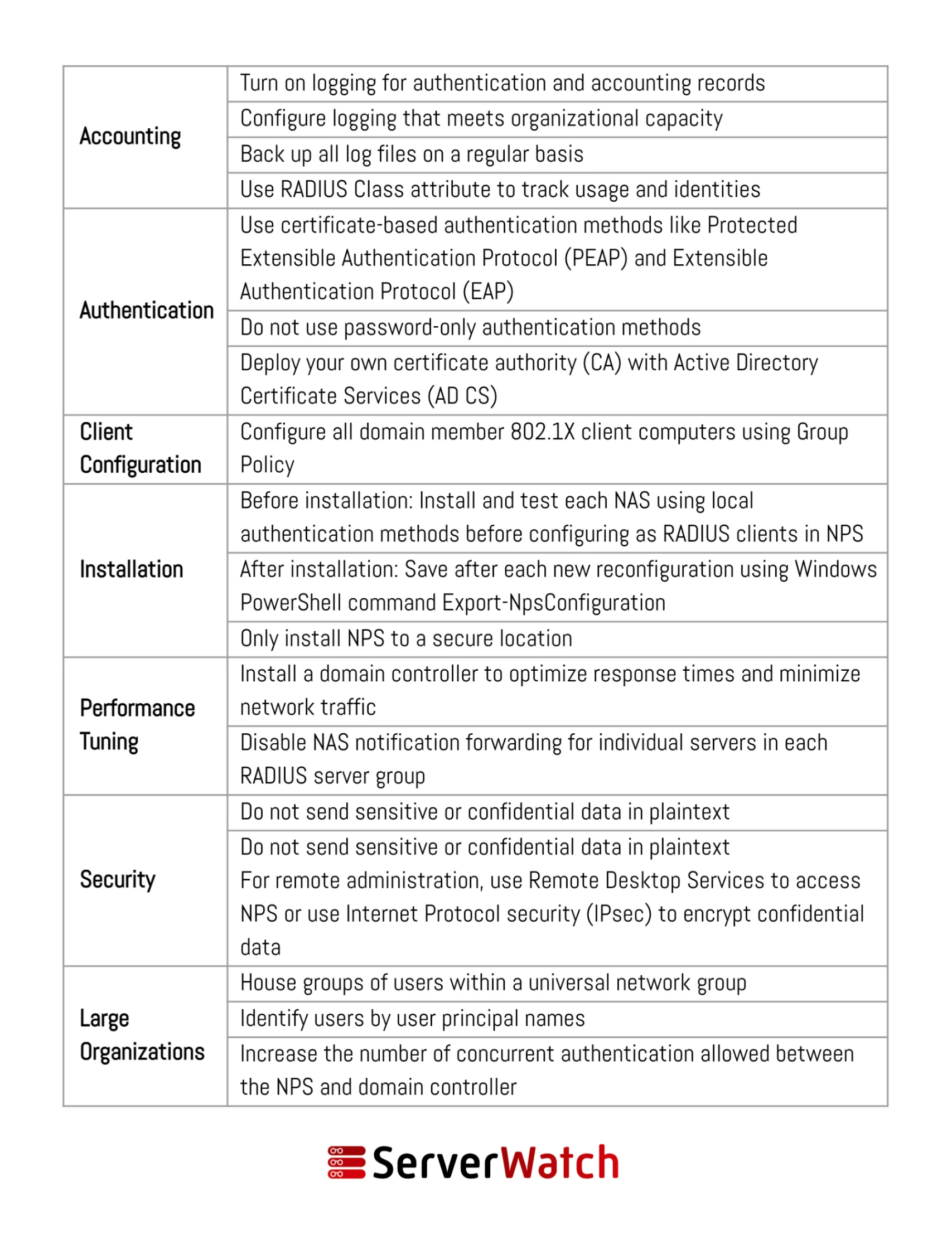
To ensure high availability, optimal performance, and uncompromised security, administrators managing NPS deployments must adhere to established industry best practices.
First, redundancy is critical. Because NPS controls the gateway to the entire network, a single point of failure can disrupt all incoming connections. Organizations should deploy multiple NPS instances configured in a server farm or load-balanced cluster to guarantee failover protection.
Second, administrators must secure RADIUS client configurations. Communication between the network access server (client) and NPS relies on shared secrets. These secrets must be cryptographically strong, randomly generated, and rotated regularly to prevent brute-force sniffing attacks. Furthermore, network segmentation should be implemented so that RADIUS traffic traverses dedicated, secure management VLANs rather than public or unencrypted subnets.
Third, proactive monitoring and log management are indispensable. Administrators should integrate NPS event logs with centralized Security Information and Event Management (SIEM) platforms to monitor for anomalous authentication spikes, repeated failed login attempts, or unauthorized access patterns. Regular testing using specialized RADIUS testing tools ensures that policy changes do not inadvertently lock out legitimate users or leave security gaps unaddressed.
Conclusion: The Indispensable Role of NPS in Modern Network Architecture
As the modern enterprise perimeter continues to dissolve into a complex mesh of cloud services, remote endpoints, and wireless networks, the imperative for rigorous, centralized access control has never been higher. Network Policy Server remains an indispensable tool for Windows Server environments, offering a flexible, scalable, and robust architecture for enforcing network security policies. By mastering the fundamentals of RADIUS, leveraging the multi-role capabilities of NPS, and strictly adhering to operational best practices, organizations can successfully fortify their digital infrastructure against evolving cyberthreats while streamlining administrative workflows and maintaining strict regulatory compliance.
