

The Shift from Keyword Search to Semantic Meaning
Traditional database systems have long relied on inverted indices, where documents are retrieved based on the presence of specific keywords. While efficient, this approach often fails to capture the intent behind a user’s query. If a user searches for "a way to energize a cell," a traditional system might struggle to retrieve documents about mitochondria unless those specific terms overlap.
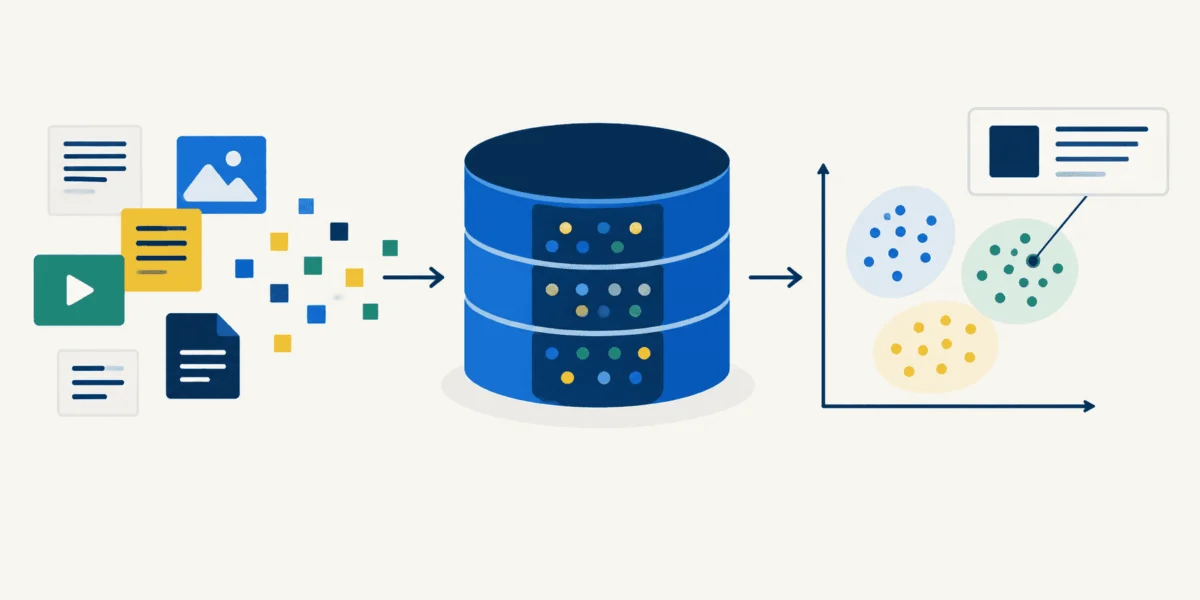
Vector databases solve this by representing data as high-dimensional vectors, or embeddings, generated by machine learning models. These vectors map semantic meaning into a geometric space. In this space, the relationship between a query and a document is determined by the mathematical distance between their respective coordinates. When a user inputs a query, the system translates it into the same vector space and identifies the data points that share the closest proximity. This allows for "fuzzy" but highly accurate retrieval based on concepts rather than literal character matches.
Step-by-Step Architectural Foundations
The process begins with setting up the development environment, which requires minimal overhead. By utilizing the sentence-transformers library alongside NumPy, developers can bypass the need for expensive GPU clusters or proprietary APIs. The initial phase focuses on initializing a VectorDB class, which acts as the core engine for indexing and retrieval.
- Environment Setup: The foundation relies on a clean workspace containing three primary components: the database logic, a corpus of text, and a testing suite. The initialization of the
VectorDBinvolves loading a pre-trained embedding model, such asall-MiniLM-L6-v2, which transforms text into a 384-dimensional vector. - Index Construction: Once the model is loaded, the
add()function iterates through the document corpus. Each document, regardless of length, is flattened into a uniform vector size. This fixed-length representation is critical for performance; it ensures that the memory footprint of the database remains predictable and that search times do not fluctuate wildly based on input size. - Semantic Retrieval: The transition from keyword search to semantic search is demonstrated when the system successfully retrieves documents that share no common words with the input query. By calculating the cosine similarity between vectors, the system identifies relevant context—such as identifying "sourdough" when a user asks about "sour bread."
- Scoring and Thresholds: A critical component of vector search is the scoring mechanism. Unlike boolean search, which returns a binary "hit" or "miss," vector search provides a confidence score. This allows developers to implement "guard rails," setting a minimum threshold for relevance to ensure that the system does not return noise when no truly relevant data exists.
- Metadata Filtering: Real-world applications require more than just vector similarity; they require constraints. By integrating metadata—such as topics, categories, or dates—the system can perform pre-filtering. This ensures that a query about "mitochondria" in a biology context does not erroneously pull up an unrelated comic book reference.
- Data Integrity and Persistence: The final stages of the tutorial address the practicalities of production-ready systems, including robust error handling to prevent index corruption and methods for serializing the database. Saving the index involves separating the raw document text (stored in JSON) from the vector embeddings (stored in NumPy files), which allows for efficient loading and prevents "model drift," where an index becomes incompatible with the model used to create it.
Computational Performance and Scalability
A key insight into the scalability of vector databases is that the core search operation—the dot product calculation—is highly optimized in modern computing environments. As demonstrated in the scaling analysis, the time required to perform a search increases linearly with the number of documents, but remains remarkably fast. Even with 100,000 documents, the scan time remains in the single-digit millisecond range.
This efficiency is due to the nature of linear algebra in NumPy. By representing the entire database as a single matrix, the system can perform a full-corpus scan using a single matrix multiplication operation. This is significantly faster than iterating through individual records. Consequently, the bottleneck in a small-scale system is often the overhead of the Python loop itself, whereas in a large-scale production system, the bottleneck shifts to the hardware’s ability to hold the entire vector matrix in memory.
Broader Implications for AI Infrastructure
The rise of vector databases represents a fundamental shift in how applications handle information. By moving the "intelligence" of search into the embedding model, developers can build systems that behave more like human experts—understanding context, synonyms, and nuanced relationships between ideas.
From an industry perspective, this "build it yourself" approach serves a dual purpose. First, it demystifies the proprietary "black box" nature of many managed vector database services. By seeing that the core functionality is essentially a series of matrix operations, developers can make more informed decisions about whether to build a custom solution or utilize an enterprise-grade managed platform. Second, it highlights the importance of the embedding model itself. The quality of a vector database is entirely dependent on the quality of the model used to create the vectors; if the model does not understand the nuances of the domain, the database will fail to retrieve accurate information, regardless of how fast or optimized the search engine is.
Strategic Considerations for Developers
As organizations integrate vector search into their workflows, they must account for several strategic factors:
- Model Selection: Choosing an embedding model is the most important decision in the architecture. Different models excel at different domains, such as medical literature, legal documents, or casual conversation.
- Dimensionality vs. Performance: While higher-dimensional vectors can capture more nuance, they also increase the memory and storage requirements. Developers must strike a balance based on their specific hardware constraints.
- Index Maintenance: In production environments, data is rarely static. Mechanisms for updating, deleting, and re-indexing documents are essential to prevent the database from becoming stale.
- Hybrid Search: Many modern systems are moving toward "hybrid search," which combines vector-based semantic retrieval with traditional keyword indexing. This provides the best of both worlds: semantic understanding for concepts and exact matching for specific terminology.
Conclusion
The development of a functional vector database, while mathematically sophisticated, is grounded in accessible programming principles. By mastering the transition from raw text to high-dimensional vectors, and by understanding how to perform efficient matrix operations, developers can create powerful, context-aware applications. The journey from a simple 25-document script to a high-performance, scalable search system illustrates why vector databases are becoming the cornerstone of the modern AI-driven enterprise. As these tools continue to evolve, the ability to build and maintain such systems will remain a defining skill in the software engineering landscape.
