

The rapid proliferation of Large Language Models (LLMs) has shifted the focus of software engineering from simple integration to rigorous quality assurance. While industry-standard benchmarks such as MMLU (Massive Multitask Language Understanding) and GSM8K provide a snapshot of general model reasoning, they often fail to address the nuance of domain-specific applications. For enterprises deploying customer support agents, automated code reviewers, or RAG (Retrieval-Augmented Generation) pipelines, general-purpose metrics are insufficient. The industry is currently moving toward the development of proprietary evaluation harnesses—bespoke testing frameworks that provide developers with full control over how models are scored, audited, and improved.
The Evolution of Model Evaluation
The necessity for custom evaluation arises from the "black box" nature of proprietary LLMs. In the early stages of generative AI adoption, developers relied on subjective "vibes-based" testing, where a few team members would interact with a chatbot and determine if the results felt accurate. As of 2024 and 2025, however, the industry has recognized that this approach is neither scalable nor auditable.
A test harness functions as the essential scaffolding between an input and a desired output. In a traditional software context, a harness provides the environment for unit and integration testing. In the context of LLMs, this requires a cyclical process: feeding prompts into the model, capturing the non-deterministic output, and programmatically validating that output against a "golden" standard. Without a formal, repeatable pipeline, developers cannot objectively measure if a model update—or a change in system prompts—has introduced regressions in performance, latency, or safety.
Constructing the Four Pillars of Evaluation
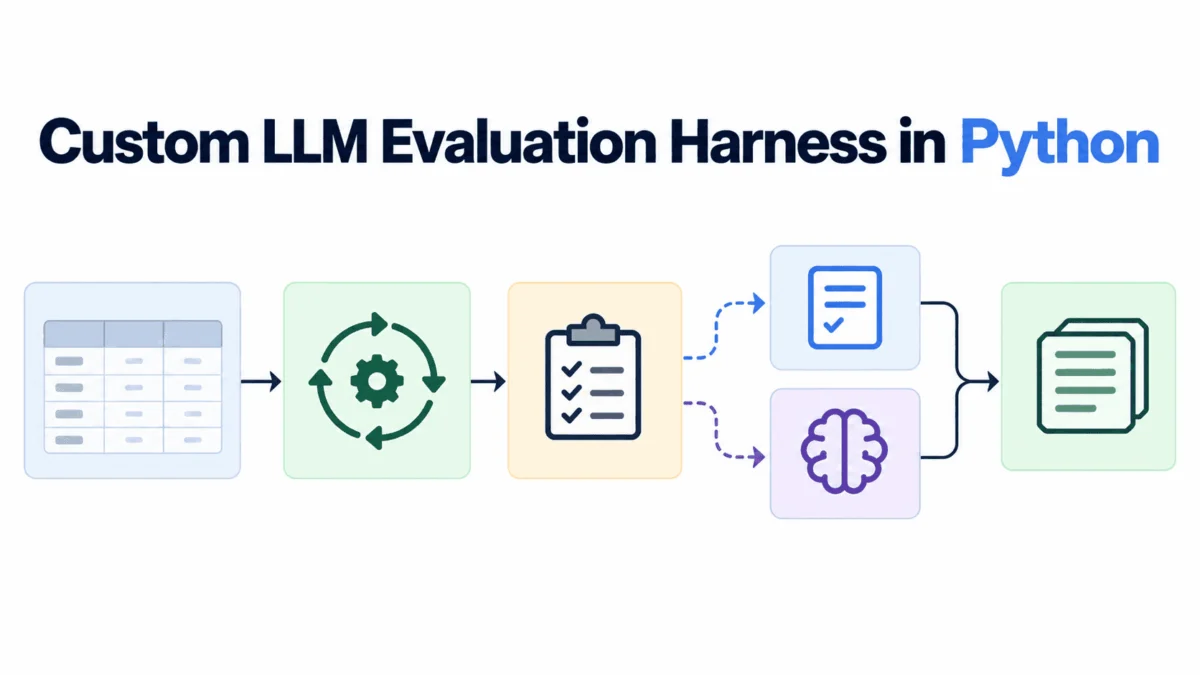
Building an effective evaluation framework requires four distinct, modular components. By keeping these components decoupled, developers ensure that their testing pipeline remains resilient to changes in model providers or evolving business requirements.
1. The Golden Dataset: Defining the Baseline
The foundation of any evaluation strategy is the "golden dataset." Unlike synthetic benchmarks generated by other AI models, a high-quality golden dataset is derived from real-world user logs and documented failure modes. Industry best practices suggest maintaining a set of 50 to 100 diverse test cases. These should include "happy path" queries, edge cases, and known adversarial prompts designed to test refusal policies. Each case must contain a unique identifier, the user input, and a clear, objective expected outcome. This structure allows teams to track performance trends over time, identifying which specific categories of queries are prone to error.
2. The Inference Runner: Managing Concurrency
The inference runner acts as the bridge to the LLM backend. Utilizing tools like LiteLLM allows developers to abstract the API calls, enabling the evaluation of multiple models—such as GPT-4o, Claude 3.5 Sonnet, or Llama 3—using a unified interface. To maintain efficiency, the runner should leverage Python’s native asyncio library. By executing API calls concurrently rather than sequentially, developers can drastically reduce the wall-clock time required for large-scale evaluation runs. This is critical for CI/CD integration, where developers need rapid feedback loops to confirm that a prompt change has not degraded performance.
3. The Judge Layer: Measuring Success
The "Judge" is the core intelligence of the harness. There are two primary methodologies for grading:
- Deterministic Evaluation: This is the most cost-effective and precise method. It is best suited for scenarios where the output must contain specific keywords, conform to a JSON schema, or avoid restricted content.
- LLM-as-a-Judge: This approach uses a secondary, highly capable model to analyze the output of the model under test. By providing the judge model with a specific rubric and requiring structured output—enforced by libraries like Pydantic—developers can achieve human-level reasoning in the evaluation process. The use of Pydantic to force a boolean "pass/fail" result is a standard safeguard against the natural ambiguity of LLM text generation.
4. Logging and Analytics
The final component is the logging layer, which records every result as a line-delimited JSON (.jsonl) file. This format is inherently crash-safe and allows for incremental data analysis. By separating the inference phase from the scoring phase, developers gain the ability to re-score past results if the evaluation criteria or the "Judge" rubric changes, without incurring the time and cost of re-running the inference.
Technical Prerequisites and Implementation
The technical barrier to entry for building a robust harness is relatively low, provided the development environment is configured correctly. Python 3.10 or later is recommended to ensure full compatibility with modern asynchronous patterns.
- Dependency Management: Utilizing
litellmsimplifies the integration of various providers, whilepydanticensures data integrity. - Latency and Cost Tracking: Beyond functional correctness, mature evaluation harnesses should track the latency of each API call and the associated token costs. These metrics are vital for production teams balancing quality against infrastructure budgets.
- Version Control: The golden dataset should be version-controlled alongside the application code. This ensures that every evaluation run is reproducible and that the team can correlate a drop in pass rates with a specific version of the prompt or model.
Broader Industry Implications
The trend toward internal evaluation harnesses represents a maturation of the AI industry. As businesses move from experimentation to production, the reliance on third-party vendor benchmarks is waning in favor of internal auditing. Companies that fail to implement such frameworks often face "model drift," where updates to an underlying model cause silent failures in production systems.
Furthermore, the "Judge" approach is facilitating a new form of automated oversight. By using LLMs to monitor other LLMs, organizations can enforce complex safety and compliance policies at scale—such as ensuring that financial advice is qualified with appropriate disclaimers or that technical documentation remains strictly within the scope of the provided context.
Conclusion and Future Outlook
The shift toward custom-built evaluation harnesses marks a critical transition in the software lifecycle of AI-driven applications. By building a modular system comprising a golden dataset, an asynchronous runner, a structured judge layer, and a robust logging mechanism, developers move from guessing about model performance to measuring it with mathematical precision.
As the ecosystem continues to evolve, the integration of these harnesses into CI/CD pipelines will become standard practice. Future advancements in this space will likely include the automation of golden dataset generation—using historical logs to identify "high-uncertainty" queries that warrant human review—and the development of more granular, multi-dimensional scoring rubrics. For now, however, the ability to build and maintain a custom harness remains the most reliable strategy for any team aiming to deploy LLMs in high-stakes environments. By controlling the testing environment, organizations retain ownership over the quality of their intelligence, ensuring that their AI agents perform consistently, reliably, and within the bounds of their operational requirements.
