
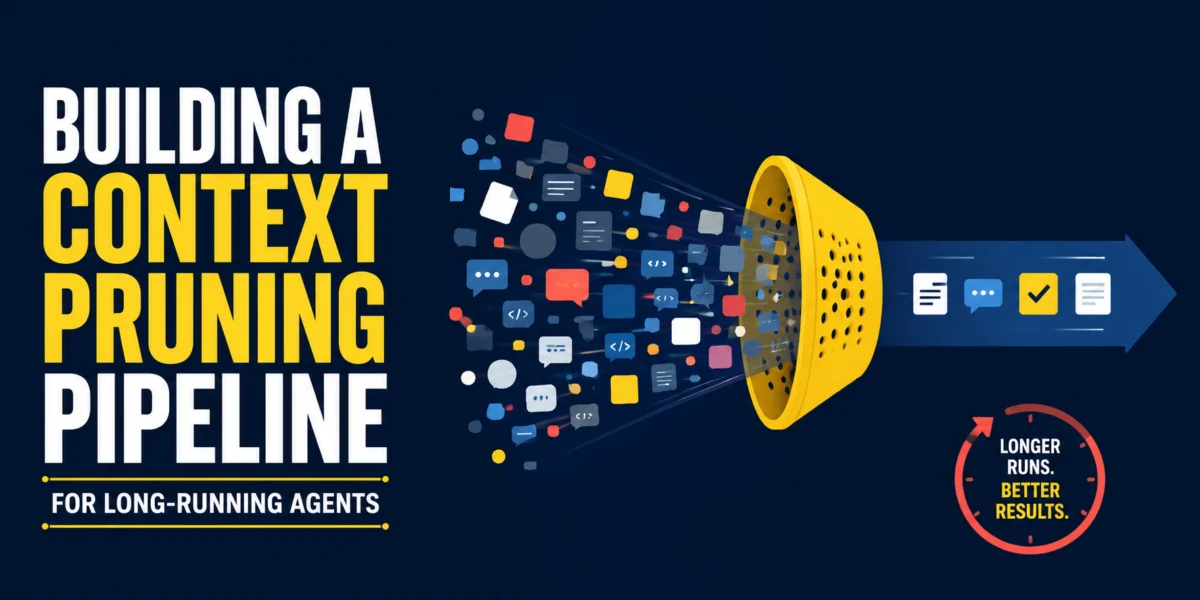

Modern AI agents, powered by large language models (LLMs), are increasingly deployed in long-running, continuous operational environments. These agents, from advanced customer service chatbots to sophisticated internal knowledge assistants, are designed to maintain ongoing dialogues, accumulating vast amounts of conversational memory. While crucial for coherent and personalized interactions, this ever-growing history presents a significant challenge: efficiently managing the LLM’s context window. Passing an entire, unbounded conversation history to an LLM is a recipe for prohibitive token costs, significant latency bottlenecks, and a discernible degradation in the agent’s reasoning capabilities as it struggles with an overwhelming volume of potentially irrelevant information.
The Escalating Challenge of Unmanaged Context in AI Agents
The architectural design of current LLMs necessitates that all information relevant to a given query be present within a finite context window. For an AI agent designed to engage in prolonged interactions—spanning hours, days, or even weeks—this constraint quickly becomes a bottleneck. Each turn in a conversation adds to the memory footprint, and as the context window expands, several critical issues emerge.
Firstly, token costs skyrocket. Major LLM providers charge based on the number of tokens processed (both input and output). A typical enterprise-grade LLM interaction might cost a fraction of a cent per request, but when each request includes thousands of historical tokens, these costs multiply rapidly. For instance, if an agent processes 50,000 tokens per interaction and handles millions of interactions monthly, the financial burden becomes unsustainable. Data from industry benchmarks suggest that context windows exceeding 8,000 tokens can lead to exponential cost increases, making long-term deployments economically unviable without intelligent pruning.
Secondly, latency bottlenecks become pronounced. Processing larger context windows requires more computational resources and time. In real-time applications like live customer support or interactive development assistants, even a few hundred milliseconds of added latency per turn can significantly degrade the user experience, leading to frustration and reduced adoption. As context windows grow, the delay can extend into several seconds, rendering the agent impractical for dynamic human-computer interaction.
Finally, degradation in reasoning is a subtle yet critical problem. LLMs, despite their impressive capabilities, are not immune to information overload. When presented with an excessively long and cluttered context, models can struggle to identify the most relevant pieces of information, leading to "lost in the middle" phenomena, where crucial details buried within the context are overlooked. This can result in less accurate, less coherent, and ultimately less useful responses, undermining the very purpose of the AI agent.
Pioneering a Smarter Memory Strategy: Beyond Sliding Windows
Traditional memory strategies for AI agents often rely on a simplistic "sliding window" approach. This method discards the oldest parts of the conversation history as new turns are added, keeping only the most recent interactions. While straightforward to implement, this technique suffers from a critical flaw: it indiscriminately forgets old information, including potentially vital details that might become relevant again later in the conversation. Imagine an agent forgetting a user’s name or a key project detail simply because the conversation shifted to a different topic for a few turns.
Recognizing these limitations, AI researchers and developers have been exploring more sophisticated memory management techniques. The proposed context pruning pipeline represents a significant leap forward, moving beyond brute-force recency to a selective, smarter approach that provides the LLM with precisely what it needs as context. This strategy hinges on dynamically managing recent conversational memory by prioritizing information based on its semantic relevance to the current user prompt.
In essence, the context for an LLM is pruned down to three core elements:
- The Current User Prompt: The immediate query or statement from the user, which is the primary focus of the agent’s current task.
- The Most Recent Agent-User Interaction: The immediately preceding turn (both the user’s last message and the agent’s last response) to ensure conversational flow and coherence.
- Semantically Relevant Historical Turns: A select number of past interactions from the archived conversation history that are deemed highly similar in meaning to the current user prompt.
Everything in the conversation history that falls outside the scope of these three elements is intelligently discarded from the active prompt’s context. This selective pruning dramatically saves compute resources, reduces memory consumption, and, crucially, improves the LLM’s ability to focus on pertinent information, thereby enhancing its reasoning and response quality.
A Practical, Open-Source Implementation via Semantic Similarity
To demonstrate the efficacy of this approach, a practical, free-to-run local solution has been developed, leveraging open-source embedding models. While commercial APIs offer high efficiency, this open-source alternative provides accessibility and flexibility for developers and researchers.
The implementation simulates a long-running pipeline, employing a mocked conversation history alongside sentence transformer models to identify semantic similarities. The process begins with the necessary Python imports:
import numpy as np
from sentence_transformers import SentenceTransformer
from scipy.spatial.distance import cosine
Here, numpy is included for numerical operations, sentence_transformers provides the capability to convert text into meaningful numerical vectors (embeddings), and scipy.spatial.distance.cosine is used to calculate the similarity between these vectors.
Next, a pre-trained embedding model, all-MiniLM-L6-v2 from the sentence_transformers library, is loaded and initialized. This model is chosen for its balance of efficiency and accuracy, being lightweight enough for local execution while powerful enough to capture nuanced semantic characteristics. Simultaneously, a simulated agent history is created, mirroring a real-world dialogue exchange between a user and an AI agent. In a production environment, this history would typically be fetched from a persistent database or a session store.
# Initialize a lightweight open-source embedding model
model = SentenceTransformer('all-MiniLM-L6-v2')

# 1. Simulated Agent History (Usually fetched from a database)
chat_history = [
    "role": "user", "content": "My name is Alice and I work in logistics.",
    "role": "agent", "content": "Nice to meet you, Alice. How can I help with logistics?",
    "role": "user", "content": "What's the weather like today?",
    "role": "agent", "content": "It's sunny and 75 degrees.",
    "role": "user", "content": "I need help calculating route efficiency for my fleet.",
    "role": "agent", "content": "Route efficiency involves analyzing distance, traffic, and load weight.",
    "role": "user", "content": "Thanks, that makes sense.",
    "role": "agent", "content": "You're welcome! Let me know if you need anything else."
]
The Core Logic: The prune_context() Function
The heart of the context pruning pipeline resides in the prune_context() function. This function takes three arguments: the current_prompt from the user, the full history of the conversation, and top_k, an integer specifying the number of semantically relevant past turns to retrieve.
def prune_context(current_prompt, history, top_k=2):
    # If the conversation history is too short, we simply return it
    if len(history) <= 2:
        return history + ["role": "user", "content": current_prompt]

    # Extracting the most recent turn (last user/agent pair)
    recent_turn = history[-2:]

    # The rest of the history will be eligible for semantic pruning
    archived_turns = history[:-2]

    # 2. Embedding the current prompt
    prompt_emb = model.encode(current_prompt)

    # 3. Embedding archived turns and computing similarities
    scored_turns = []
    for turn in archived_turns:
        turn_emb = model.encode(turn["content"])
        # We want similarity, so we subtract cosine distance from 1
        similarity = 1 - cosine(prompt_emb, turn_emb)
        scored_turns.append((similarity, turn))

    # 4. Sorting by highest similarity and slicing the Top-K turns
    scored_turns.sort(key=lambda x: x[0], reverse=True)
    top_semantic_turns = [turn for score, turn in scored_turns[:top_k]]

    # Sorting the semantic turns chronologically (optional but recommended for LLMs)
    top_semantic_turns.sort(key=lambda x: archived_turns.index(x))

    # 5. Assemble the final pruned context
    pruned_context = top_semantic_turns + recent_turn + ["role": "user", "content": current_prompt]
    return pruned_context
This function systematically prunes the context through several stages:
- Base Case Handling: If the conversation history is very short (e.g., two messages or less), the function bypasses pruning and returns the entire history along with the current prompt. This ensures that initial interactions are always fully preserved, preventing premature loss of context before sufficient history has accumulated.
- Recent Turn Preservation: The most recent user-agent interaction (
history[-2:]) is explicitly extracted and preserved. This ensures that the immediate conversational flow is maintained, as LLMs typically rely heavily on the preceding turn for coherence and contextual understanding. This component is crucial for natural dialogue. - Archived Turns for Pruning: The remainder of the history (
history[:-2]) is designated asarchived_turns. These are the messages eligible for semantic pruning, forming the pool from which relevant past interactions will be retrieved. - Embedding the Current Prompt: The
current_promptis transformed into a high-dimensional vector representation (prompt_emb) using the pre-trainedSentenceTransformermodel. This embedding captures the semantic meaning of the prompt. - Embedding Archived Turns and Computing Similarities: Each message within the
archived_turnsis also converted into an embedding vector. The cosine similarity between each archived turn’s embedding and theprompt_embis then calculated. Cosine similarity measures the angle between two vectors, with values closer to 1 indicating higher similarity. By subtracting the cosine distance from 1, we obtain a direct measure of similarity, where 1 means identical and 0 means no similarity. - Sorting and Top-K Selection: The archived turns are then sorted in descending order based on their calculated similarity scores. The
top_kmost semantically similar turns are selected. This step is where the intelligence of the pruning lies, as it prioritizes information directly related to the current query, regardless of its chronological position. - Chronological Re-sorting (Optional but Recommended): The
top_semantic_turnsare re-sorted back into their original chronological order. While semantic retrieval might pull messages out of order, presenting them chronologically to the LLM can improve its understanding of the narrative flow and prevent potential confusion. - Assembling the Pruned Context: Finally, the
pruned_contextis assembled by concatenating the chronologically sortedtop_semantic_turns, therecent_turn, and thecurrent_prompt. This creates a compact yet semantically rich context window for the LLM.
Illustrative Simulation and Impact Analysis
To illustrate the pipeline in action, consider a scenario where a user, Alice, has had a conversation about logistics and fleet efficiency, then diverged to other topics, and now wishes to revisit the earlier discussion.
# Simulation Execution
current_request = "Can we go back to the fleet math?"
optimized_context = prune_context(current_request, chat_history)

# Output the result
print("--- PRUNED CONTEXT WINDOW ---")
for msg in optimized_context:
    print(f"msg['role'].upper(): msg['content']")
Given the chat_history provided earlier and a top_k=2 (default), the prune_context function processes the current_request. The embedding model identifies that "Can we go back to the fleet math?" is semantically similar to earlier messages discussing "calculating route efficiency for my fleet" and "Route efficiency involves analyzing distance, traffic, and load weight."
The resulting context window demonstrates the pipeline’s effectiveness:
--- PRUNED CONTEXT WINDOW ---
USER: I need help calculating route efficiency for my fleet.
AGENT: Route efficiency involves analyzing distance, traffic, and load weight.
USER: Thanks, that makes sense.
AGENT: You're welcome! Let me know if you need anything else.
USER: Can we go back to the fleet math?
Notice how the conversation about "What’s the weather like today?" was entirely omitted, as it held no semantic relevance to the current prompt. The initial introduction ("My name is Alice…") was also pruned. The pipeline successfully retrieved the two most semantically relevant messages (which, in this specific example, happened to form a complete user-agent interaction) and combined them with the immediately preceding turn and the current request. It’s important to clarify that the top_k strategy operates at the individual message level, not necessarily on full user-agent pairs. Thus, the two retrieved messages here formed a coherent interaction, but in other cases, top_k might retrieve two user messages or two agent messages, or non-consecutive parts of the chat history, which would then be re-sorted chronologically.
Broader Implications and Future Outlook
The implementation of such a context pruning pipeline carries significant implications for the development and widespread adoption of AI agents. By effectively managing conversational memory, this technique directly addresses the critical challenges of cost, latency, and reasoning degradation that have historically hindered the scalability of long-running LLM-powered applications.
For enterprises, this means the ability to deploy more sophisticated and persistent AI agents without incurring prohibitive operational costs. Customer service agents can maintain context over extended, multi-session interactions, providing a more personalized and effective user experience. Internal knowledge assistants can recall obscure project details from weeks prior, enhancing productivity and knowledge retention. The ability to efficiently retrieve specific, relevant information from vast histories enables AI agents to become truly indispensable, acting as reliable long-term partners rather than ephemeral conversational tools.
Moreover, this approach fosters greater trust in AI systems. By ensuring that agents consistently recall and reference pertinent information, users gain confidence in the AI’s ability to understand and respond intelligently, even when conversations span complex topics and extended periods.
Looking ahead, research in AI agent memory management continues to evolve. Future enhancements might include:
- Hierarchical Memory Structures: Distinguishing between short-term, medium-term, and long-term memory, each with its own pruning and retrieval strategies.
- Graph-based Memory: Representing conversational elements and their relationships as a knowledge graph, allowing for more complex reasoning and retrieval beyond simple semantic similarity.
- Multimodal Context Pruning: Extending these principles to agents that process and generate information across various modalities, such as text, images, and audio.
- Adaptive Pruning: Dynamically adjusting
top_kor other pruning parameters based on the complexity of the conversation or the current task.
In conclusion, the context pruning pipeline, leveraging semantic similarity and open-source embedding models, represents a foundational technique for building robust, efficient, and intelligent long-running AI agents. It addresses a core architectural challenge of LLMs, paving the way for a new generation of AI applications that can engage in truly continuous, context-aware interactions, unlocking unprecedented capabilities and value across diverse industries.
