
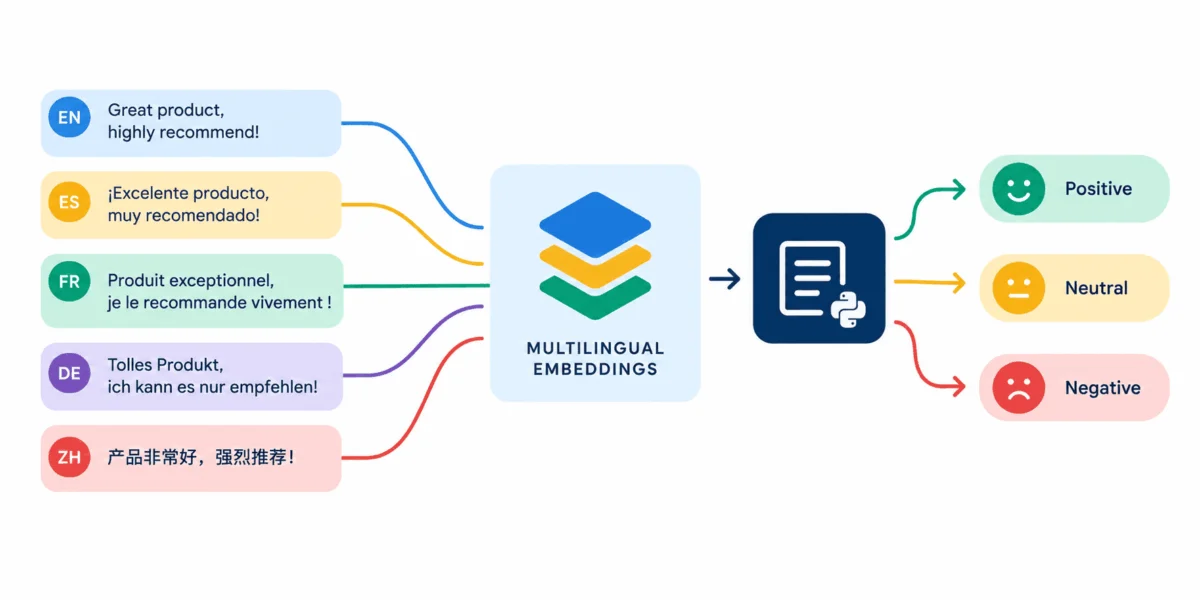

In the contemporary landscape of global commerce and digital communication, the ability to categorize information across linguistic boundaries is a critical operational requirement for enterprises and researchers alike. Traditionally, organizations seeking to deploy text classification systems for international audiences were forced to navigate the logistical complexity of training and maintaining discrete machine learning models for every individual language in their portfolio. This approach, while effective in isolation, introduced significant overhead in infrastructure management, data labeling, and model maintenance. However, the emergence of multilingual large language model (LLM) embeddings has fundamentally altered this paradigm, enabling a more efficient, "barrier-free" architecture. By leveraging numerical representations that map text from diverse languages into a unified, shared vector space, developers can now deploy a single downstream classifier capable of processing global datasets with unprecedented coherence.
The Evolution of Multilingual NLP
The history of natural language processing (NLP) in classification tasks has been marked by a transition from keyword-based frequency counting to sophisticated semantic understanding. In the early 2010s, techniques such as TF-IDF and word embeddings like Word2Vec provided the foundation for sentiment analysis and topic categorization. However, these models were largely language-specific. A system trained on English customer reviews could not natively interpret Spanish or German input without costly machine translation pre-processing, which often suffered from semantic degradation and latency.
The shift toward transformer-based architectures and, subsequently, multilingual embedding models, represents a departure from this fragmented approach. Models such as BGE-M3 (BGE Multilingual model) are pre-trained on massive corpora spanning over 100 languages. These models identify the underlying semantic intent of a sentence, effectively "translating" the conceptual meaning into a mathematical vector. Consequently, the phrase "This product is fantastic" and its Spanish equivalent, "¡Este producto es fantástico!", result in nearly identical numerical representations. This convergence allows a lightweight machine learning model—such as a logistic regression classifier or a support vector machine—to operate on the semantic vector rather than the raw text, rendering the original language irrelevant to the model’s predictive capabilities.
Technical Implementation: A Unified Pipeline
The construction of such a pipeline requires a robust integration of specialized libraries. By utilizing Scikit-LLM, developers can bridge the gap between high-performance LLM APIs and the standard Scikit-learn ecosystem. To ensure reproducibility and eliminate reliance on paid, proprietary cloud services, developers can utilize local hosting solutions such as Ollama.
The initial deployment phase involves establishing the runtime environment. This includes installing the necessary Python dependencies, such as the scikit-llm library and datasets for data management, alongside the Ollama distribution for local inference. Once the Ollama server is operational as a background process, the system can pull the BGE-M3 model. The final configuration step within the pipeline involves pointing Scikit-LLM to the local server endpoint, effectively treating the local model as a standardized interface for embedding generation.
Dataset Preparation and Analysis
A primary benchmark for testing these systems is the Amazon Multi-language Reviews dataset. This dataset is particularly well-suited for classification tasks due to its inherent 5-star rating structure, which provides a clear ground-truth label for each entry. A standard implementation utilizes a sample of 2,000 reviews, balanced equally between English and Spanish to ensure the model does not develop a bias toward the higher-frequency language.
Data management is critical in this phase. The dataset must be shuffled thoroughly to prevent the model from learning an order-based pattern—a common pitfall in machine learning pipelines. By concatenating the English and Spanish subsets into a single dataframe, researchers can create a robust training set that reflects real-world variability. Following the data preparation, the pipeline is divided into two primary stages: a vectorization stage, where text is converted into embeddings using the GPTVectorizer, and a classification stage, where a logistic regression model interprets these embeddings to predict the 5-star ratings.
Evaluating System Performance
Upon executing the pipeline and evaluating the results against a test set, the performance metrics reveal the strengths and limitations of the approach. Empirical analysis of classification reports generally shows higher precision and recall for "extreme" ratings (1-star and 5-star), likely due to the presence of highly distinctive, emotive vocabulary in those reviews. Conversely, intermediate ratings (2, 3, and 4 stars) often exhibit lower performance metrics.
This performance gap can be attributed to several factors. First, the inherent ambiguity of intermediate reviews—which often contain a mix of positive and negative sentiments—makes them harder to categorize even for human annotators. Second, the capacity of the embedding model to resolve nuances in "middle-of-the-road" feedback is constrained by the dimensionality of the vector space and the specific training objective of the LLM. Nevertheless, the overall accuracy achieved through this unified approach is often comparable to, or better than, individual monolingual models that lack the cross-lingual semantic context.
The Broader Implications for Global Enterprise
The transition to unified multilingual pipelines has profound implications for data science teams. By reducing the number of models that need to be monitored and updated, organizations can achieve a more sustainable "MLOps" (Machine Learning Operations) lifecycle. This architecture is particularly advantageous for e-commerce platforms, customer support systems, and social media monitoring tools that operate across international borders.
From a resource perspective, the ability to bypass expensive translation services is a major cost-saving measure. Furthermore, the loss of nuance that typically occurs during automated translation is mitigated because the embedding process captures meaning directly from the source language. As these multilingual embedding models continue to improve in density and accuracy, the reliance on language-specific training data will likely diminish, paving the way for "zero-shot" or "few-shot" classification systems that can be deployed for new languages with minimal additional data collection.
Future Trajectories
Looking ahead, the integration of more powerful, quantized local LLMs will likely enhance the performance of these pipelines. Current research is focused on fine-tuning the downstream classifiers to better distinguish between subtle sentiment shifts in neutral text. Furthermore, as the community develops more sophisticated evaluation frameworks, the transparency of these "black box" embedding models will improve, allowing for better error analysis and targeted data augmentation.
Ultimately, the development of a multilingual classification pipeline using Scikit-LLM and BGE-M3 demonstrates a significant shift toward modularity in AI architecture. By decoupling the semantic representation (handled by the LLM) from the predictive decision-making (handled by the classifier), researchers have created a blueprint for future-proof AI systems. This methodology not only democratizes access to complex NLP tasks but also ensures that organizations can scale their operations globally without being tethered to the constraints of traditional, language-siloed modeling techniques. As the technology matures, it will undoubtedly become the standard for any data-driven entity operating in a linguistically diverse environment.
