
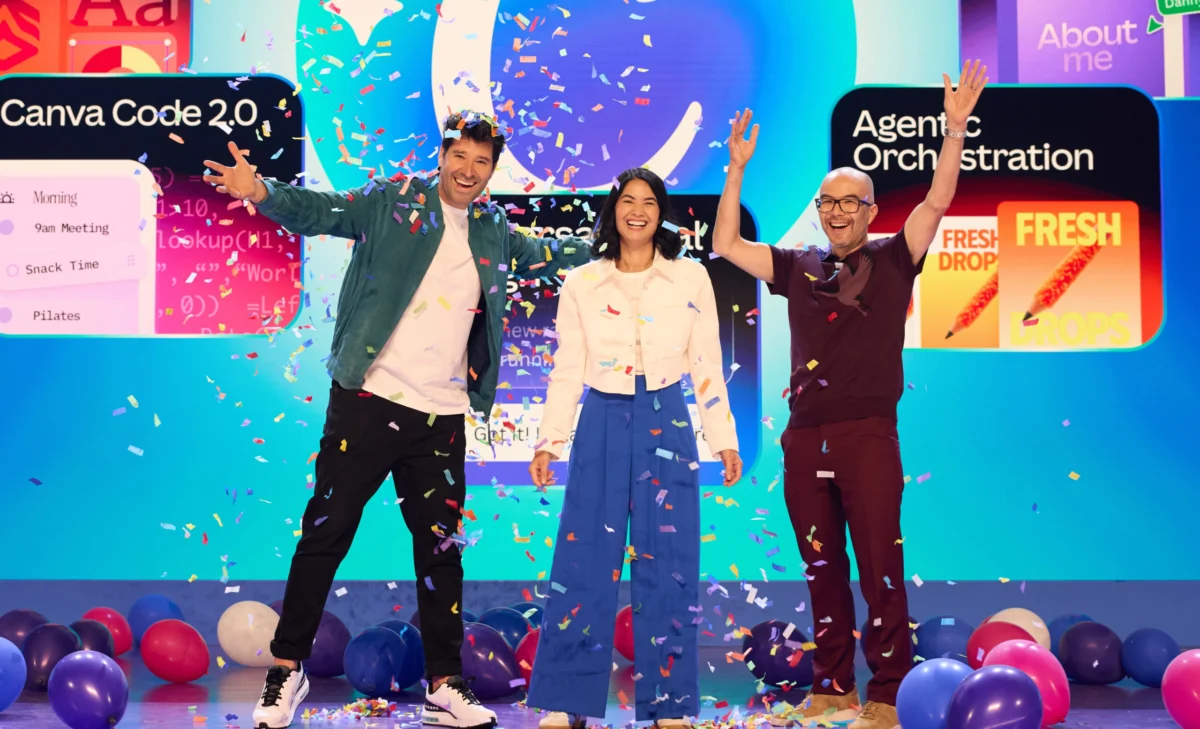

The global design powerhouse Canva has officially launched a sweeping overhaul of its platform, transitioning from a specialized visual communication tool into a sophisticated agentic automation hub designed to centralize professional workflows. Announced at the company’s annual Canva Create conference, the introduction of Canva AI 2.0 represents a strategic pivot toward "agentic AI"—systems capable of not only generating content but executing complex, multi-step tasks across a variety of third-party applications. This move positions the Sydney-based unicorn as a direct competitor to established enterprise productivity suites, aiming to simplify advanced artificial intelligence for a mass audience in the same way it democratized graphic design over a decade ago.
The cornerstone of this evolution is a fundamental rearchitecting of the Canva interface to place intelligent agents at the center of the user experience. According to Canva Co-Founder and COO Cliff Obrecht, the company’s mission remains rooted in accessibility, focusing on taking expensive, high-barrier technologies and making them intuitive for non-specialists. By integrating agentic AI, Canva seeks to provide users with a "creative partner" that understands context, manages data across platforms, and automates repetitive administrative burdens, effectively allowing the platform to serve as the primary environment where professional work occurs.
The Architecture of Canva AI 2.0
Canva AI 2.0 is built upon a five-pillar framework designed to bridge the gap between creative output and administrative productivity. This agentic architecture is powered by the proprietary Canva Design Model, a foundation model specifically trained to understand the nuances of layout, hierarchy, and visual branding. Unlike general-purpose large language models (LLMs) that focus primarily on text or basic image generation, Canva’s model is engineered to interact with the discrete elements of a design file, allowing for granular manipulation and structural understanding.
A primary feature of this new architecture is the introduction of "Connectors." These allow Canva AI to interface directly with an ecosystem of third-party applications, including Gmail, Google Drive, Slack, Microsoft 365, Outlook, HubSpot, Atlassian, Figma, Notion, and Zoom. Through these integrations, the AI can extract context from disparate sources—such as a specific thread in Slack or a calendar invitation—and automatically synthesize that information into a formatted Canva design. For example, a user can instruct the AI to review an upcoming meeting on their Google Calendar and generate a comprehensive briefing document or presentation based on the participants and linked documents, reducing the preparation time from hours to seconds.
Complementing these connectors is the "Web Research" capability. This tool enables the agent to scan the live web to gather data, competitive intelligence, or market research, which it then structures into editable content within the Canva environment. This is intended to streamline the creation of business proposals, pitch decks, and sales reports by eliminating the need to toggle between a browser and a design canvas.
Automation and Contextual Intelligence
The third pillar of the update focuses on "Scheduling" and repeatable workflows. Canva is introducing the ability for users to set up agentic tasks that run on a recurring basis. This includes the automated generation of weekly internal newsletters that pull updates from Slack and Gmail, or the creation of social media content batches that are automatically resized and translated for different regional markets. By automating these "zero-second" tasks, Canva aims to move beyond a reactive tool to a proactive assistant.
Central to the success of these agents is the "Memory Library," a contextual framework that stores user preferences, brand guidelines, and historical data. To initiate this, Canva has introduced an "About Me" document, which serves as a foundational reference point for the AI to understand the user’s role, tone of voice, and professional requirements. This memory allows the AI to provide more accurate results over time, ensuring that a marketing manager in New York and a teacher in London receive tailored outputs that align with their specific contexts.
Finally, the platform has addressed a long-standing request from its professional user base by introducing a robust "Offline Mode." Available across desktop and mobile applications, this feature ensures that users can continue working on designs without an active internet connection. Changes are cached locally and synchronized automatically once connectivity is restored, a critical update for business travelers and users in regions with inconsistent infrastructure.
Chronology of Innovation and Technical Development
The transition to an AI-first company has been a multi-year endeavor for Canva. Founded in 2013 by Melanie Perkins, Cliff Obrecht, and Cameron Adams, the company initially focused on breaking the monopoly held by complex professional design software. Over its first decade, Canva scaled to over 185 million monthly active users, but the emergence of generative AI in late 2022 necessitated a rapid technical evolution.
Two years ago, Canva began a massive "replumbing" of its organizational structure and technical stack. This included the establishment of a dedicated research division, which now comprises over 100 specialized AI researchers and scientists. While the first generation of Canva’s proprietary models took over two years to bring to market, the company has now achieved a "frontier lab" velocity. According to Obrecht, the team is currently able to train, evaluate, and deploy new models in as little as one month. This acceleration is driven by significant investments in training infrastructure and closed-loop reinforcement learning systems.
In late 2023, Canva introduced its initial AI suite, "Magic Studio," which included tools like Magic Write and Magic Switch. However, the launch of AI 2.0 represents a qualitative shift. While the previous iteration focused on isolated generative tasks, the new version is designed for end-to-end agency. Cameron Adams, Canva’s Chief Product Officer, noted that the advancements made in the last six months alone have surpassed what the company originally predicted would take five to ten years to achieve.
Supporting Data and Market Performance
Canva’s push into the enterprise sector is backed by significant usage statistics. The company reports that 100 million people currently create presentations on the platform every month. Furthermore, "Canva Docs," the company’s visual-first word processing tool, has become one of its fastest-growing product categories since its debut. This data suggests a clear trend: users are increasingly seeking tools that merge traditional productivity (text and data) with high-end creative expression.
The company’s growth remains robust in a competitive landscape. Canva recently surpassed $2 billion in annualized revenue and continues to see high adoption rates within the Fortune 500. By integrating with Anthropic’s Claude—embedding Canva’s design capabilities directly into the AI assistant—Canva is also expanding its footprint into the broader AI ecosystem, ensuring that its tools are available wherever users are interacting with intelligent systems.
Strategic Implications and Competitive Analysis
The launch of Canva AI 2.0 carries profound implications for the software-as-a-service (SaaS) industry. For years, the market has been divided between "productivity" tools (Google Workspace, Microsoft 365) and "creativity" tools (Adobe Creative Cloud). Canva is attempting to collapse this distinction. By allowing a design platform to act as an orchestrator for Gmail, Slack, and Salesforce data, Canva is challenging the dominance of traditional document-centric workflows.
Industry analysts suggest that this "contextual lock-in" is the new frontier of enterprise competition. As AI agents become more prevalent, the platform that holds the most comprehensive "memory" of a user’s work will likely become the most indispensable. Canva’s strategy of using a simple "About Me" document to build this context is a calculated move to lower the friction of AI adoption.
However, the path forward is not without challenges. Canva faces stiff competition from Adobe, which has integrated its Firefly AI across its suite, and from Microsoft, which is aggressively rolling out Copilot agents across its vast enterprise install base. The success of Canva’s agentic vision will depend on its ability to maintain its signature simplicity while handling the security and governance requirements of large-scale corporate environments.
Official Outlook and Future Directions
The leadership at Canva views the current AI 2.0 release as the "further expression" of the sweet spot between productivity and creativity. The company intends to continue expanding its library of connectors and refining the autonomy of its agents. The ultimate goal is to reach a state where complex professional outputs—such as a monthly team newsletter or a comprehensive market analysis—can be generated with "zero seconds" of manual labor through pre-scheduled agentic workflows.
As the digital landscape becomes increasingly multi-modal, Canva’s bet on visual-first communication may prove prescient. By moving beyond static templates and into the realm of active automation, the company is positioning itself not just as a tool for making things look good, but as the engine that drives how work is performed, synthesized, and communicated in the AI era. The coming months will determine if users are ready to move the center of their professional gravity from the inbox and the spreadsheet to the creative canvas.
