
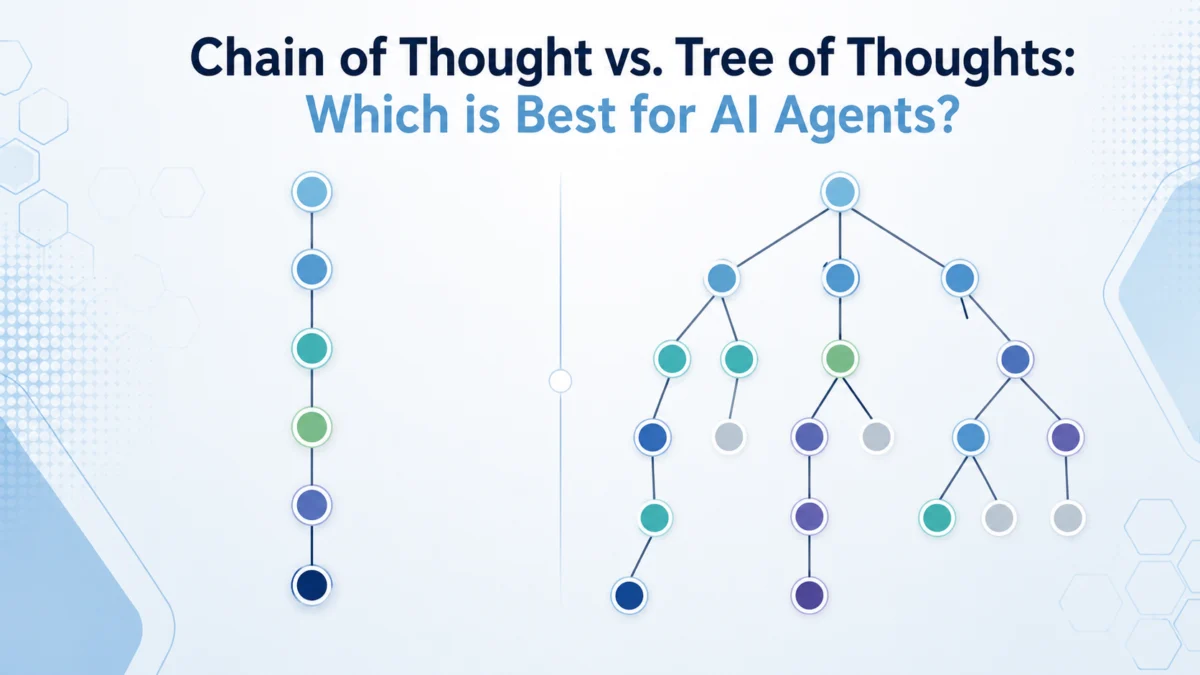

The evolution of artificial intelligence has moved beyond simple pattern matching toward sophisticated reasoning frameworks that allow large language models (LLMs) to approach complex problem-solving. As developers seek to build more autonomous AI agents capable of executing multi-step workflows, two primary methodologies—Chain of Thought (CoT) and Tree of Thoughts (ToT)—have emerged as the industry standards for enhancing model reliability. While both frameworks aim to overcome the inherent "next-token" limitations of neural networks, they offer vastly different trade-offs regarding computational intensity, accuracy, and strategic depth.
The Fundamental Constraint of Predictive Modeling
At the core of modern LLMs lies a transformer architecture designed to predict the most statistically probable next token. This probabilistic nature is highly efficient for generating human-like prose but becomes a significant liability when faced with logic-heavy tasks. Without a structured reasoning framework, a model prone to "greedy decoding" will attempt to reach a conclusion in a single, rapid trajectory.
Research from institutions such as Google DeepMind and Princeton University has demonstrated that this tendency often results in "hallucinated" logic, where the model produces a grammatically coherent output that is mathematically or logically invalid. Because the model lacks an internal mechanism to "pause" and reflect, it often commits to a flawed premise early in the generation process, which then cascades into a final, erroneous output. This phenomenon, often termed "logical drift," is the primary catalyst for the development of deliberate reasoning architectures.
Chronology of Reasoning Advancements
The shift toward structured reasoning began in earnest around 2022. The publication of the "Chain of Thought Prompting Elicits Reasoning in Large Language Models" paper by Wei et al. marked a turning point. It proved that simply prompting a model to "think step-by-step" yielded a statistically significant increase in performance across arithmetic and commonsense reasoning benchmarks.
By early 2023, the limitations of this linear approach became evident in complex coding and strategic planning tasks. This led to the introduction of Tree of Thoughts, a framework inspired by classical heuristic search algorithms used in game theory, such as Monte Carlo Tree Search. Unlike the linear chain, ToT allowed for a branching exploration of potential outcomes, marking a transition from "linear thinking" to "deliberate planning" within AI systems.
Chain of Thought: The Linear Workhorse
Chain of Thought (CoT) acts as a form of "cognitive scaffolding." By requiring the model to articulate its intermediate reasoning steps, CoT forces the transformer to allocate more compute cycles to the problem-solving phase. In a technical sense, CoT expands the latent space available for the model to process information before it arrives at a terminal token.
Technical Characteristics:
- Predictability: The process follows a singular, predictable path from premise to conclusion.
- Auditability: Because the reasoning is documented in plain text, it is highly accessible for developers attempting to debug where a model went wrong.
- Efficiency: CoT requires minimal additional latency, as it essentially extends the output length of a standard inference call.
Despite its utility, CoT suffers from an inability to self-correct. In an empirical study of model performance on the GSM8K math benchmark, CoT models demonstrated a high accuracy rate but failed consistently when a mistake was made at the very first step of a multi-part equation. Because there is no mechanism to "backtrack," the error is locked into the model’s working memory for the duration of the response.
Tree of Thoughts: The Branching Specialist
Tree of Thoughts (ToT) represents a departure from the linear paradigm by introducing a state-based approach to reasoning. In this framework, the model generates multiple potential "branches" of thought at each node. A controller or a secondary agent evaluates these branches, assigning a score based on their likelihood of leading to a correct result.
The Anatomy of a ToT Process:
- Decomposition: The problem is broken down into modular units.
- Generation: The model generates multiple candidate solutions or steps for each unit.
- Evaluation: An evaluator (often the LLM itself) assesses the quality of each branch.
- Search: Algorithms like Breadth-First Search (BFS) or Depth-First Search (DFS) are used to prune low-quality branches and prioritize high-potential paths.
This approach is computationally expensive. Where CoT might require a single prompt-response cycle, a complex ToT implementation can trigger dozens of iterative calls. However, for tasks like software architecture design, complex legal analysis, or strategic logistics, this "search" capability is indispensable. It allows the agent to simulate the consequences of an action, detect a failure state, and reset its strategy—a capability that mimics human trial-and-error.
Data-Driven Performance Implications
Comparative performance benchmarks reveal that the advantage of ToT over CoT is proportional to the ambiguity of the task. In tasks like "Game of 24"—a mathematical puzzle where four numbers must be combined to equal 24—CoT typically achieves a success rate of approximately 74%, while ToT approaches 90% accuracy.
However, the "cost-per-reasoning-cycle" for ToT is significantly higher. In enterprise environments, this manifests as a direct trade-off between latency and accuracy. A study of API usage in agentic systems suggests that for standard administrative tasks, the marginal utility of ToT is negative; the added cost of hundreds of extra tokens does not yield a performance improvement sufficient to justify the budget. Conversely, for high-stakes decision-making where a single error could cause a system failure, the cost is viewed as a necessary investment in safety.
Industry Perspectives and Implementation
Software architects and AI engineers are increasingly adopting a "tiered reasoning" strategy. In this architecture, the agent system acts as a router. Incoming requests are analyzed for complexity:
- Tier 1 (Routine): Requests such as data retrieval or simple classification are handled via standard zero-shot prompting or simple CoT. This ensures low latency and minimal cost.
- Tier 2 (Analytical): Tasks requiring multi-step logical deduction, such as summarization of complex financial reports, utilize advanced CoT with few-shot examples to maintain accuracy.
- Tier 3 (Complex): Strategic tasks, such as autonomous debugging or long-term planning, are routed to a ToT framework.
This hybrid approach allows organizations to balance the performance requirements of their agents with the practical realities of infrastructure costs and user-facing latency.
Broader Impact and Future Outlook
The maturation of these frameworks signifies a shift in how we perceive AI agents. They are no longer mere "chatbots" that provide static answers; they are becoming active, reasoning entities that perform work. The transition from linear Chain of Thought to the branching, self-correcting Tree of Thoughts represents the "agentification" of LLMs.
Looking forward, the integration of these techniques into native model architectures—rather than just as prompting layers—is the next frontier. We are already seeing research into "System 2" thinking for AI, where models are trained to pause, reflect, and verify their outputs before finalizing them. This architectural shift will likely make the distinction between CoT and ToT less about prompt engineering and more about how the model manages its own internal compute allocation.
For businesses and developers, the implications are clear: as AI moves into more critical infrastructure roles, the ability to select the right reasoning framework is a key competitive advantage. While Chain of Thought provides the foundational stability needed for daily operations, Tree of Thoughts offers the strategic depth required for the next generation of autonomous problem-solving agents. The goal remains consistent: to move from generating the most likely words to generating the most accurate outcomes.
