
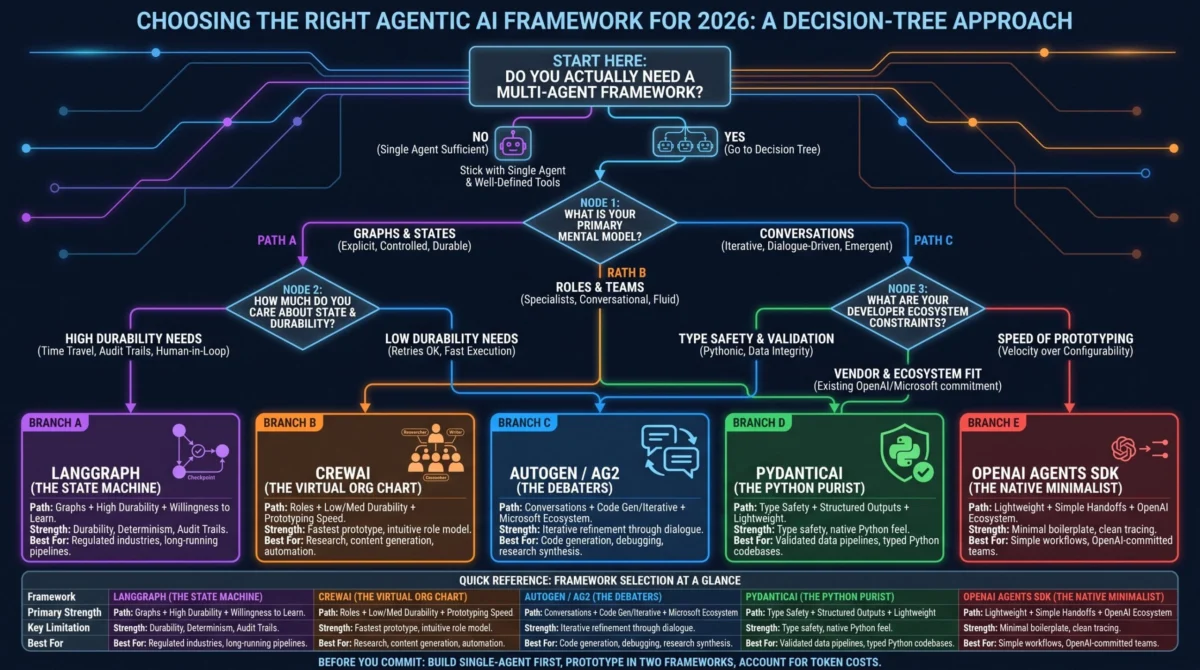

The landscape of agentic artificial intelligence has shifted dramatically over the past 36 months, evolving from the experimental "scaffolding" of 2023 into a highly stratified ecosystem of robust orchestration frameworks. As organizations move beyond initial proofs of concept, the focus has transitioned from mere functionality to the rigorous demands of production-grade software: reliability, observability, auditability, and deterministic output. Developers currently tasked with architecting these systems face a pivotal decision, as the choice of framework in 2026 will dictate the operational stability and scalability of their infrastructure for the foreseeable future.
The Evolution of Agentic Orchestration
To understand the current urgency, one must look at the chronology of the field. In 2023, the industry was defined by the rapid emergence of Large Language Models (LLMs) and the immediate desire to chain them together. Early tools were often little more than glue code, lacking the state management required for complex, multi-step processes. By 2024, the "agent" concept—autonomous entities capable of using tools and reflecting on their progress—became the industry standard.
The year 2025 marked the "Year of Production," where the limitations of early prototypes became painfully apparent. Companies attempting to deploy agents in high-stakes environments—such as financial auditing or medical diagnostics—faced significant issues with "hallucination drift" and non-deterministic behavior. Consequently, the frameworks that now dominate the 2026 market are those that prioritize structure over open-ended experimentation.
A Data-Driven Approach to Framework Selection
Most developers fall into the trap of selecting frameworks based on superficial metrics such as GitHub repository stars or trending discourse on social platforms. However, industry analysis suggests that these metrics are often decoupled from the actual performance requirements of production systems. A 2026 survey of engineering leads at Fortune 500 companies indicates that the primary cause of project failure in agentic AI is not the choice of model (LLM), but the choice of orchestration logic.
The decision-making process must begin with a fundamental audit of the workload. Data suggests that approximately 40% of projects currently utilizing multi-agent frameworks could be resolved more efficiently and with lower latency using a single, well-optimized agent. Over-engineering by introducing multiple agents adds significant overhead in token consumption, latency, and debugging complexity.
The Three Pillars of Architectural Decision-Making
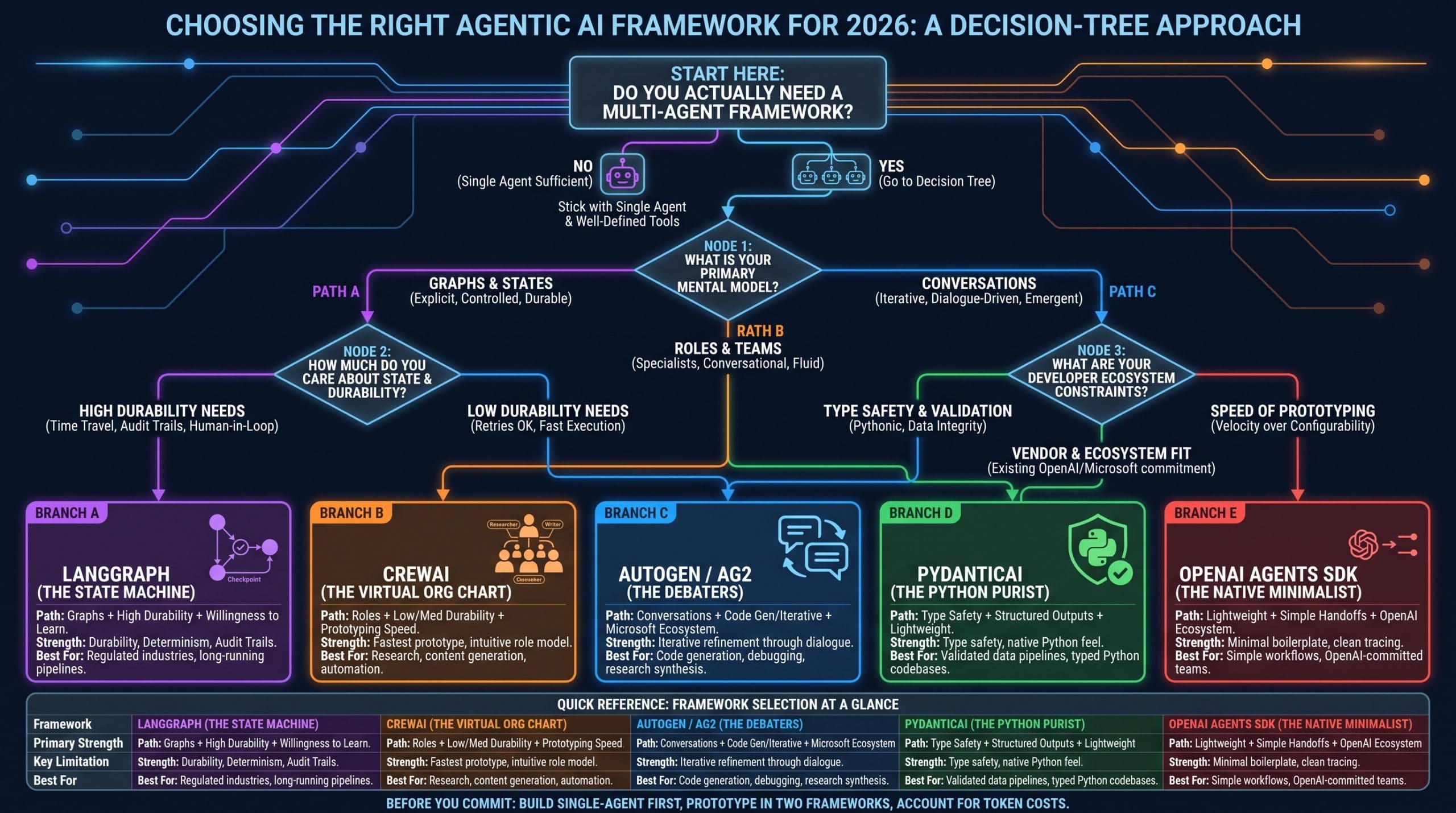
When moving to a multi-agent architecture, engineering teams must evaluate three critical nodes to ensure the framework aligns with their operational reality.
1. The Mental Model of Execution
Architectures typically fall into three buckets: graph-based state machines, role-based organizational charts, or conversational dialogue loops. Graph-based models are essential for workflows requiring strict adherence to compliance protocols, where every state transition must be logged and potentially audited. Conversely, role-based models—which simulate teams of specialists—are more effective for creative and iterative tasks where the "human-like" handoff is a feature, not a bug.
2. Durability and State Persistence
The requirement for "durability" refers to the system’s ability to pause, inspect, and resume long-running workflows. In industries where an agent’s decision has legal or financial implications, the ability to store the exact state of an agent’s memory at any given millisecond is non-negotiable. Frameworks that lack robust persistence layers are ill-suited for any task that involves high-value assets.
3. Ecosystem Alignment and Type Safety
Modern enterprise development demands strict integration with existing codebases. For teams heavily invested in Python, the ability to enforce type safety through tools like Pydantic is a significant driver of long-term maintainability. Frameworks that ignore these standards often lead to "silent failures" where data is malformed at the interface between agents.
Comparative Analysis of Leading Frameworks
The current market is dominated by five primary architectures, each serving distinct operational needs.
LangGraph: The Deterministic Standard
LangGraph has become the industry choice for regulated sectors. By modeling agents as nodes in a directed graph, it provides the "time travel" capabilities necessary for debugging and compliance. While the learning curve is steep, the ability to inject human-in-the-loop approvals at any junction makes it the most robust option for enterprise-grade automation.
CrewAI: The Prototyping Specialist
For teams that need to demonstrate value quickly, CrewAI offers a highly intuitive "virtual org chart" metaphor. Its strength lies in its speed; developers can configure agents with specific roles and goals in a fraction of the time required by lower-level frameworks. However, this ease of use comes at the cost of granular control, making it less ideal for systems where every micro-decision must be audited.
AutoGen / AG2: The Conversational Engine
Built on the premise of iterative dialogue, AG2 excels in environments where code generation and peer-review loops are required. By forcing agents to communicate until they reach a consensus, it mimics human collaborative problem-solving. It remains the preferred framework for organizations integrated into the Microsoft/Azure ecosystem, though it requires careful prompt engineering to prevent "conversational drift."
PydanticAI: The Developer’s Choice
PydanticAI represents a shift toward minimalist, library-first architecture. It does not attempt to solve the orchestration problem globally; instead, it solves the data validation problem locally. For teams that want to build their own custom orchestration layer while maintaining strict data integrity, PydanticAI is the superior choice.
OpenAI Agents SDK: The Minimalist Path
The OpenAI Agents SDK is an excellent choice for teams that are fully committed to the OpenAI API and require rapid deployment. It minimizes boilerplate code and provides excellent built-in observability. However, it introduces significant vendor lock-in, which may pose a strategic risk for companies aiming for model-agnostic infrastructure.
Implications for Future Operational Costs
A critical, often overlooked aspect of multi-agent deployment is the exponential increase in operational expenditure (OpEx). Because each agent performs its own reasoning and tool execution, token consumption can scale linearly with the number of agents in the "crew." Organizations must factor in the cost of "chatter"—the overhead tokens used for internal coordination—which can account for up to 30% of total inference costs in poorly architected systems.
Strategic Recommendations for Engineering Leads
To successfully implement agentic AI in a production environment, leadership should adhere to the following best practices:
- Iterative Complexity: Always begin with a single, highly refined agent. Only introduce multi-agent orchestration when the complexity of the workflow necessitates parallel processing or specialized domain expertise.
- Cross-Framework Validation: Before committing to a long-term architecture, perform a "bake-off" by implementing a subset of the workflow in two different frameworks. The differences in development time and debugging ease will quickly reveal the best fit for the team’s existing skill set.
- Observability First: Regardless of the chosen framework, implement comprehensive tracing from day one. In an agentic system, you cannot debug what you cannot visualize.
- Compliance-Ready Architecture: If the system handles sensitive data, prioritize frameworks that support explicit state checkpoints and audit trails. The ability to reconstruct a sequence of events after a system failure is a prerequisite for any enterprise-grade deployment.
As of 2026, the agentic AI market is no longer in its infancy. The selection of a framework is now a mature engineering decision, requiring a balance between development velocity and long-term system stability. By focusing on the specific requirements of the workload—rather than the popularity of the tool—organizations can build resilient, high-performance agentic systems capable of driving meaningful enterprise value.
