
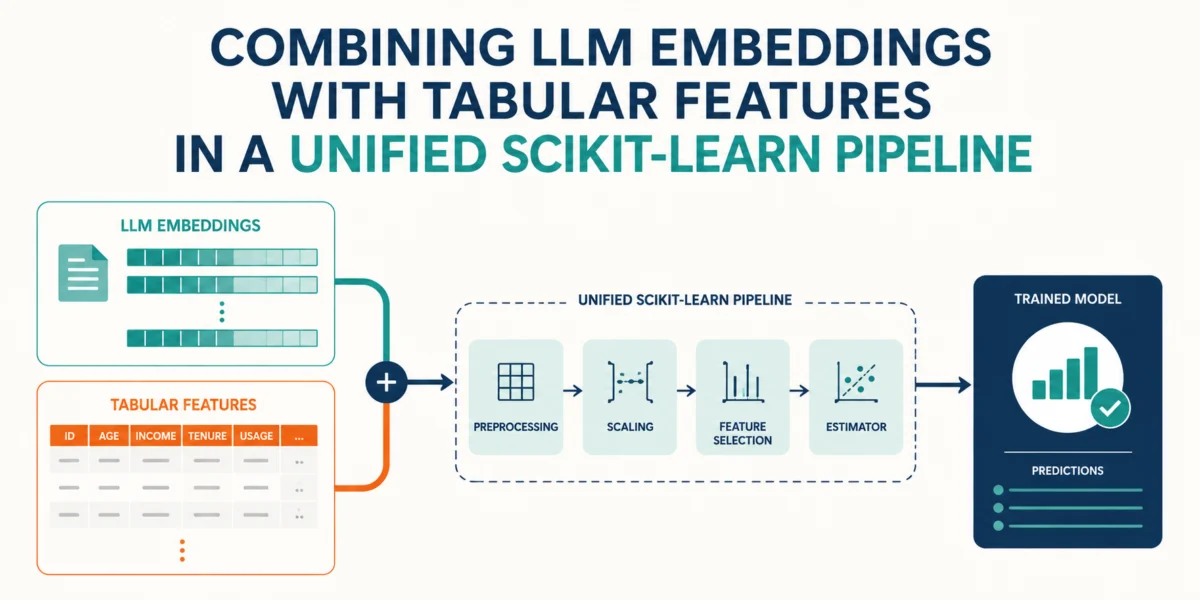

The current landscape of machine learning development is marked by a divergence between heavy-duty generative AI and the pragmatic requirements of enterprise-grade tabular classification. While Large Language Models (LLMs) have revolutionized natural language understanding, they are frequently deployed in isolation. Real-world business applications—such as automated ticket triage, customer churn propensity modeling, and fraud detection—rarely rely on text alone. They necessitate a unified architecture capable of digesting mixed data types in a single, repeatable workflow.
The Evolution of Hybrid Machine Learning Architectures
Historically, data scientists managed text and tabular features through disjointed processes. Text was traditionally processed via Term Frequency-Inverse Document Frequency (TF-IDF) or Bag-of-Words models, while tabular data underwent independent preprocessing like scaling or encoding. This fragmentation often led to "data drift" and maintenance bottlenecks during production deployment.
The emergence of the Scikit-learn ColumnTransformer provided a significant turning point in the field. By allowing developers to define independent processing branches for different data subsets within a single object, it bridged the gap between disparate data streams. The integration of modern Hugging Face sentence-transformers into this framework represents the next phase of this evolution, replacing dated bag-of-words techniques with semantically rich, high-dimensional vector embeddings.
Technical Implementation: A Methodological Overview
The process of constructing a unified pipeline begins with the ingestion of heterogeneous data. For a classification task, the model must ingest a DataFrame containing a "message" column (unstructured text) alongside features such as "account_age_days," "is_premium" status, and "priority_score."
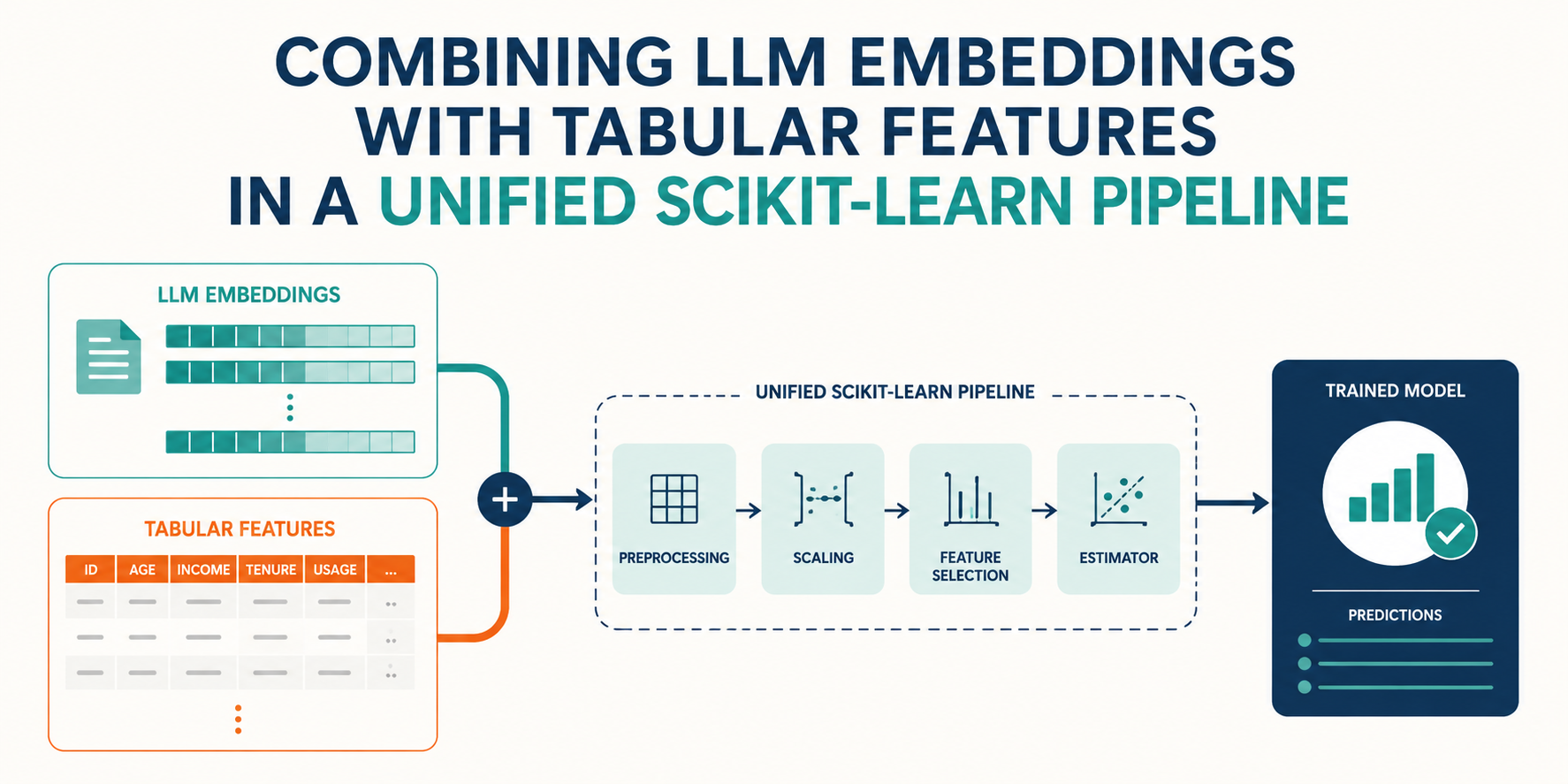
To maintain professional standards, developers utilize the BaseEstimator and TransformerMixin classes from Scikit-learn. This ensures the custom TextEmbedder behaves identically to native transformers, such as StandardScaler or OneHotEncoder. By encapsulating the model initialization within the fit method, developers adhere to the "cloning" protocols required for cross-validation and hyperparameter optimization, which are essential for rigorous model evaluation.
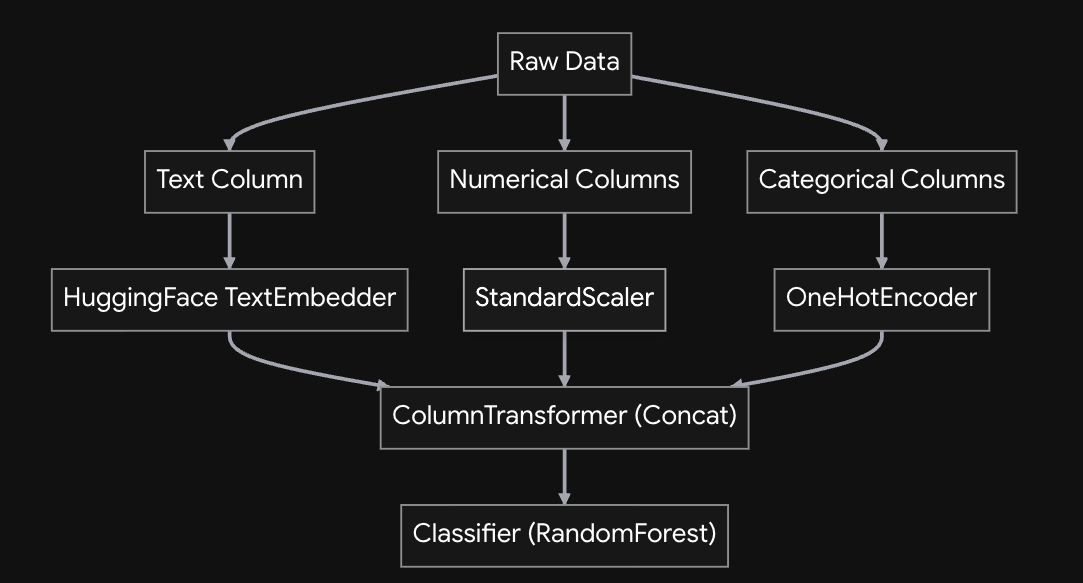
In a representative scenario, the pipeline execution follows a linear sequence:
- Feature Segmentation: The dataset is partitioned into three distinct streams—textual, numerical, and categorical.
- Parallel Transformation:
- The
TextEmbedderleverages a lightweight model, such asall-MiniLM-L6-v2, to convert raw text into a 384-dimensional vector space. - Numerical features are subjected to
StandardScalerto ensure Gaussian distribution, mitigating the impact of outliers. - Categorical variables are passed through
OneHotEncoderto convert binary or multinomial flags into machine-readable arrays.
- The
- Concatenation: The
ColumnTransformerautomatically flattens these disparate outputs into a single high-dimensional matrix. - Classification: A final estimator, such as a Random Forest or Gradient Boosting machine, consumes the concatenated features to perform the ultimate inference.
Data Integrity and the Problem of Synthetic Noise
A critical challenge in developing these models is the management of noise. In real-world data environments, features are seldom perfectly predictive. For example, while "account age" may be a strong indicator of legitimacy, spammers frequently utilize compromised, older accounts to bypass heuristic filters.
When benchmarking these pipelines, researchers intentionally introduce overlap between classes. In a study comparing hybrid models, researchers found that models relying solely on text often achieved 92% accuracy, whereas models incorporating "noisy" tabular features improved to 99%. This indicates that the synergy between structured and unstructured data provides a "cushion" for the model, allowing it to reconcile contradictory signals in the text with metadata context.
Industry Implications and Deployment Readiness
The shift toward unified pipelines has profound implications for MLOps (Machine Learning Operations). By embedding the transformer within the Scikit-learn pipeline, the entire preprocessing logic is serialized alongside the model. This eliminates the "training-serving skew"—a common failure point where the code used to process data at inference time differs slightly from the code used during training.
Furthermore, the focus on CPU-friendly models like sentence-transformers reflects an industry-wide move toward cost-efficiency. While massive models like LLaMA 3 or GPT-4 provide unparalleled depth, they introduce significant latency and infrastructure costs. For high-throughput applications like real-time spam detection, lightweight embedding models offer a superior balance of performance and resource utilization.
Expert Perspectives on Multi-Modal Integration
Industry practitioners note that the primary barrier to adoption for these unified pipelines is the complexity of managing stateful transformers. However, as documentation for the ColumnTransformer API has matured, the barrier to entry has lowered. Leading data scientists advocate for this approach, suggesting that "the future of predictive modeling is not in choosing between text or tabular, but in the intelligent fusion of both."
The ability to maintain a single object that encapsulates the entire feature engineering process—from the initial text string to the final classification probability—simplifies the CI/CD (Continuous Integration/Continuous Deployment) pipeline. It allows DevOps teams to deploy a single binary artifact that contains all the logic necessary for the model to operate in a production environment.
Future Trajectories: Towards Autonomous Pipelines
As the industry moves toward 2026 and beyond, the automation of these pipelines is likely to accelerate. Current trends suggest the integration of automated hyperparameter tuning (AutoML) directly into the ColumnTransformer workflow, enabling the model to automatically determine the optimal dimensionality of the embeddings based on the specific requirements of the dataset.
In summary, the unification of LLM embeddings with structured tabular features represents a maturation of the field. By leveraging the flexibility of the Scikit-learn ecosystem and the power of Hugging Face’s pre-trained models, organizations can build systems that are not only highly accurate but also maintainable, scalable, and resilient to the chaotic nature of real-world data. This architecture ensures that as language models continue to evolve, the underlying infrastructure of the classification pipeline remains a stable, reliable foundation for enterprise decision-making.
