
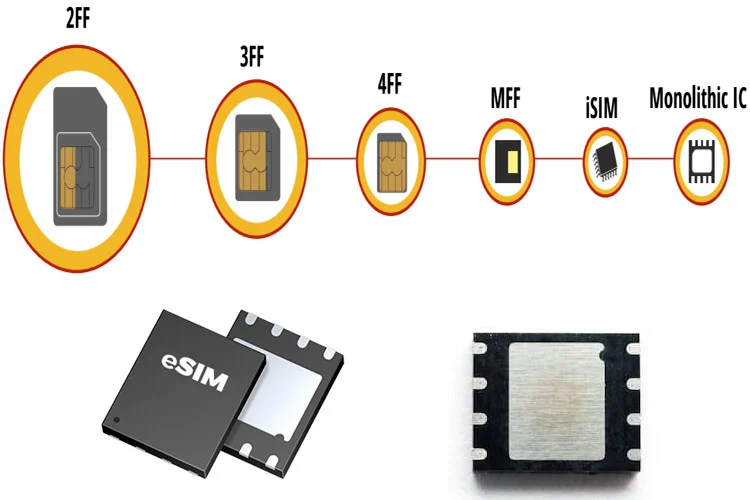

The telecommunications industry is currently undergoing a fundamental shift in how mobile connectivity is delivered and managed, driven primarily by the transition from physical Subscriber Identity Module (SIM) cards to embedded SIM (eSIM) technology. An eSIM, or embedded Universal Integrated Circuit Card (eUICC), represents the digitalization of the traditional SIM card, integrated directly into a device’s motherboard during the manufacturing process. Unlike its plastic predecessors, which required manual handling and physical slots, the eSIM is a programmable component that allows users to download and change carrier profiles over-the-air (OTA). This innovation is not merely a change in form factor; it is a structural evolution that affects device design, consumer behavior, and the logistical operations of global mobile network operators (MNOs).
The Chronological Evolution of SIM Technology
To understand the significance of the eSIM, one must look at the timeline of SIM development, which has consistently moved toward miniaturization and increased efficiency. The first SIM card was introduced in 1991 by Giesecke+Devrient for the Finnish wireless network operator Radiolinja. At that time, SIM cards were the size of a standard credit card.
As mobile devices became more compact, the industry introduced the Mini-SIM in 1996, followed by the Micro-SIM in 2003, and the Nano-SIM in 2012. Each iteration reduced the plastic footprint but maintained the requirement for a physical tray and manual insertion. The concept of the eSIM began to gain traction in the mid-2010s, primarily driven by the need for connectivity in small-form-factor devices like smartwatches and industrial Internet of Things (IoT) sensors where a traditional SIM slot was physically impractical.
In 2016, the Samsung Gear S2 Classic 3G became the first high-profile consumer device to feature an eSIM. This was followed by Apple’s integration of the technology into the Apple Watch Series 3 in 2017 and the iPhone XS lineup in 2018. A pivotal moment in the North American market occurred in 2022, when Apple released the iPhone 14 series as eSIM-only devices in the United States, effectively signaling the beginning of the end for the physical SIM tray in flagship smartphones.
Technical Mechanics: How Remote Provisioning Works
The core functionality of an eSIM relies on a technology known as Remote SIM Provisioning (RSP). In a traditional setup, the authentication keys and subscriber identity are "burned" onto the chip at the factory. With eSIM, the hardware is blank upon manufacturing.
When a user subscribes to a mobile plan, the carrier provides a digital profile. This profile is typically delivered via a QR code or an activation code that points the device to a Subscription Manager Data Preparation (SM-DP+) server. The device establishes a secure connection with this server to download the encrypted profile, which contains the International Mobile Subscriber Identity (IMSI) and the unique authentication keys required to access the carrier’s network.
One of the most significant technical advantages of the eSIM is its ability to store multiple profiles simultaneously. While only one or two profiles (depending on the device’s modem capabilities) can be active at once, a user can store half a dozen or more profiles in the device’s memory, allowing for near-instantaneous switching between different carriers or international roaming plans without needing to restart the device or handle hardware.
Strategic Advantages for Consumers and Manufacturers
The adoption of eSIM technology offers a multifaceted array of benefits that extend beyond simple convenience.
Hardware Design and Durability
For manufacturers, the removal of the physical SIM tray is a major design victory. The space occupied by a SIM slot—including the tray mechanism and the internal reader—is valuable real estate within a modern smartphone. Eliminating this component allows engineers to increase battery capacity, improve thermal management, or include additional sensors. Furthermore, removing the SIM slot removes a point of entry for water and dust, significantly enhancing the structural integrity and IP (Ingress Protection) rating of the device.
Enhanced Security
From a security perspective, eSIMs are inherently superior to physical cards. If a smartphone is stolen, a thief can easily remove a physical SIM card to prevent the device from being tracked via cellular networks. An eSIM, however, is soldered to the motherboard and cannot be removed. To change or delete the eSIM profile, a user typically needs to bypass the device’s biometric or passcode security, making it much easier for the rightful owner to locate a lost or stolen device.
Streamlined International Roaming
For frequent travelers, the eSIM eliminates the need to visit local kiosks or wait for a physical SIM card to arrive by mail. Travelers can purchase "travel eSIMs" from global providers before they even board their flight. Upon landing, the device automatically connects to the local partner network, ensuring immediate connectivity and often providing significantly lower rates than traditional roaming packages offered by home carriers.
Market Data and Industry Adoption Trends
Data from GSMA Intelligence indicates a rapid acceleration in eSIM adoption. As of late 2023, over 800 mobile operators worldwide have launched commercial eSIM services for smartphones. Market analysts project that by 2025, there will be over 2.4 billion eSIM smartphone connections globally, representing approximately 33% of the total smartphone market.
The growth is not limited to consumer electronics. The automotive industry has become one of the largest adopters of eSIM technology. Modern "connected cars" use eSIMs for emergency call systems (eCall), over-the-air software updates for engine control units, and in-car infotainment services. By using an eSIM, car manufacturers can manage vehicle connectivity across different regions using a single hardware SKU, rather than managing dozens of different physical SIM cards for different national markets.
Device Compatibility and Ecosystem Growth
While initially a feature reserved for "ultra-premium" devices, eSIM support has trickled down to mid-range hardware. Current compatible devices include:
- Apple: Every iPhone model from the iPhone XS and XR onwards, including the iPhone SE (2nd and 3rd Gen). All cellular-capable iPads since 2018 also support the technology.
- Samsung: The Galaxy S20 series and all subsequent flagship models (S21, S22, S23, S24). The Galaxy Z Fold and Z Flip series have featured eSIM since their inception.
- Google: Every Pixel smartphone since the Pixel 2.
- Wearables: The Apple Watch (Series 3 and later), Samsung Galaxy Watch (all LTE versions), and various Garmin and Huawei smartwatches.
Despite this hardware growth, consumer awareness remains a hurdle. A 2023 survey suggested that while hardware support is high, a significant portion of the consumer base still defaults to physical SIMs due to a lack of understanding regarding the digital activation process.
Step-by-Step Activation Workflow
The process of activating an eSIM is standardized but differs slightly between operating systems.
Activating on Apple iOS
- Navigate to Settings > Cellular.
- Tap Add eSIM or Set Up Cellular.
- Select Use QR Code.
- Scan the QR code provided by the carrier.
- Follow the on-screen prompts to label the plan (e.g., "Primary" or "Travel").
In some cases, carriers support "eSIM Carrier Activation," where the plan is assigned to the device based on its IMEI (International Mobile Equipment Identity). In this scenario, a notification will appear on the iPhone saying "Carrier Cellular Plan Ready to Be Installed."
Activating on Android (Google Pixel/Samsung)
- Open Settings > Network & Internet (or Connections).
- Tap SIMs or SIM Manager.
- Select Add SIM or Download a SIM instead?.
- Scan the QR code provided.
- Once the profile is downloaded, select Settings to choose which SIM to use for data, calls, and SMS.
Industry Challenges and Regulatory Perspective
Despite the clear benefits, the transition to eSIM has faced some resistance. Some carriers were initially hesitant to support eSIM because it makes "churning"—the act of switching from one carrier to another—much easier for the consumer. With a physical SIM, the friction of waiting for a new card often keeps customers from switching. With eSIM, a customer can switch providers in minutes from their living room.
Regulatory bodies in various jurisdictions, including the FCC in the United States and the European Commission, have monitored the transition to ensure that carriers do not use eSIM technology to "lock" consumers into their networks. The GSMA (the global organization representing mobile operators) has established strict standards for interoperability to ensure that an eSIM-capable device can work on any participating network.
Environmental and Economic Implications
The environmental impact of the SIM card industry is substantial. Billions of plastic SIM cards are produced annually, many of which end up in landfills. Each card is embedded in a credit-card-sized piece of plastic for shipping, leading to significant plastic waste and carbon emissions from logistics and delivery.
The shift to eSIM is a key component of the telecommunications industry’s "Green Initiative." By digitizing the subscriber profile, the industry can eliminate thousands of tons of plastic waste and significantly reduce the carbon footprint associated with the manufacturing and shipping of physical cards. Economically, carriers save on the overhead costs of maintaining physical inventory in retail stores and the postage costs of mailing cards to customers.
Future Outlook: From eSIM to iSIM
The trajectory of this technology points toward the Integrated SIM (iSIM). While the eSIM is a separate chip soldered to the motherboard, the iSIM integrates the SIM functionality directly into the device’s main processor (System on a Chip or SoC). This further reduces space requirements and power consumption, paving the way for a future where virtually every battery-powered object—from smart glasses to medical implants—can have independent, secure cellular connectivity.
In conclusion, the eSIM is more than a digital version of a plastic card; it is a transformative technology that facilitates a more flexible, secure, and environmentally sustainable mobile ecosystem. As carrier support becomes universal and consumers become more comfortable with digital provisioning, the physical SIM card will likely follow the path of the floppy disk and the CD-ROM into technological obsolescence. For the modern user, the transition offers unparalleled freedom to manage connectivity on their own terms, across a growing landscape of connected devices.
