
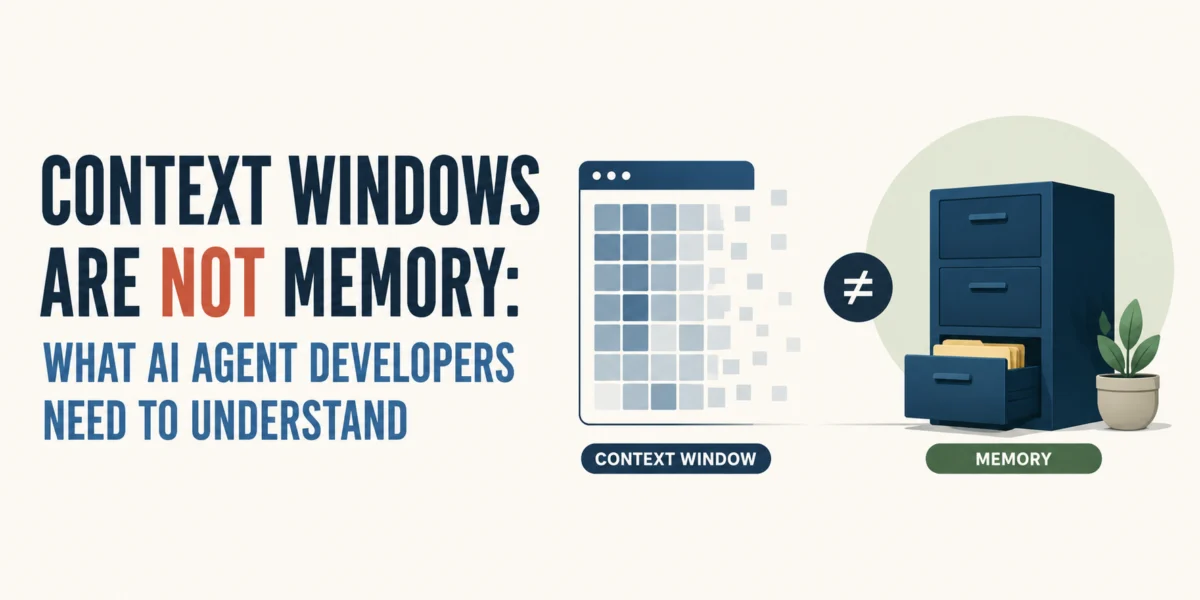

The rapid advancements in large language models (LLMs) have ushered in an era of sophisticated AI agents, capable of complex reasoning and interaction. A critical misconception, however, has emerged among developers: equating a model’s vast "context window" with genuine agent memory. While impressive, context windows—the limited input capacity allowing models to process information and prior conversation in a single pass—are fundamentally stateless scratchpads, not persistent memory. This distinction is crucial for building reliable, scalable, and cost-effective AI agents, necessitating a deeper understanding of an agent’s true cognitive stack, which integrates techniques like retrieval, compression, summarization, and robust state management.
The Evolution of Context and the Memory Misconception
Early natural language processing (NLP) models operated with extremely limited context, often processing sentences in isolation. The advent of transformer architectures, and subsequently large language models like GPT and Claude, dramatically expanded this capacity. From a few hundred tokens to hundreds of thousands, and now even millions of tokens in cutting-edge models (e.g., Anthropic’s Claude 3.1 with a 200K token context, Google’s Gemini 1.5 Pro offering 1M tokens, and even experimental versions reaching 2M), the sheer volume of information these models can "see" at once has grown exponentially.
This impressive scale has led many developers to a natural, yet flawed, conclusion: if an LLM can ingest an entire codebase, a lengthy conversation transcript, or a comprehensive user manual, it must be "remembering" it. This intuition, however, overlooks a fundamental architectural reality: every single API call to an LLM is a fresh start. The model is inherently stateless; it has no recollection of previous interactions unless that entire interaction history is explicitly re-fed into its context window with each new prompt. This is akin to an office worker clearing their entire desk after every single task, only to meticulously lay out all previous documents again for the next task, simply to "remember" what transpired.
The immediate consequence of this "re-reading" strategy, especially in long-running agentic applications, is a rapid escalation in operational costs and latency. Each subsequent turn in a conversation or a task requires re-sending the accumulated history, leading to a "snowballing" effect where prompt length grows linearly, or even exponentially, with interaction complexity. This not only consumes more API tokens (directly impacting billing) but also increases the computational load and time required for the model to process the input, degrading user experience. For instance, a complex debugging agent might need to review hundreds of thousands of tokens of code, error logs, and prior diagnostic steps at every interaction, making the process slow and prohibitively expensive.
Deconstructing the Agent’s Cognitive Stack
To overcome the inherent statelessness of LLMs and imbue AI agents with genuine, persistent memory, developers must implement a layered "cognitive stack." This stack comprises several distinct, yet interconnected, mechanisms that manage and leverage information far beyond the temporary confines of the context window.
Retrieval-Augmented Generation (RAG): The Intelligent Archivist
Retrieval-Augmented Generation (RAG) systems have emerged as a cornerstone of modern AI agent architectures, acting as an intelligent archivist for dynamic, external knowledge. Unlike a context window that merely holds transient information, RAG enables an agent to fetch specific, relevant data from a vast, persistent knowledge base "just-in-time" for a given query or task. This knowledge base can range from structured databases and document repositories to vector stores containing semantic embeddings of information.
The core mechanism of RAG involves converting user queries and relevant documents into high-dimensional numerical representations called embeddings. A vector search engine then identifies document chunks whose embeddings are most "similar" (semantically relevant) to the query. These top-K relevant chunks are then injected into the LLM’s context window alongside the user’s prompt, enriching the model’s understanding and enabling it to generate more informed and accurate responses.
However, in the dynamic, multi-turn environment of an AI agent, RAG presents unique challenges. Simple vector similarity, while powerful, doesn’t always equate to semantic truth or temporal relevance. Consider an agent managing a project schedule: a user might initially state, "Move the project deadline to end of Q3," and later, "Actually, the Q3 deadline is too aggressive; let’s aim for October 31st." A naive RAG system might retrieve both statements based on semantic similarity to a query about "project deadline," potentially leading to contradictory information being presented to the LLM.
Sophisticated RAG implementations for agents must incorporate reconciliation logic. This involves not just retrieving information but also assessing its validity, recency, and coherence. Techniques like timestamping retrieved chunks and prioritizing the most recent information, as demonstrated in the original example, are vital. Other advanced RAG strategies include:
- Hybrid Retrieval: Combining keyword search (for precise matches) with vector search (for semantic understanding).
- Re-ranking: Using a smaller, more powerful LLM or a specialized ranking model to re-evaluate the relevance of retrieved documents, going beyond initial vector similarity.
- Query Expansion/Rewriting: Using the LLM itself to rephrase or expand the user’s query to improve retrieval accuracy, especially for ambiguous or complex questions.
- Graph-based Retrieval: Leveraging knowledge graphs to retrieve not just documents but structured facts and relationships.
These enhancements transform RAG from a simple document lookup system into a sophisticated information management layer, ensuring the agent receives not just relevant data, but actionable and consistent data.
Compression: Bandwidth Optimization for the Context Window
Compression, in the context of AI agents, is a strategic bandwidth optimization technique aimed at reducing the token footprint of information while preserving its core meaning or factual content. It’s akin to zipping a large file: the data remains intact, but its size is significantly reduced for easier transmission and storage. For LLMs, this means more information can fit into the finite context window, or the same amount of information can be processed at a lower cost and latency.
Various algorithmic techniques can be employed for context compression:
- Stop-word Stripping and Punctuation Removal: Simple methods to remove non-essential tokens.
- Redundancy Elimination: Identifying and removing repetitive phrases or data points within a text.
- Specialized Compression Models: Models like LLMLingua are designed specifically to reduce token count while retaining semantic fidelity, often by identifying and pruning less critical parts of a prompt. These models analyze the input and generate a condensed version that is significantly shorter but still conveys the essential information for the main LLM to process effectively.
- Prompt Caching: Storing and reusing common prompt components to avoid re-sending them.
- Structured Data Serialization: Representing large datasets (e.g., JSON payloads from API responses) in a more compact format, possibly using schema-aware compression or by only including essential fields.
The utility of compression is particularly evident when an agent needs to process large volumes of raw data, such as API responses, verbose logs, or extensive configuration files. For example, a developer agent might receive a 15,000-token API response. Compressing this payload to 5,000 tokens ensures that the primary LLM has ample remaining context window space to perform its main task, such as analyzing the response, debugging, or generating code, without incurring excessive token costs or hitting context limits. This balance between fidelity and conciseness is key; the goal is to shrink the "physical footprint" without losing the "underlying facts."
Summarization: Abstraction for Cognitive Efficiency
While compression aims for lossless or near-lossless reduction, summarization takes a different approach: it extracts the essence of information, replacing the original data with a concise abstraction. This is an inherently irreversible, lossy process. Once summarized, the original granular detail is typically gone from the active context. This characteristic mandates a crucial architectural pattern: forked storage.
When summarization is applied, the raw, unabridged transcript or document should first be dumped into cheap, persistent "cold storage" (e.g., AWS S3 buckets, Azure Blob Storage, or basic SQL tables). Only then is the synthesized summary passed into the active prompt for the LLM. This "two-step write" ensures that if a later stage in the agent’s operation requires the full original detail, it can always be retrieved from cold storage, preventing irreversible loss of information.
Summarization techniques can be broadly categorized:
- Extractive Summarization: Identifies and extracts key sentences or phrases directly from the source text.
- Abstractive Summarization: Generates new sentences and phrases to capture the main points, often requiring a deeper understanding of the text and potentially leading to more fluent but less faithful summaries.
For AI agents, summarization is vital for managing long-running conversations or complex multi-step tasks. Instead of re-feeding an entire dialogue history, the agent can use a summary of past turns, reducing context window pressure and cost. However, the quality of the summary is paramount. A poorly summarized conversation can lead to the agent "forgetting" crucial details or misinterpreting the user’s intent. Therefore, the choice of summarization model and prompt engineering for effective summarization is critical. The trade-off is between the fidelity of the summary and its conciseness, with the forked storage pattern providing a safety net for detail retrieval when necessary.
Memory Persistence as a State Machine: The Agent as Administrator
The most critical component for true agent memory is a robust, persistent state machine. This is where the analogy of the agent as a "database administrator" rather than the "database" itself becomes most apt. A context window, even with RAG, compression, and summarization, still only provides a temporary view of information. Genuine memory requires the agent to actively interpret, structure, and store information in a durable external system.
Consider a user interaction: "My dog’s name is Goofy, but we might rename him Pluto." An agent with true memory doesn’t just process this in its context window; it recognizes the intent to update a piece of user-specific information. It then explicitly triggers a "tool-call" or API interaction to a backend system (e.g., a knowledge graph, a relational database, or a NoSQL store like Redis) to update the user’s profile with this new fact. The tool call would abstractly look something like:
  "tool": "update_entity_graph",
  "params":
    "subject": "User_Dog",
    "attribute": "Name",
    "value": "Goofy",
    "notes": "Considering Pluto"
This structured update allows the agent to maintain a consistent, evolving understanding of the user and their environment across sessions and interactions. The specific backend technology (SQL, NoSQL, graph database) is less important than the agent’s discipline in managing it.
The operational loop for an agent with persistent memory involves a crucial "query-then-commit" discipline:
- Query at the Start of Every Turn: Before processing a new user message, the agent actively queries its persistent memory (e.g., an entity graph or database) to retrieve all relevant, known facts about the user, their preferences, ongoing tasks, and historical context. This ensures the agent begins each interaction with the most up-to-date understanding of its "world state."
- Commit Updates at the End of Every Turn: After processing the user’s message, generating a response, and potentially executing tools, the agent identifies any new information or changes to existing facts. It then explicitly commits these updates back to its persistent memory via tool calls or direct database operations.
This continuous cycle ensures that the agent’s internal representation of reality remains synchronized with the external, durable memory system. This approach also allows for sophisticated memory management features, such as:
- Long-Term Memory: Storing facts that persist indefinitely.
- Episodic Memory: Storing specific past interactions or events.
- Semantic Memory: Storing general knowledge and concepts.
- Forgetting Mechanisms: Implementing policies to selectively forget or archive less relevant information, addressing privacy concerns and preventing memory bloat.
The development of robust memory persistence is arguably the most complex and critical aspect of building truly intelligent and reliable AI agents, moving them beyond mere conversational interfaces to capable, state-aware entities.
Broader Implications and the Path Forward
The distinction between context windows and true agent memory has profound implications across several dimensions:
- Economic Efficiency: Relying solely on large context windows is prohibitively expensive for complex, long-running tasks. Optimized memory management via RAG, compression, summarization, and state machines drastically reduces token usage and associated API costs. Early estimates suggest that well-implemented memory strategies can reduce operational costs by orders of magnitude for persistent agents.
- Performance and Latency: Shorter, more focused prompts enabled by effective memory management lead to faster inference times, improving the responsiveness and user experience of AI agents. In applications requiring real-time interaction, such as customer service or gaming NPCs, this is non-negotiable.
- Reliability and Coherence: Agents equipped with genuine memory are less prone to "hallucinations" or contradictory statements because they operate from a consistent, reconciled knowledge base. They can maintain conversational coherence over extended periods, remembering user preferences, past actions, and established facts.
- Scalability: External memory systems are inherently more scalable than relying on context window expansion. Databases and knowledge graphs can be sharded, replicated, and optimized independently, supporting a vast number of concurrent agent interactions.
- Ethical Considerations: Robust memory management allows for better control over data retention and privacy. Explicitly storing and managing information outside the LLM’s transient context means developers can implement clear policies for data access, modification, and deletion, aligning with regulatory requirements like GDPR.
In conclusion, while the increasing size of LLM context windows is an impressive feat of engineering, it should not be conflated with an agent’s ability to remember. The future of robust AI agents lies in a sophisticated cognitive stack that intelligently manages information flow. Developers must embrace the architectural discipline of treating the LLM as a powerful reasoning engine, not a database, and equip it with the necessary tools—retrieval systems for accessing external knowledge, compression for efficient data transfer, summarization for abstracting historical context, and persistent state machines for durable memory. By mastering these layers, we can move beyond the illusion of a giant desk and build truly intelligent agents that possess a sharp pencil, an organized filing cabinet, and the wisdom to leverage its contents optimally.
