
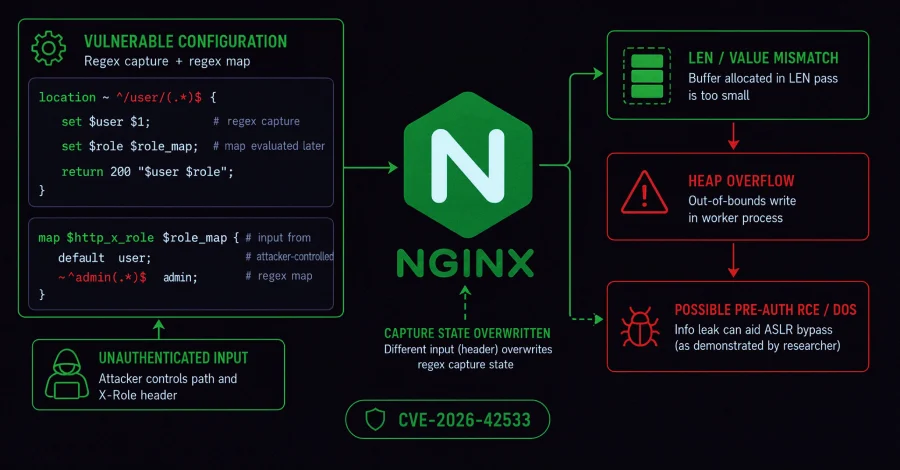

F5 has released critical security patches to address a severe heap buffer overflow vulnerability, identified as CVE-2026-42533, within the widely used Nginx web server. This flaw could allow a remote, unauthenticated attacker to trigger a denial of service (DoS) by crashing or restarting worker processes with specially crafted HTTP requests. More alarmingly, under specific conditions where Address Space Layout Randomization (ASLR) is disabled or can be bypassed, the vulnerability may also lead to remote code execution (RCE), giving attackers significant control over affected systems.
Urgent Patching Recommended for Widespread Vulnerability
The fixes were rolled out on July 15, with Nginx 1.30.4 (stable) and 1.31.3 (mainline) receiving the necessary updates. NGINX Plus customers should upgrade to version 37.0.3.1. Users operating on any earlier builds are strongly urged to upgrade immediately to mitigate potential risks. This vulnerability is not confined to recent versions; it impacts every Nginx version from 0.9.6 through 1.31.2, a remarkably broad range that stretches back to 2011, coinciding with the introduction of regex support in Nginx’s map directive. The extensive reach of affected versions underscores the critical nature of this flaw, as countless legacy systems might be running vulnerable software.
The Common Vulnerability Scoring System (CVSS) v4 rates this vulnerability at a high 9.2, while the older v3.1 scale assigns it an 8.1, both indicating a severe risk. F5 has also characterized the attack complexity as high, suggesting that exploiting this flaw might require a certain level of technical sophistication. However, the potential for remote code execution elevates it beyond a mere denial-of-service threat, making swift action imperative for system administrators globally.
Understanding the Technical Roots of the Flaw

At its core, CVE-2026-42533 stems from a heap buffer overflow embedded within Nginx’s script engine. This engine is responsible for dynamically assembling strings from directives during request processing. The vulnerability manifests under a very specific and intricate configuration: when a regex-based map directive’s output variable is referenced within a string expression, and that reference occurs after a capture from an earlier regex match.
Nginx’s script engine employs a two-pass evaluation mechanism for string processing. In the first pass, the engine calculates the required size for the resulting string and allocates a buffer accordingly. The second pass then writes the actual bytes into this pre-allocated buffer. The critical breakdown occurs because both passes read from the same shared capture state. When a map directive’s regex is evaluated between these two passes, it inadvertently overwrites this shared capture state.
Consequently, the initial measuring pass sizes the buffer based on the original capture, such as a $1 reference from a location match. However, the subsequent writing pass attempts to fill this buffer using data from a different, attacker-controlled capture. Since the attacker can manipulate the size of this second capture, the pre-allocated buffer becomes too small, leading to a heap buffer overflow. Both the length and the content of this overflow can be directly influenced by the malicious HTTP request, making it a powerful primitive for attackers.
Configuration-Dependent Exposure and Broader Product Impact
It is crucial to note that this vulnerability does not indiscriminately affect every Nginx server instance. Exposure is contingent on the server’s specific configuration, rather than solely its version. This means that even if a server is running a vulnerable version, it might not be exploitable if its configuration does not meet the precise conditions required to trigger the overflow.
F5’s advisory details that, in addition to the core Nginx server and NGINX Plus, several other F5 products are also susceptible. These include NGINX Ingress Controller, Gateway Fabric, App Protect WAF, and Instance Manager. While fixes have been released for the core Nginx server and NGINX Plus, F5 had not, at the time of publication, listed specific fixed builds for these downstream products. This gap in patching information for widely deployed F5 solutions could leave organizations using these products exposed for a longer period, necessitating close monitoring of F5’s official announcements for updates.

A Chorus of Researchers and a Deeper Dive into RCE Potential
The discovery of CVE-2026-42533 was not the work of a single entity. F5 acknowledged that more than a dozen independent researchers simultaneously brought this critical issue to their attention, highlighting the widespread scrutiny Nginx receives from the security community. The Nginx changelog specifically credits Mufeed VH of Winfunc Research and Nginx maintainer Maxim Dounin for their contributions to the fix.
Among the credited researchers, Stan Shaw, who publishes under the alias "cyberstan," provided a particularly detailed writeup that delves deeper into the exploitability of the flaw than F5’s initial advisory. While F5’s official stance conditions remote code execution on ASLR being disabled or bypassable, Shaw’s analysis contends that the vulnerability itself provides a reliable method to bypass ASLR.
Shaw explained to The Hacker News that the capture clobbering mechanism not only enables the overflow but also works in reverse. When the clobbered capture is smaller than the original, the oversized buffer that was initially allocated for the larger capture ends up returning uninitialized heap data. Shaw’s research indicates that on a default Ubuntu 24.04 build, a single unauthenticated GET request can be leveraged to recover the memory addresses necessary to construct an effective RCE payload.
"A reader of the F5 advisory could reasonably conclude this is DoS-only on default systems. It is not," Shaw asserted, challenging the perceived severity. He claimed a 10 out of 10 success rate in his own testing for achieving RCE. To prevent immediate weaponization, Shaw is currently withholding the full exploitation details and a proof-of-concept (PoC). This responsible disclosure practice aims to give organizations a crucial window to patch before exploit code becomes publicly available.
Mitigation Strategies: The Only Complete Solution is an Upgrade

Given the severity, the primary and most robust mitigation is to upgrade Nginx to the patched versions: 1.30.4 or 1.31.3, or NGINX Plus 37.0.3.1. For organizations unable to immediately deploy these patches, F5 suggested a temporary workaround: switching affected regex maps to use named captures instead of numbered captures. Shaw confirmed that this mitigation largely closes the main exploitation path for most configurations.
However, Shaw also pointed out a significant limitation to this temporary fix. He discovered a narrower, secondary code path that still leads to the same overflow, even when using named captures. This occurs if a map directive defines the same named group as the location regex. He confirmed this bypass using AddressSanitizer, noting that F5’s advisory does not mention this specific variant. "Upgrading to 1.30.4 / 1.31.3 is the only complete fix," Shaw emphasized, underscoring the inadequacy of partial mitigations against a sophisticated attacker.
Identifying Vulnerable Configurations with Precision
System administrators looking to identify if their Nginx configurations are vulnerable should specifically search for a narrow pattern: a regex-based map whose variable is used in a string expression alongside a numbered capture (e.g., $1, $2) from an earlier regex, with the numbered capture being written before the map variable.
To assist in this crucial identification process, Stan Shaw has released his own Config Scanner tool on GitHub (0xCyberstan/CVE-2026-42533-Config-Scanner). This scanner automates the process of checking Nginx configurations, following include directives, and specifically flagging only those orderings that are exploitable. It is important to remember that this tool is designed solely for identification and does not contain any exploitation capabilities.
A Disturbing Pattern: Nginx’s Two-Pass Engine Under Scrutiny

This latest vulnerability marks a concerning trend, as it is the third heap overflow flaw discovered in Nginx’s expression-evaluation code within approximately two months. This sequence of vulnerabilities suggests a fundamental weakness in a core component of the web server.
The previous incidents include:
- Rift (CVE-2026-42945): Disclosed in May, this vulnerability was quickly exploited in the wild, serving as a stark reminder of how rapidly critical flaws can be weaponized once public.
- Overlapping-captures bug (CVE-2026-9256): Discovered just days after Rift, this flaw resided in the rewrite module and presented another heap overflow risk.
All three vulnerabilities share a common architectural weakness: Nginx’s two-pass script engine. This design attempts to size a buffer in one pass and then write data into it in a subsequent pass. In each case, a subtle manipulation or unexpected state change between these two passes causes the write operation to exceed the measured buffer size. While the specific triggers differ – a stale flag in Rift, overlapping captures in the rewrite bug, and clobbered capture state in CVE-2026-42533 – the underlying problem remains the same: a two-pass design that, under specific conditions, over-trusts its initial measurement.
The Race Against Exploitation: Act Now
As of July 20, CVE-2026-42533 had not yet been added to CISA’s Known Exploited Vulnerabilities catalog, nor had any public exploit code appeared. However, the timeline of previous Nginx vulnerabilities, particularly Rift, offers a cautionary tale. Rift’s exploit code became public within days of its disclosure, leading to active exploitation shortly thereafter. Stan Shaw’s intention to publish his proof-of-concept 21 days after the patch date means organizations have a limited window to upgrade before the threat escalates.
The Hacker News reached out to F5 for clarification on whether the named captures mitigation fully addresses CVE-2026-42533, given the variant documented by Shaw, and for an update on when fixed builds for the affected downstream products would be shipped. F5 had not provided a response by the time of publication. This lack of immediate clarity from the vendor further emphasizes the need for organizations to prioritize upgrading to the fully patched Nginx versions as the most secure and complete resolution. The potential for unauthenticated remote code execution on a widely deployed web server makes this a critical security event that demands immediate attention from IT and security teams.
