

The rapid proliferation of autonomous AI agents has fundamentally altered how organizations interact with web-based data, but this shift has brought a hidden fiscal challenge: the "token tax." As AI agents increasingly rely on recursive search queries, file retrievals, and complex reasoning loops, the sheer volume of data fed into large language models (LLMs) has begun to impact operational budgets. A simple search query that would take a human seconds to process can, for an AI agent, involve pulling in voluminous logs, nested JSON objects, and metadata-heavy payloads, all of which consume precious context window space and incur significant per-token costs.
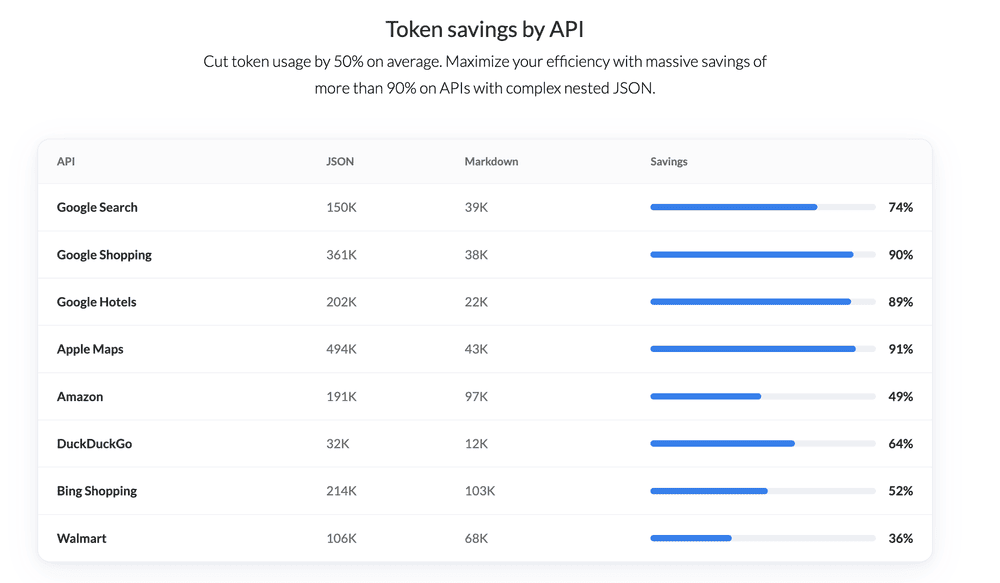
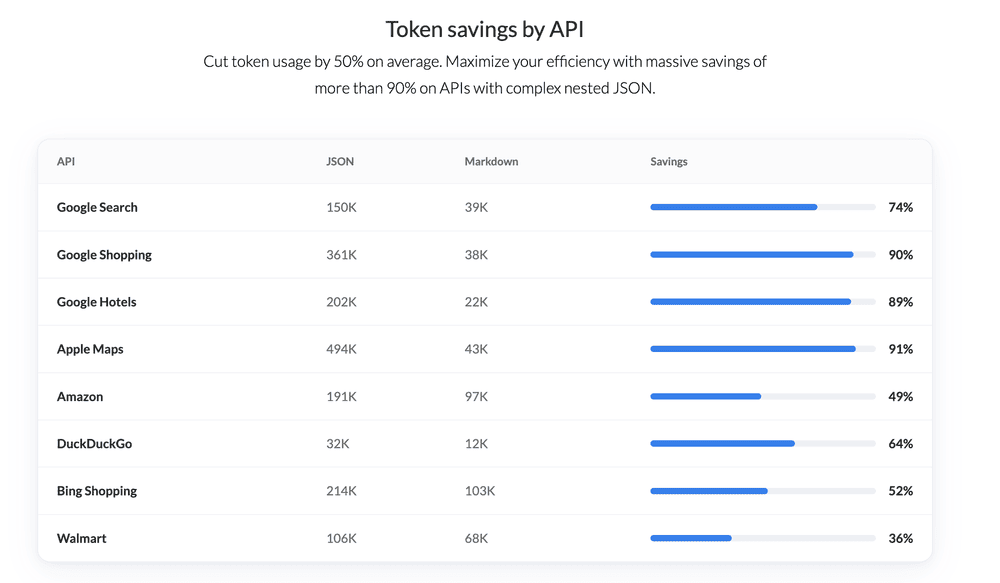
In response to this growing inefficiency, developers are shifting toward optimized data delivery formats. Recent benchmarks from SerpApi, a leading provider of search engine scraping services, indicate that transitioning from traditional JSON outputs to Markdown-formatted responses can reduce token consumption by as much as 74 percent. This technical shift represents a critical juncture in the evolution of AI infrastructure, where data structure is becoming as vital as the algorithms themselves.
The Anatomy of Token Bloat in AI Agents
To understand the scale of the problem, one must first recognize the nature of LLM consumption. Models like GPT-4, Claude, and Gemini process information as tokens—segments of characters that serve as the fundamental unit of measurement for both input (context) and output (generation). When an AI agent performs a search, it typically receives a response in JSON (JavaScript Object Notation). While JSON is the gold standard for software engineering and API interoperability, it is inherently verbose.
A standard JSON payload includes structural elements—curly braces, bracketed arrays, key-value pairs, and extensive metadata—that are essential for programmatic parsing but largely redundant for an LLM’s reasoning process. For instance, an AI agent tasked with finding local coffee shops does not need the raw tracking links, server-side timestamps, or internal class identifiers that accompany a standard search result. Yet, because these characters exist in the text stream, they consume tokens.
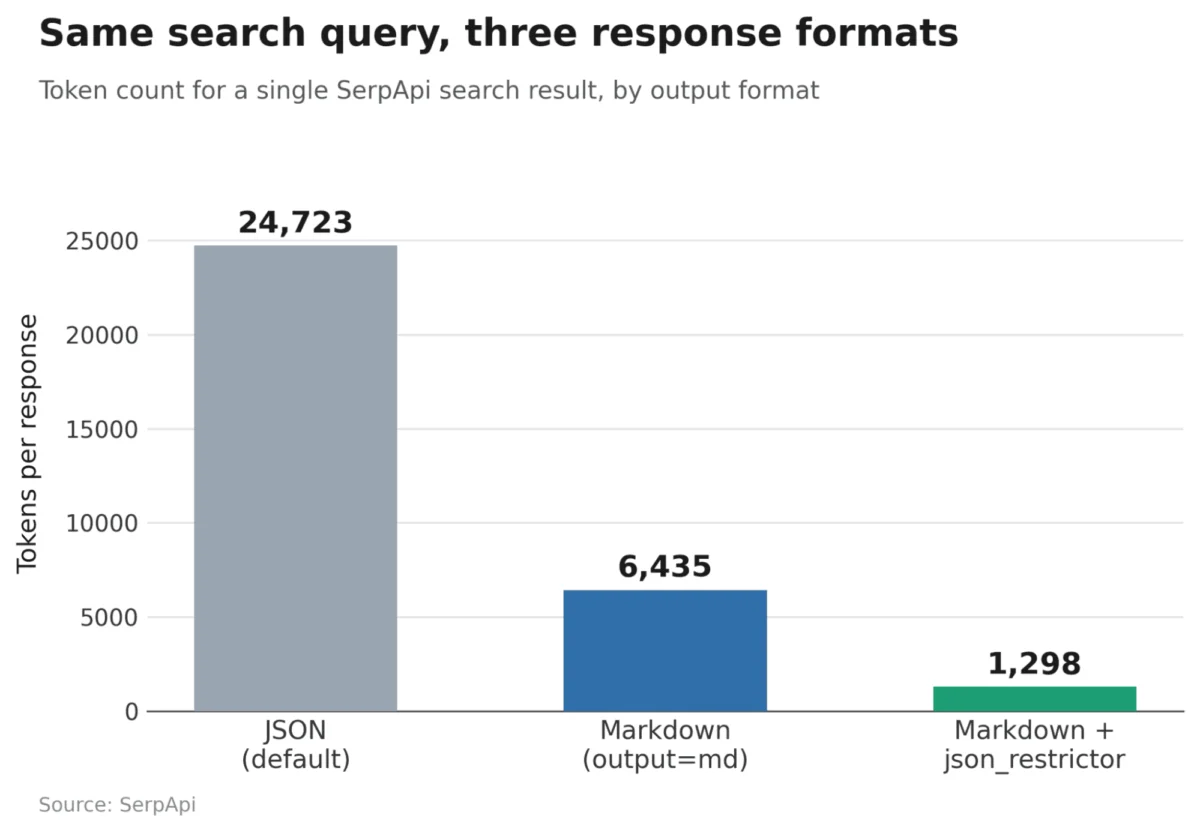
In a recent demonstration, a query for "coffee" yielded a JSON payload of 24,723 tokens. When the same search was executed with the new Markdown output feature, the token count plummeted to 6,435. By stripping away non-essential structural noise, the data becomes more "dense" with information, allowing the model to focus on the semantic content—the actual search results—rather than the syntax of the delivery format.
Chronology of the Shift Toward LLM-Optimized Data
The rise of LLM-native development has occurred in three distinct phases over the past 24 months.
- The Discovery Phase (2022–Early 2023): Developers began building basic agents using standard APIs. During this time, high costs were dismissed as the "price of innovation." Data formatting was rarely a priority, as context windows were small and the primary bottleneck was model capability rather than context length.
- The Context Expansion Phase (Mid-2023–Early 2024): With the introduction of models featuring 128k, 200k, and even 1M+ token context windows, the issue shifted from "will it fit?" to "how much does it cost to fill?" Organizations began realizing that filling a large context window with low-quality, verbose data was not only expensive but could actually degrade model performance, a phenomenon known as "lost in the middle" or retrieval dilution.
- The Optimization Phase (Present): The current era is defined by extreme efficiency. Companies are now implementing middleware and data-shaping layers to ensure that every token provided to an LLM contributes to the reasoning process. The introduction of Markdown-based API outputs is a direct byproduct of this requirement.
Comparative Analysis: JSON vs. Markdown
The decision between JSON and Markdown for AI agents is not a matter of one being universally superior to the other; rather, it is a choice based on the specific architecture of the pipeline.
JSON: The Structural Powerhouse
JSON remains the industry standard for backend systems that require strict typing. If an application needs to store specific numerical values—such as a product price as a floating-point number, or a geographic coordinate as a latitude/longitude pair—JSON ensures that data remains consistent and machine-readable. In these scenarios, the overhead of the JSON structure is a necessary trade-off for data integrity.
Markdown: The Cognitive Optimizer
Markdown is designed for human readability, which, by extension, makes it highly effective for LLMs. Because LLMs are trained extensively on text-heavy, human-authored content, they excel at interpreting Markdown tables, lists, and headers. By converting search results into Markdown, a service effectively performs a "pre-processing" step that translates raw data into a narrative or structured format that the model can parse with minimal cognitive load.
The impact of this optimization extends beyond mere cost reduction. By reducing the input token count, developers can effectively "fit" more information into a single context window. This allows agents to perform more complex multi-step reasoning tasks without hitting the model’s limit, thereby improving the overall reliability of the agentic system.
Implications for AI-Driven Enterprise Architecture
The move toward token-efficient data delivery has significant implications for enterprise AI deployment. As businesses scale their AI agent fleets, the cumulative cost of search-related API calls can reach thousands of dollars per month. If a company can reduce that spend by 70 percent through simple formatting changes, the ROI on their AI initiatives increases substantially.
Furthermore, the "noise" reduction provided by Markdown formatting has been shown to improve model accuracy. When an LLM is forced to parse through thousands of tokens of tracking data and internal metadata, the signal-to-noise ratio drops. By isolating the relevant information—the product names, descriptions, and URLs—the model is less likely to become distracted by non-functional data, potentially reducing the incidence of hallucinations or irrelevant reasoning.
Strategic Recommendations for Developers
For organizations looking to integrate these efficiencies into their current workflows, the path is relatively straightforward. The most effective strategy involves a tiered approach:
- Audit Current Consumption: Before implementing changes, teams should perform a baseline audit of their API calls. By tracking token usage per request, developers can identify which queries are the most "expensive" and prioritize those for optimization.
- Implement Server-Side Filtering: Tools such as SerpApi’s
json_restrictorallow for field-level control before the data even reaches the application layer. By requesting only the specific keys necessary for the task (e.g.,title,snippet,link), developers can drastically prune the payload size. - Adopt Format-on-Demand: Use JSON for data-heavy, analytical tasks and transition to Markdown for retrieval-augmented generation (RAG) and agentic workflows where the LLM is the primary consumer.
- Monitor Token Delta: Continuous monitoring is essential. As models evolve and API providers update their endpoints, the "token cost" of a query can fluctuate. Maintaining a dashboard to monitor these metrics ensures that cost-saving measures remain effective over the long term.
The Road Ahead
As AI agents become increasingly autonomous, the industry is moving away from the era of "brute force" data processing toward an era of "intelligent data delivery." The ability to tailor the shape of information to the specific needs of the consumer—whether that consumer is a database, a UI, or an LLM—will be a defining characteristic of high-performing AI systems.
The adoption of Markdown as an output standard is likely only the beginning. We can anticipate future developments where APIs offer dynamic, context-aware data delivery, where the model itself requests the specific level of detail it requires for a given task. Until then, the transition to lean, human-readable data formats provides a clear, actionable path for developers to enhance performance, reduce costs, and build more efficient agentic systems. In an ecosystem where every token counts, the structure of data has officially become the most valuable real estate in the AI stack.
