

The foundational architecture of the modern internet often remains invisible to everyday users, yet every digital interaction—from streaming video and mobile banking to enterprise resource planning—depends entirely on hardware residing somewhere in the physical world. While the terms "virtual server" and "physical server" are frequently discussed in enterprise technology boardrooms, they do not denote a state of tangible versus intangible existence. Instead, they describe how computational machinery is structured, allocated, and managed to meet the relentless demands of global data consumption.
Understanding the distinction between these two infrastructural paradigms has become critical for Chief Information Officers (CIOs), systems architects, and business leaders alike. As global data generation continues to surge—projected by market analysts to exceed 180 zettabytes globally—organizations must carefully weigh the architectural, financial, and operational trade-offs of bare-metal physical servers versus agile virtual machines (VMs).
The Evolution of Server Architecture: A Chronological Overview
To fully comprehend the contemporary debate between physical and virtual servers, it is necessary to examine the historical trajectory of enterprise computing over the past three decades.
During the late 1990s and early 2000s, enterprise IT was defined almost exclusively by physical infrastructure. Organizations purchased dedicated, rack-mounted hardware—often referred to as bare-metal servers—to run specific applications, host internal databases, or serve corporate websites. In this era, the standard industry practice involved over-provisioning hardware. Because a single physical server typically ran only one operating system and a limited set of applications to ensure stability, hardware utilization rates often hovered between 10% and 15%. This meant organizations were investing massive capital expenditures (CapEx) in physical machinery that sat largely idle most of the time, consuming floor space, electricity, and cooling resources in dedicated on-premises server rooms.
The paradigm shifted dramatically in the mid-2000s with the mainstream commercialization of server virtualization, pioneered heavily by companies like VMware. By introducing a hypervisor—a thin layer of software that abstracts the physical hardware—IT administrators could suddenly slice a single physical server into multiple isolated virtual machines. Each VM operated with its own operating system and dedicated resource allocations of CPU, RAM, and storage. This breakthrough revolutionized enterprise computing, allowing companies to drastically reduce hardware footprints, lower energy consumption, and maximize server utilization rates to 70% or higher.
By the early 2010s, the rise of hyperscale cloud computing providers—including Amazon Web Services (AWS), Microsoft Azure, and Google Cloud Platform—cemented virtual servers as the default engine of the digital economy. Today, virtual machines drive the vast majority of global server workloads, enabling startups and multinational corporations alike to scale computing resources up or down dynamically with just a few clicks.
Defining the Contenders: Physical Servers
Despite the dominance of cloud computing and virtualization, physical servers remain a cornerstone of modern IT infrastructure. A physical server is a tangible machine comprising a chassis, central processing units (CPUs), graphics processing units (GPUs), random-access memory (RAM), local storage drives, power supply units, and network interface cards. These machines run an operating system and application software designed explicitly to serve other computers across a network—functioning as web servers, database hosts, or enterprise resource hubs.
Key Characteristics and Architectural Advantages
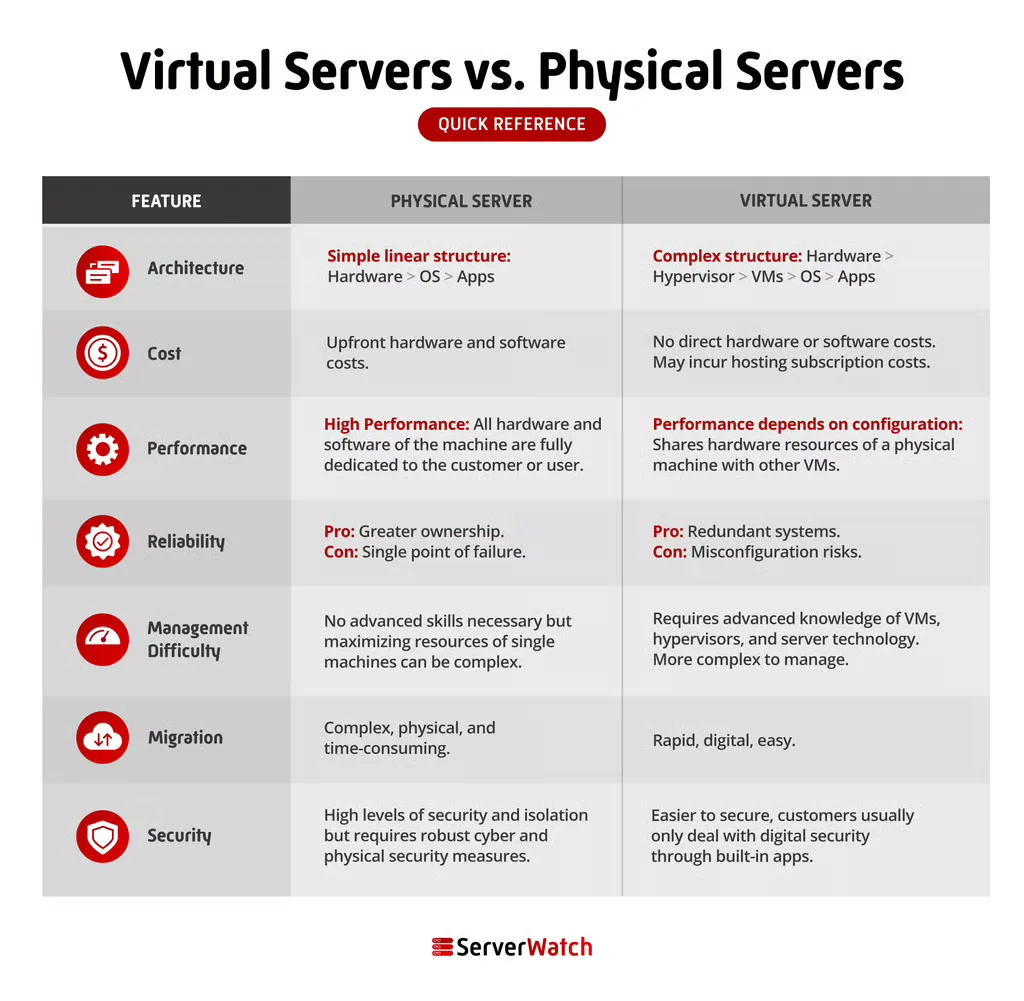
The defining characteristic of a physical server is absolute resource exclusivity. Unlike virtual environments where resources are shared or pooled, a bare-metal server dedicates 100% of its computational power, memory bandwidth, and I/O throughput to the tenant or application running directly on its hardware.
Key attributes of physical servers include:
- Maximized Performance: Without the slight overhead introduced by a virtualization hypervisor, bare-metal servers deliver raw, unmitigated processing speeds. This makes them ideal for compute-intensive tasks such as complex financial modeling, high-performance computing (HPC), and massive relational databases.
- Enhanced Security and Isolation: Because there are no neighboring virtual machines sharing the same hardware substrate, the attack surface is significantly reduced. Multi-tenancy vulnerabilities, such as potential hypervisor escapes or cross-VM side-channel attacks, are entirely eliminated.
- Hardware Control: Administrators retain granular, low-level control over firmware, hardware configurations, and component selection, allowing for highly customized deployments tailored to exact enterprise specifications.
Primary Use Cases and Industry Adoption
While virtualization handles the bulk of routine workloads, physical servers are deployed strategically for applications that demand uncompromising reliability and performance. Prominent use cases include:

- High-Transaction Databases: Organizations running massive, latency-sensitive transactional databases often rely on bare-metal architecture to prevent performance degradation.
- Regulatory Compliance Workloads: Highly regulated sectors—such as financial services, healthcare, government defense, and aerospace—frequently utilize physical servers to meet stringent data isolation and sovereignty mandates.
- Legacy Applications: Certain enterprise applications cannot easily be containerized or virtualized without breaking dependencies, requiring dedicated physical hardware to remain operational.
Defining the Contenders: Virtual Servers
A virtual server, or virtual machine (VM), is a digital emulation of a physical computer system. Operating via software known as a hypervisor, a virtual server utilizes a fraction of a physical machine’s overall resources to create a self-contained, isolated operating environment.
To visualize this architecture, consider a state-of-the-art rack-mounted physical server equipped with massive processing power, extensive memory arrays, and high-speed storage. Rather than dedicating this entire machine to a single client or application, virtualization allows an operator to divide the hardware into dozens of discrete virtual servers. Each VM receives an allocated share of CPU cores, memory, and storage, functioning as an independent entity complete with its own operating system and software stack.
Key Characteristics and Architectural Advantages
Virtual servers have fundamentally transformed how organizations procure, deploy, and manage IT infrastructure. Their primary advantages include:
- Agility and Rapid Deployment: While provisioning a physical server can take weeks or months due to hardware procurement and shipping delays, a virtual server can be spun up, configured, and deployed via software APIs in a matter of minutes.
- Cost Efficiency and OpEx Model: By consolidating multiple workloads onto a single physical chassis, organizations achieve massive economies of scale. Furthermore, virtual servers hosted in the cloud shift expenses from capital expenditure (CapEx) to operational expenditure (OpEx), allowing businesses to pay only for the resources they consume.
- Simplified Migration and Disaster Recovery: Because virtual servers exist essentially as software configurations, they can be easily backed up, snapshotted, and migrated from one physical host to another with minimal downtime. This capability underpins modern disaster recovery and business continuity strategies.
Primary Use Cases
The versatility of virtual servers has made them ubiquitous across virtually every industry and consumer-facing digital service. Common applications include:
- Web Hosting and Application Development: Developers frequently spin up virtual servers in test environments to write, debug, and deploy software applications quickly.
- Enterprise IT and Scalable Workloads: E-commerce platforms, customer relationship management (CRM) systems, and enterprise resource planning (ERP) software rely heavily on VMs to scale resources dynamically during peak traffic periods.
- Virtual Desktop Infrastructure (VDI): Organizations utilize virtual servers to stream secure, centralized desktop environments to remote employees, regardless of the end-user’s physical hardware.
Comparative Analysis: Physical vs. Virtual Servers
When evaluating infrastructure strategies, IT decision-makers must weigh several critical operational dimensions.
Cost and Financial Implications
While virtual servers typically require lower upfront investments and reduce ongoing maintenance burdens—since cloud vendors handle hardware failures, power costs, and physical security—they can become expensive at massive, sustained scales. Conversely, physical servers demand significant initial capital outlays for hardware procurement, specialized data center housing, and internal engineering talent for maintenance and physical repairs, yet they can offer predictable, lower long-term costs for stable, high-intensity workloads.
Performance and Resource Management
Performance outcomes depend heavily on workload architecture. Bare-metal physical servers consistently outperform virtual servers in raw, unthrottled computational tasks because they bypass hypervisor overhead. However, modern virtualization technologies have narrowed this performance gap significantly, and virtual servers offer superior resource elasticity, allowing organizations to dynamically reallocate computing power based on fluctuating real-time demand.
Management and Operational Complexity
Managing physical infrastructure requires hands-on labor, including physical hardware replacements, firmware updates, cabling, and environmental monitoring within a data center. In contrast, virtual servers—particularly those managed through public cloud providers—abstract away underlying hardware complexities, allowing IT teams to focus entirely on software management, security patching, and application deployment.
Strategic Implications for Modern Enterprises
The debate between physical and virtual servers is no longer a binary choice where one technology entirely supersedes the other. Instead, modern enterprise architecture increasingly relies on a hybrid approach.
Market data indicates that while over 80% of enterprise server workloads run on virtualized or cloud environments, bare-metal physical servers continue to experience steady demand, particularly for specialized workloads involving artificial intelligence (AI) training, machine learning (ML), intensive data analytics, and strict regulatory compliance frameworks.
Ultimately, the optimal server strategy depends on an organization’s specific operational requirements. Enterprises prioritizing agility, rapid scalability, and reduced infrastructure overhead will find virtual servers to be the superior vehicle for growth. Meanwhile, organizations requiring uncompromising computational performance, airtight data isolation, and absolute hardware ownership will continue to rely on the enduring power of physical, bare-metal servers.
