
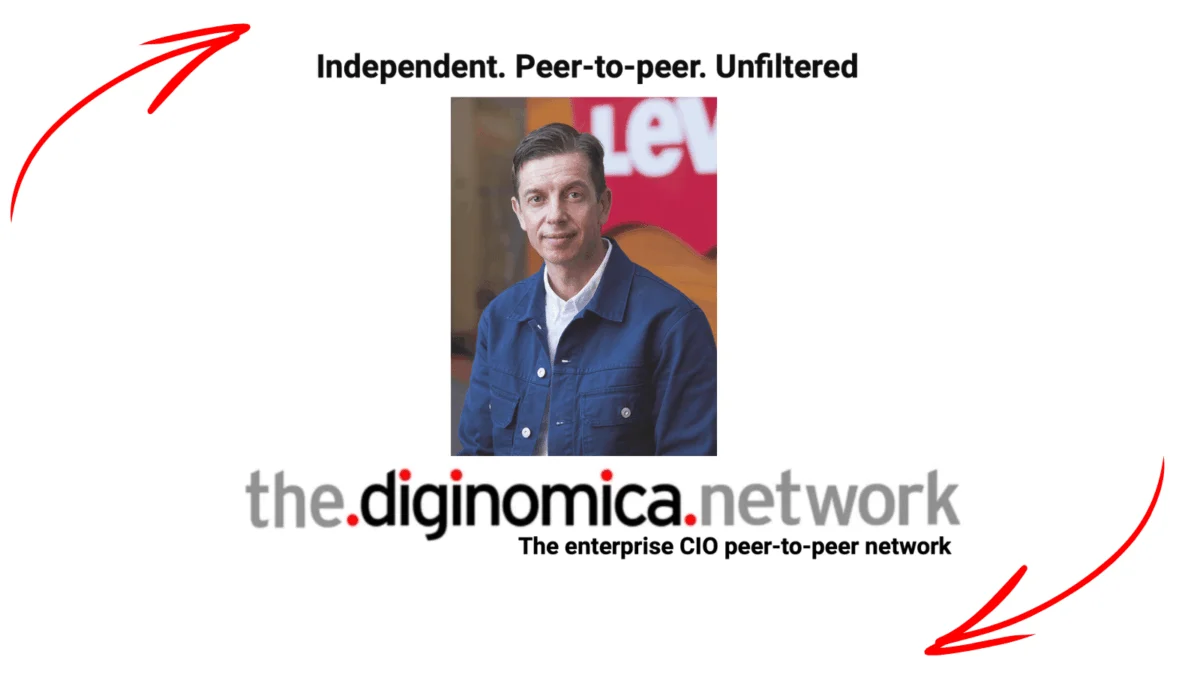

Levi Strauss & Co., the iconic denim and apparel manufacturer born out of the San Francisco gold rush 170 years ago, is undergoing a modern technological gold rush of its own. Faced with the demands of a fast-paced global retail market, the company has spent the last three years executing a sweeping digital transformation strategy. Central to this modernization effort is a foundational overhaul of its enterprise resource planning (ERP) systems, the consolidation of disparate data pipelines, and the strategic deployment of agentic artificial intelligence.
Chief Digital & Technology Officer Jason Gowans, speaking from the company’s Soho, London creative hub, outlined how the historic brand is rewiring its operational fabric. Far from being merely a traditional apparel vendor dependent on wholesale distribution, Levi’s has evolved into a multi-channel global retailer. Today, roughly one-third of its business is driven by women’s apparel—and even higher in certain international markets—while operating a sophisticated blend of company-owned stores, digital platforms, and global wholesale partnerships spanning 120 countries.
Building the Foundation: Project Solar and Global ERP Standardization
To support its ambitions of expanding its "Denim Lifestyle" portfolio—which encompasses tops, skirts, T-shirts, and non-denim trousers alongside its famous jeans—Levi’s recognized that legacy infrastructure could no longer suffice. Under the leadership of CEO Michelle Gass and executive technology stakeholders, the company initiated a massive modernization program known internally as Project Solar.
Historically, Levi’s operated across nine distinct, heavily customized instances of ERP software scattered worldwide. This fragmentation created data silos and complicated global inventory visibility across the company’s approximately 50,000 points of distribution, which include roughly 3,300 stores (1,200 of which are company-owned).
To unify these operations, Levi’s initiated a global migration to SAP S/4HANA for fashion. Championed heavily by the company’s chief financial officer, Project Solar has relied on a dedicated cross-functional team staffed full-time by employees from finance, technology, and commercial business units. Rather than outsourcing the heavy lifting entirely to external systems integrators, Levi’s leveraged its internal workforce to drive the implementation, supported by structured enterprise playbooks.
The phased global rollout has already yielded significant operational efficiencies. While the final regional deployment—covering Europe—is slated for go-live in the spring of 2027, earlier implementations in North America and other markets have established a standardized data baseline. Gowans noted that the European rollout will seamlessly inherit advanced technological layers, including pre-tested agentic AI applications, derived from the lessons learned in preceding deployments.
Harnessing Agentic AI to Eliminate Administrative Friction
One of the most tangible returns on investment from Levi’s technology overhaul has been the integration of agentic AI within its ERP framework. While the majority of Levi’s supply chain orders arrive via electronic data interchange (EDI), roughly 20% of inbound orders historically arrived in more than 200 unstructured formats, including emails, PDF documents, and spreadsheets.
Manually processing these diverse documents into the company’s ERP system was traditionally a labor-intensive, five-day administrative bottleneck. By deploying specialized AI agents capable of parsing unstructured data and automatically populating the ERP, Levi’s has reduced this administrative cycle from five days down to just 10 minutes.
Beyond supply chain logistics, the company has targeted customer-facing operations and internal retail enablement. Through internal hackathons, Levi’s engineering and retail teams developed an AI-enabled mobile application called Stitch, designed specifically for store associates. Retail locations utilizing the Stitch application have reported an eight-point improvement in customer satisfaction metrics. The tool empowers staff with enhanced product knowledge and personalized recommendations, directly elevating the in-store consumer experience.
Furthermore, these hackathons have democratized product development and innovation across Levi’s international workforce. Artificial intelligence translation tools have allowed non-English-speaking employees to pitch high-fidelity product and service prototypes with greater clarity, fostering a more inclusive and globally collaborative innovation culture.
Data Consolidation and First-Party Insights
Complementing its ERP centralization, Levi’s has rationalized its data storage architecture. The company consolidated its disparate data marts—previously scattered across Amazon Web Services, Microsoft Azure, and Google Cloud—onto Google BigQuery. This strategic consolidation eliminated data silos and established a unified data governance model.
This unified repository has heightened the value of Levi’s first-party data, reducing the company’s reliance on external market research resources. Central to this data-driven strategy is the Red Tab loyalty program, which boasts over 50 million active members. By analyzing consumer preferences, purchasing trends, and fit metrics directly from its loyal customer base, Levi’s has optimized multiple facets of its business model.
Data feedback loops derived from online search behavior and merchandise returns are systematically integrated back into the company’s digital platforms. For instance, customer feedback regarding garment fit and styling has been leveraged to improve pairing advice on the Levi’s website and mobile application. According to company metrics, these iterative, data-backed enhancements have already lifted digital search conversion rates by 2%.
Pragmatic Cost Management and Cloud FinOps
As enterprise technology leaders face intense scrutiny regarding the return on investment for generative AI tools and LLM token usage, Levi’s has adopted a pragmatic approach to financial governance. The company implemented a robust Cloud FinOps framework to monitor, allocate, and optimize digital expenditures, including the tracking of AI token consumption.
Rather than viewing tools like Microsoft Copilot through the lens of short-term cost-cutting, Gowans draws a parallel to foundational workplace software. Comparing generative AI assistants to ubiquitous tools like email, Excel, or PowerPoint, Levi’s treats AI as an embedded "thought partner" designed for summarization, information retrieval, and workflow augmentation. By establishing automated routing mechanisms that direct specific workloads to the most cost-effective and appropriate AI models, Levi’s is actively managing the cost curve of enterprise AI adoption.
Broader Implications for the Retail Sector
The digital transformation at Levi Strauss & Co. offers a compelling case study for legacy manufacturing and retail enterprises navigating the shift toward direct-to-consumer (DTC) digital ecosystems. By pairing a rigorous, foundational ERP overhaul with targeted deployments of agentic and generative AI, the company has demonstrated how traditional brands can modernize without losing their cultural heritage.
As retail competitors grapple with the complexities of omnichannel distribution, volatile supply chains, and rising consumer expectations for personalization, Levi’s strategy underscores a critical technological truth: advanced artificial intelligence cannot succeed without a clean, standardized data foundation. With Project Solar set to conclude its global deployment in Europe by 2027, Levi’s is positioning its technological architecture to support its next generation of growth, proving that even a 170-year-old institution can successfully weave digital innovation into the fabric of its daily operations.
