
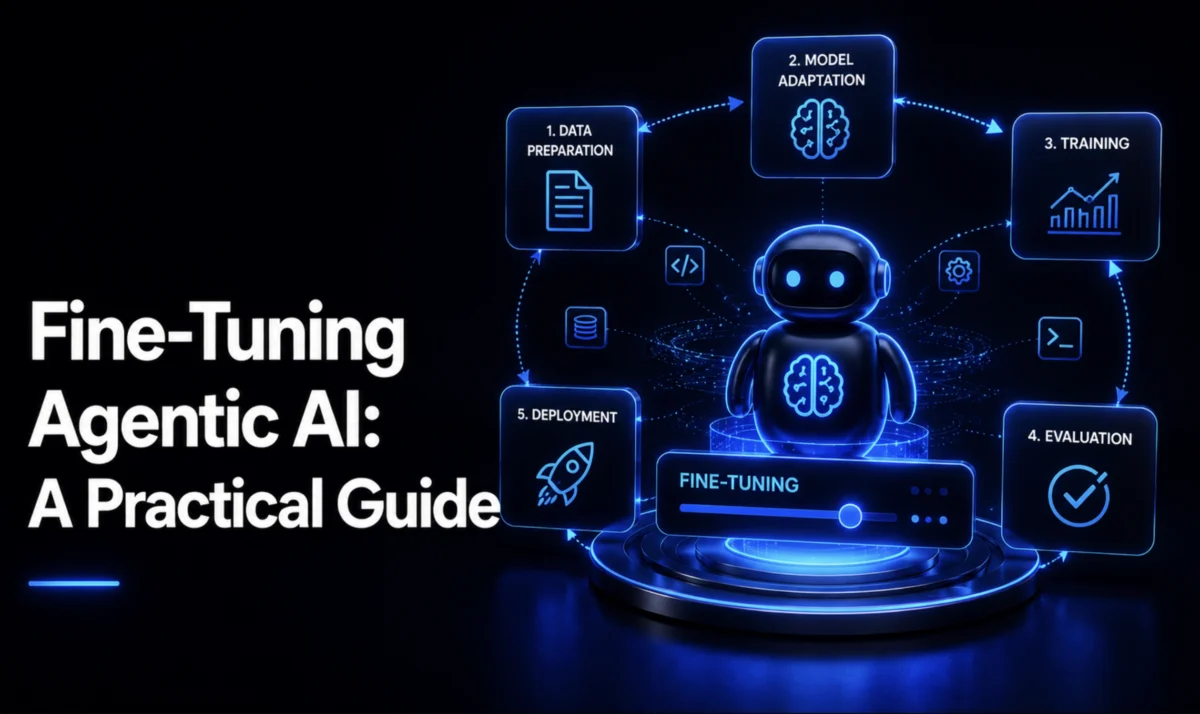

In the rapidly evolving landscape of artificial intelligence, the transition from static language models to agentic systems capable of executing multi-step tasks has fundamentally shifted the requirements for model optimization. Modern agentic AI—systems that navigate software environments, perform tool calls, and interact with external APIs—requires a nuanced approach to fine-tuning that extends far beyond the basic training of weights. Industry data from 2026 indicates that while frontier base models exhibit high levels of general linguistic proficiency, the failure rate for specialized agentic workflows remains significant, often hovering between 15% and 25% in complex production environments. This inefficiency is rarely the result of a single parameter error; rather, it is a failure of the holistic system. To bridge this gap, engineers must treat the agentic lifecycle as a four-part optimization challenge: rigorous dataset construction, parameter-efficient fine-tuning (PEFT), inference-time hyperparameter calibration, and preference alignment.
The history of fine-tuning has evolved from the era of brute-force full-model training to the current reliance on specialized adapters. The introduction of Low-Rank Adaptation (LoRA) and its quantized successor, QLoRA, transformed the economics of agentic development, allowing teams to deploy 70B-parameter models on hardware that previously could not sustain them. However, as these methods have become democratized, the focus has shifted from "can we train it?" to "can we control it?"
The Anatomy of the Agentic Dataset
The cornerstone of a successful agentic model is not the sheer volume of data, but the structural integrity of the training examples. A model may be able to articulate a refund policy with perfect clarity, yet fail to execute the issue_refund tool call due to minor discrepancies in schema syntax. Data engineers now prioritize "schema-first" dataset construction. By validating every entry against a strictly defined tool schema—checking for required parameters, data types, and function availability—teams can preemptively eliminate the hallucinations that plague agents during runtime.
Current best practices suggest that a high-quality seed set of 150 to 200 hand-crafted examples, augmented by synthetic data generation via a teacher model, provides superior results compared to larger, unvetted datasets. The industry standard involves a filtering pipeline: generating synthetic data, applying a "judge model" to score instruction adherence, and systematically discarding the bottom 20% of generated rows. This ensures that the model learns the nuances of function calling rather than merely memorizing templates.
Parameter-Efficient Fine-Tuning and QLoRA
The technical implementation of QLoRA has become the industry standard for optimizing agent behavior without incurring the prohibitive costs of full-parameter training. By freezing the base model in 4-bit precision and introducing low-rank adapter matrices—typically targeting attention layers such as q_proj, k_proj, v_proj, and o_proj—developers can achieve high levels of task-specific performance while modifying less than 2% of the model’s total parameter count.
The selection of rank (r) and alpha (alpha) parameters is critical. Recent peer-reviewed studies on tool-calling agents suggest that an r=4 and alpha=32 configuration, paired with a moderate dropout rate of 0.05, serves as a stable baseline for most support-triage applications. This configuration balances the need for expressive adaptation against the risk of catastrophic forgetting—the phenomenon where a model loses its general-purpose knowledge as it learns specialized agentic tasks.
Beyond Training: The Role of Inference-Time Hyperparameters
A common oversight in current development cycles is the neglect of runtime configuration. Engineers often dedicate significant resources to the training phase while treating inference settings as an afterthought. However, empirical data shows that small adjustments to temperature and the implementation of retry policies can yield performance gains equal to or greater than those achieved through additional training epochs.
For a typical triage agent, a "temperature zero" setting is generally preferred for deterministic tool calling. Yet, in scenarios involving ambiguity, a dynamic retry policy—allowing the agent to re-attempt a failed call at a lower temperature—has been shown to increase overall success rates by as much as 10-15%. This suggests that the agent’s "runtime environment" is as critical a component of the system as the weights themselves.
Aligning Behavior with Direct Preference Optimization (DPO)
While Supervised Fine-Tuning (SFT) is effective for teaching syntax, it is insufficient for teaching judgment. SFT operates on the premise of a single "correct" label, whereas real-world agentic behavior requires the model to distinguish between "correct" and "optimal." This is where Direct Preference Optimization (DPO) becomes vital.
By training on pairs of responses—one labeled "chosen" and one "rejected"—DPO allows the model to learn the subtleties of policy-adjacent decision-making. For instance, in a dispute resolution scenario, an agent might be capable of calling an issue_refund tool correctly, but the preferred action for a high-value or ambiguous request should be escalate_to_human. DPO provides the mathematical framework to penalize the "correct but inappropriate" action, effectively refining the agent’s judgment.
Evaluation Discipline and the "Ship or Hold" Verdict
The most critical phase of the agentic lifecycle is the final evaluation. Without a rigorous testing framework, developers risk shipping models that perform well on narrow tasks while suffering from degraded reasoning in other areas. The industry is moving toward "verdict-based" evaluation, where automated tests measure two key vectors: tool-call accuracy and general capability scores (such as MMLU or GSM8K).
The implementation of a "forgetting threshold"—a pre-defined limit on how much general performance the model is permitted to lose during fine-tuning—has become a mandatory gatekeeper for production deployment. If a fine-tuning run improves tool-call accuracy but results in a decline in general capability that exceeds this threshold, the system triggers a "HOLD" verdict. This prevents the silent degradation of model intelligence, a problem that has historically led to silent production failures in complex enterprise AI deployments.
Broader Implications and Future Outlook
The holistic approach to fine-tuning represents a maturing of the AI development lifecycle. As organizations transition from prototyping to deploying mission-critical agents, the demand for reliability, reproducibility, and rigorous testing will only increase. The days of relying on "black box" training are coming to a close. Instead, the future of agentic AI lies in the meticulous management of these four levers: data, efficient training, inference tuning, and preference alignment.
For developers and organizations, the lesson is clear: the success of an agentic project is not determined by the complexity of the underlying architecture, but by the discipline applied to the entire optimization stack. By treating the fine-tuning process as a system of interconnected dials rather than a linear task, teams can build agents that not only perform their designated functions with high accuracy but also maintain the reasoning capabilities necessary for real-world complexity. This shift toward systematic, data-driven optimization is likely to become the defining characteristic of the next generation of enterprise-grade AI.
