

The landscape of artificial intelligence software engineering is saturated with evaluation tools, frameworks, and benchmarks designed to measure everything from an agent’s capability to resolve complex, real-world GitHub issues to its proficiency inside a command-line terminal environment. Despite this proliferation of testing metrics, a distinct void remained when it came to evaluating the efficacy of AI-driven code review systems. Recognizing this gap, GitHub—in collaboration with Microsoft—has officially unveiled ReviewBench, an open-source benchmarking initiative engineered to measure how accurately and effectively AI code review agents detect genuine, actionable problems within pull requests.
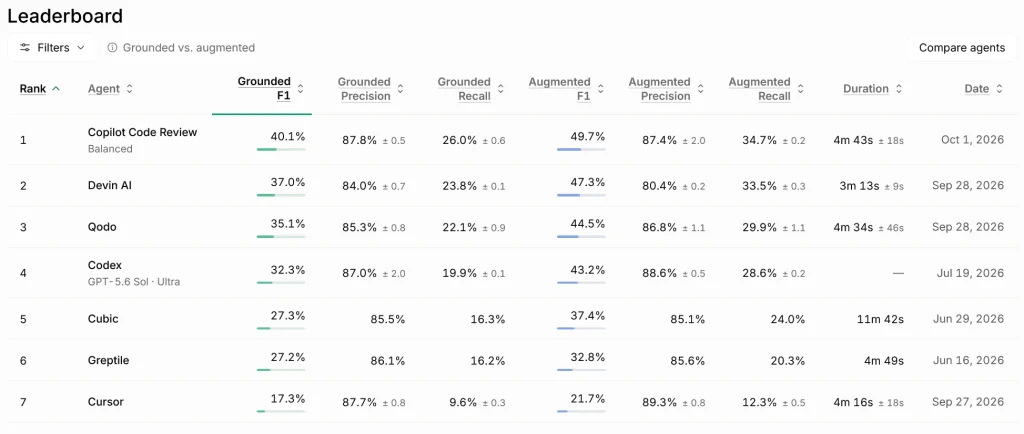
At launch, the inaugural ReviewBench leaderboard places GitHub Copilot code review at the top position, an outcome that, while unsurprising given the platform’s origin, has ignited broader industry discussions surrounding benchmark independence, methodology design, and the fragmentation of AI code evaluation standards.
The Evolution of Automated Code Review Architecture
Code review has historically stood as a cornerstone of software engineering quality assurance, demanding significant human capital, meticulous attention to detail, and deep contextual understanding of codebases. In recent years, the market has seen an influx of commercial and open-source alternatives aiming to automate this labor-intensive process. Competitors such as Qodo, Greptile, Cubic, Devin, Cursor, and CodeRabbit have rapidly populated the market, offering specialized AI-assisted reviews.
GitHub first entered this competitive arena in October 2024 by introducing Copilot code review into public preview, eventually moving toward general availability for paid subscribers by April 2025. Since its inception, the tool has undergone substantial architectural iterations. By March 2026, GitHub transitioned the reviewer onto an advanced agentic architecture capable of pulling in comprehensive repository context. Subsequent updates expanded its operational capabilities, introducing pull request approval permissions, a usage-based billing model tied to GitHub Actions minutes for private repositories, and the implementation of a more thorough "Balanced" review mode as the default configuration on September 28, 2026.

As these tools evolved from superficial syntax checkers into sophisticated agentic reviewers, the industry lacked a standardized yardstick to measure their comparative performance. ReviewBench was designed precisely to address this evaluation deficit by providing a rigorous, reproducible methodology for testing code inspection accuracy.
Methodology, Dataset Construction, and Benchmark Architecture
To construct a reliable evaluation corpus, the creators of ReviewBench analyzed a vast sample pool of 103.9 million pull requests. From this analysis, they curated a benchmark dataset comprising 219 public pull requests drawn from 187 public repositories across 19 distinct programming languages. To ensure the test accurately reflects real-world complexities, the repository-size and language distributions closely mirror overall GitHub usage, while pull request sizes were intentionally weighted away from trivial, single-file modifications to favor more substantial code contributions.
Establishing a definitive reference set of code issues required a multi-layered approach. The benchmark aggregates insights from human review comments, subsequent modifications implemented by code authors, automated static-analysis tools, and outputs generated by various large language models. To classify findings within this reference framework, the project utilizes Claude Sonnet 5, while a specialized LLM matcher determines whether candidate findings proposed by competing tools correspond to underlying issues within the established reference set.
According to the project’s methodology documentation, human evaluators and automated classifiers achieved a 96.6% agreement rate regarding the classification of true and false positives, with 47 initial findings manually corrected to maintain data integrity. Under these testing parameters, GitHub Copilot code review—operating in its "Balanced" configuration—achieved a grounded F1 score of 40.1%. The F1 score mathematically combines precision and recall into a single metric, offering a balanced assessment of a model’s ability to accurately identify issues without generating an overwhelming volume of false alarms.
Nuances, Caveats, and Initial Leaderboard Discrepancies

Despite the meticulous design of ReviewBench, several significant caveats accompany its inaugural release. GitHub explicitly noted that the initial entries on the leaderboard were generated internally by running publicly available versions of each competing product. Crucially, the external vendors neither conducted nor independently verified these specific test runs.
Furthermore, because testing occurred across different dates, the age of the evaluation data varies considerably among products. While Copilot was tested on October 1, 2026, competitors such as Cubic and Greptile were evaluated during testing runs conducted as far back as June 2026. ReviewBench project organizers emphasize that commercial software products iterate rapidly, meaning historical scores may not reflect current product capabilities, nor do they guarantee performance within a proprietary corporate codebase.
These qualifications carry heightened weight given that the benchmark was developed and published by GitHub, a major commercial vendor whose own flagship product occupies the top tier of the leaderboard. To mitigate concerns regarding bias, the project team has open-sourced the entire dataset, evaluation methodology, and judging infrastructure, alongside a self-service submission portal allowing external vendors to run and submit updated evaluations at their discretion.
Industry Response and the Proliferation of Competing Benchmarks
The release of ReviewBench highlights a broader debate within the AI development community regarding the best practices for evaluating software engineering agents. Speaking publicly on the matter, Alejandro Carderera de Diego, a staff applied engineer at GitHub, emphasized the practical utility of the benchmark during internal product development. In a statement shared on social media, Carderera de Diego noted that the team utilized ReviewBench iteratively to refine Copilot code review, observing that its offline results consistently anticipated the outcomes of subsequent production experiments.
In their accompanying technical blog post, Carderera de Diego and Microsoft applied scientist Michelle Zhou argued that existing evaluation methods force unwarranted compromises between label quality, coverage, and real-world applicability. They stated that traditional approaches failed to bridge the gap required for rigorous, reproducible testing methodologies.

However, ReviewBench exists in a crowded ecosystem of alternative metrics that often yield markedly different conclusions. In February 2026, AI research organization Martian launched Code Review Bench, designed to evaluate code review systems through a combination of offline testing and an online tracker monitoring developer responses to review comments across active open-source repositories. At its launch, Martian noted that offline test results frequently diverged from real-world usage patterns, leading the organization to prioritize its online tracker as its primary evaluation metric.
Data from Martian’s leaderboards illustrate the variability inherent in modern benchmarking. On Martian’s online tracker, Cubic secured the top position with an F1 score of 64.9%, followed by Greptile and CodeRabbit, while GitHub Copilot ranked fourth with 60.9%. Conversely, Martian’s offline leaderboard placed Qodo Deep in the lead, with GitHub Copilot positioned fifth using an F2 score—a metric that places greater statistical weight on recall over precision, rewarding tools that successfully capture a higher percentage of relevant issues.
Compounding this fragmentation, LangChain introduced its own version of a code review benchmark in July 2026. Tailored specifically for model evaluation rather than commercial product ranking, LangChain’s iteration utilizes 59 tasks drawn directly from the LangSmith codebase to test various underlying foundational models under a standardized agent configuration, omitting a public vendor leaderboard entirely.
Implications for the Future of AI Software Engineering
The coexistence of ReviewBench, Martian’s Code Review Bench, and LangChain’s evaluation framework underscores a fundamental truth of the current artificial intelligence boom: benchmark design fundamentally shapes the narrative of technological superiority. Because different benchmarks rely on distinct datasets, scoring rubrics, and underlying assumptions about what constitutes a valuable code review comment, direct comparisons across platforms remain exceptionally difficult.
Nevertheless, the establishment of open benchmarks like ReviewBench represents a vital maturity phase for the AI software engineering sector. As enterprises increasingly rely on automated tooling to manage software delivery pipelines, the demand for transparent, reproducible, and verifiable performance metrics will only intensify. Whether ReviewBench evolves into a broad industry-accepted standard driven by vendor participation or remains one of several competing yardsticks will depend heavily on the willingness of external software providers to engage with its submission infrastructure and contribute to its ongoing development.
