
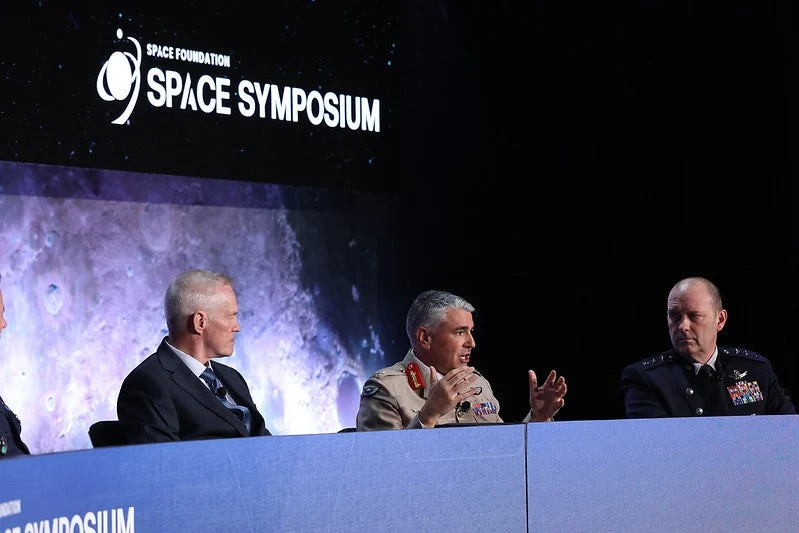

At the 39th annual Space Symposium in Colorado Springs, a critical consensus emerged among the world’s leading military space commanders: the era of unilateral space dominance has transitioned into an era of essential, integrated partnerships. The concept of "burden sharing" in the modern space domain has evolved beyond mere financial contributions; it now encompasses a strategic "burden shifting" where allies and partners contribute unique, national capabilities to strengthen collective resilience and deterrence. This collaborative framework is increasingly defined by investments in national space infrastructure, the contribution of high-fidelity data, and the sharing of operational expertise across a global network.
The symposium, a premier gathering of global space professionals, served as the backdrop for a high-level dialogue featuring military representatives from five major space-faring nations. These leaders collectively argued that no single nation, regardless of its economic or technological stature, can provide every necessary capability across the vast and increasingly congested space domain. The shift toward a multi-polar security architecture in orbit is driven by the sheer speed of technological advancement, the scale of required deployments, and the profound global interdependence of satellite-based services.
A Strategic Framework for Collective Defense
The transition from individual mission sets to integrated operations marks a fundamental change in how Western allies approach space security. Major General Vincent Chusseau, Space Commander for the French Space Command (Commandement de l’espace), emphasized that international partnership is no longer an optional component of the French space strategy—it is a foundational requirement. According to Chusseau, the effectiveness of these partnerships depends on being "ready from the beginning," a concept he described as "interoperability by design."
For France, this means that policy frameworks must be established well in advance of conflict to allow for the seamless sharing of sensitive data. Furthermore, networking architectures must be built with open standards to ensure that different national systems can communicate without friction. This approach moves away from the traditional model where nations build proprietary systems and later attempt to find ways to connect them. Instead, the goal is to create a "plug-and-play" environment where French assets can immediately augment or be supported by allied constellations.
The German Perspective: Value-Added Over Duplication
The German Space Command, led by Major General Michael Traut, provides a pragmatic view of how middle-power nations can maximize their impact within larger alliances like NATO. Germany’s approach is heavily influenced by the realization that duplicating existing capabilities—such as massive communication satellite constellations already operated by the United States—is an inefficient use of limited defense budgets.
Traut noted that the NATO command structure is undergoing significant policy shifts to better accommodate the unique demands of the space domain. Because NATO depends entirely on national contributions rather than owning its own orbital assets, the focus is on "assured access and seamless integration." Germany’s strategic goal is to build sovereign capabilities that provide "enabling functions" for the rest of the alliance. This involves focusing on specific niches where Germany can add distinct value, such as high-resolution radar imaging or sophisticated space situational awareness (SSA) sensors, rather than merely adding another redundant layer to the existing architecture.
By focusing on these enabling functions, Germany aims to ensure that it is a provider of critical services rather than just a consumer of allied intelligence. This creates a more balanced partnership where cooperation leads to greater resilience than any single nation could achieve through duplication.
Norway and the "Puzzle" of Northern Intelligence
The geographic importance of the High North was a central theme for Nils Andreas Stensønes, Chief of the Norwegian Intelligence Service. Norway occupies a unique position in the global space architecture due to its proximity to the Arctic, a region of increasing strategic competition. Stensønes argued that the goal of burden sharing should be to provide "different pieces to the puzzle" to create the most complete intelligence picture possible.
Norway’s contribution is rooted in its specialized knowledge of Arctic operations and its extensive ground station infrastructure, such as the Svalbard Satellite Station (SvalSat), which is one of the most important facilities in the world for downloading data from polar-orbiting satellites. Stensønes warned against the "traditional European problem" of competing for prestige or market share instead of cooperating on operational tasks. He emphasized that the future of space security lies in data sharing rather than just hardware development. Establishing deep-seated trust between nations is the prerequisite for this, ensuring that shared data is handled with the appropriate security protocols and cannot be compromised by adversaries.
The U.S. Space Force as a Catalyst for Integration
Since its establishment in 2019, the United States Space Force (USSF) has acted as a primary catalyst for this international shift toward integration. Major General Paul Tedman, Commander of the U.K. Space Command, highlighted the "enormous progress" made through cooperation with the USSF over the last few years. He described the USSF as a "formidable organization" that has successfully driven allies toward common "gold standards" in tactics, techniques, and operating procedures.
This alignment is not just theoretical; it is reflected in the physical infrastructure being built to move data across borders in real-time. The U.K., for example, has closely aligned its Skynet satellite communications program with U.S. architectures to ensure that British and American forces can communicate seamlessly during joint operations. This level of tactical alignment ensures that if one nation’s capability is degraded, another can step in without a loss of operational momentum.
From the American perspective, Lieutenant General Douglas Schiess, U.S. Space Force Deputy Chief of Space Operations, reiterated that transparency is the bedrock of these partnerships. Schiess noted that the U.S. must communicate its long-term target capabilities and key initiatives early so that allies can align their own national planning. This transparency prevents a vacuum where allies are unaware of the U.S. trajectory, allowing for the creation of a "resilient architecture" capable of withstanding the counter-space capabilities of potential adversaries.
Deterrence Through Interdependence
A central theme of the discussions in Colorado Springs was the role of space alliances in broader geopolitical deterrence. Lieutenant General Schiess articulated that when multiple nations align under a shared space architecture, it changes the calculus for potential aggressors. If an adversary targets a single nation’s satellite, they might be willing to accept the consequences. However, if targeting that satellite disrupts a shared network used by five, ten, or thirty nations, the diplomatic and military repercussions become significantly more severe.
This "integrated deterrence" relies on redundancy. By having multiple nations provide overlapping and complementary capabilities, the alliance ensures that no single point of failure exists. If a U.S. GPS signal is jammed, the alliance can look to Europe’s Galileo or other regional positioning systems. If a specific communication node is taken offline, the "burden shifting" model allows the mission to migrate to an allied asset.
Chronology of the Shift Toward Integrated Space Defense
The current state of high-level cooperation is the result of a decade-long evolution in space policy:
- 2014: The signing of the Combined Space Operations (CSpO) initiative between the U.S., U.K., Canada, and Australia (later joined by France, Germany, and New Zealand). This established the framework for operational coordination.
- 2019: The creation of the U.S. Space Force, which provided a dedicated military service to lead international engagement and standardize space doctrine.
- 2020-2022: The expansion of Operation Olympic Defender, a U.S.-led effort to optimize space operations and deter adversaries, to include more international partners.
- 2023-2024: The shift toward "Proliferated Warfighter Space Architecture" (PWSA), moving away from a few expensive satellites toward hundreds of smaller, interconnected satellites, a model that necessitates international ground station support and data sharing.
Implications for the Global Space Industry
The military’s move toward burden shifting has profound implications for the commercial space sector. As nations seek "interoperability by design," they are increasingly demanding that commercial providers build systems that are compatible with allied standards. This is leading to a more unified market for space technology among Western nations.
Furthermore, the focus on "data over hardware" means that software-defined satellites and cloud-based ground segments are becoming the priority. The ability to process and distribute data quickly across a coalition is now viewed as more important than the specific launch vehicle or satellite bus used to get the sensor into orbit.
As the space environment continues to undergo rapid change, the consensus from the leaders at the Space Symposium is clear: the strength of a nation in the 21st century is measured not just by its own constellations, but by the depth and resilience of its orbital alliances. By embracing burden shifting, the global community is working to ensure that space remains a stable and secure domain for all.
