

The rapid proliferation of Large Language Models (LLMs) across enterprise environments has created an urgent demand for specialized quality assurance frameworks. While public benchmarks such as MMLU (Massive Multitask Language Understanding) or GSM8K (Grade School Math 8K) provide a baseline for general reasoning capabilities, they are increasingly viewed as insufficient for production-grade applications. Organizations now require granular, domain-specific testing to ensure that LLM-driven agents—ranging from customer support bots to complex RAG (Retrieval-Augmented Generation) pipelines—adhere to proprietary safety protocols and operational standards. To address this, software architects are shifting toward building custom evaluation harnesses, a move that provides full control over testing criteria, scoring metrics, and cost management.
The Evolution of Model Evaluation
The industry transition toward custom evaluation stems from a recognition that model performance is highly contextual. In early 2023, the standard for evaluating an LLM was a visual spot-check of its outputs. By late 2024, the industry moved toward automated pipelines, yet many firms remained tethered to rigid, third-party evaluation services. Industry data suggests that companies relying solely on general-purpose benchmarks face a "domain drift" risk, where a model that scores in the 90th percentile on general tasks may fail significantly when faced with industry-specific jargon, internal legal disclaimers, or idiosyncratic database schemas. A custom test harness functions as the critical scaffolding that feeds inputs into a model, captures the resulting output, and measures that output against a predefined, domain-relevant baseline.
Core Architecture: The Four-Pillar Framework
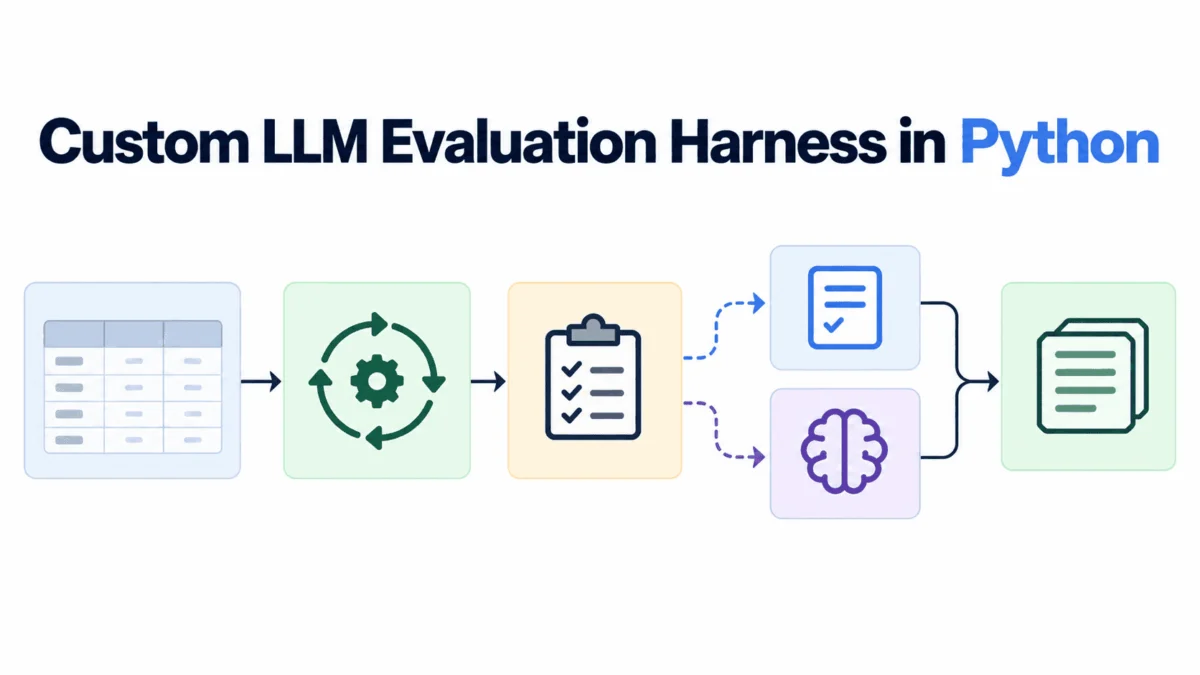
Building a robust evaluation harness requires a modular design to ensure long-term maintainability. Engineering teams are increasingly adopting a four-component architecture that decouples the data, the inference engine, the judgment mechanism, and the logging layer.
1. The Golden Dataset
The foundation of any credible evaluation system is the "golden dataset." Unlike synthetic benchmarks generated by other LLMs, a high-quality golden dataset is composed of 20 to 50 real-world edge cases. These cases are typically extracted from historical user logs, representing actual failure modes or ambiguous queries that caused previous iterations to struggle. Each record within this dataset must include a unique identifier for tracking, the raw input prompt, and a concise definition of the "expected concept" or success criteria. By focusing on messy, real-world data rather than the "happy path," developers can identify vulnerabilities in refusal policies or context retrieval accuracy that would otherwise remain hidden.
2. The Inference Runner
The inference runner acts as the transport layer for the evaluation. By utilizing abstraction libraries like LiteLLM, developers can maintain a consistent function signature regardless of the underlying model provider, whether it be OpenAI’s GPT-4o, Anthropic’s Claude 3.5, or open-source weights hosted locally. A critical component of the runner is the implementation of asynchronous processing. Utilizing Python’s asyncio library, developers can fire multiple test cases concurrently, significantly reducing the time required to evaluate datasets containing hundreds of prompts. Standard industry practice now dictates including at least three retry attempts and strict timeout constraints (e.g., 30 seconds) to ensure that network volatility does not produce false negatives in the evaluation report.
3. The Judge Layer
The judge layer is the intelligence behind the scoring process. There are two primary methodologies for this: deterministic and semantic. A deterministic judge is employed for objective validation, such as checking for the presence of a mandatory legal disclaimer or a specific JSON schema. This is both computationally inexpensive and highly consistent. Conversely, an LLM-as-a-judge is required for nuanced evaluations where semantic meaning outweighs exact string matching. By using a "judge" model to grade the output of the "target" model against a set of rubrics, developers can automate the assessment of tone, helpfulness, and safety. The use of Pydantic for structured data validation in this layer is considered a best practice, as it ensures the judge returns a machine-readable format—typically a boolean pass/fail status—preventing the pipeline from breaking due to inconsistent natural language responses.
4. The Logging and Analytics Layer
The final pillar is the logging system, which must be append-only and machine-readable. Storing results in JSONL (JSON Lines) format is the industry standard, as it provides a crash-safe way to record metadata, including timestamps, latency, and model versions. By separating the inference phase from the scoring phase, engineers can re-score previously generated outputs if they decide to modify the judge’s rubric. This decoupling saves significant capital, as it eliminates the need to pay for redundant API calls when adjusting the criteria for success.
Implementation and Operational Considerations
For developers initiating this process, Python 3.10 or later is a prerequisite to support native asynchronous workflows. The dependency footprint is intentionally kept minimal; by limiting the stack to litellm for model calls and pydantic for output enforcement, teams avoid the "black box" syndrome associated with monolithic, third-party evaluation platforms.
The process of building this harness is not merely a one-time technical task but an ongoing operational cycle. Once established, the harness should be integrated into a CI/CD (Continuous Integration/Continuous Deployment) pipeline. This allows organizations to run a regression test every time the prompt system changes or the model version is updated.
Implications for Enterprise AI
The broader implication of this shift is the professionalization of LLM deployment. As the "hype" phase of generative AI recedes, the "reliability" phase has taken hold. Stakeholders—from CTOs to legal compliance officers—are increasingly demanding quantitative proof of model behavior. A custom evaluation harness provides exactly that: a transparent, reproducible, and auditable record of model performance.
Furthermore, the capability to track latency and cost per test case offers a secondary benefit: financial optimization. By analyzing the results, organizations can identify if a more expensive, larger model is truly necessary for a given task, or if a smaller, lower-latency model achieves the same pass rate within the golden dataset.
Conclusion
While public benchmarks remain useful for gauging the general intelligence of foundational models, they cannot replace the necessity of custom validation for specific enterprise applications. By architecting a four-part system—a golden dataset, an asynchronous inference runner, a structured judge layer, and a robust logging system—engineering teams can achieve a level of transparency and control that is essential for long-term production success. As these models become more deeply integrated into business-critical workflows, the ability to define, measure, and enforce "correct" behavior will distinguish successful AI implementations from those that fail to meet real-world expectations. Future advancements in this field will likely include automated generation of test cases and more sophisticated, multi-criteria grading rubrics, but the core architecture of an independent, modular evaluation harness remains the standard-bearer for reliable, production-ready AI.
