
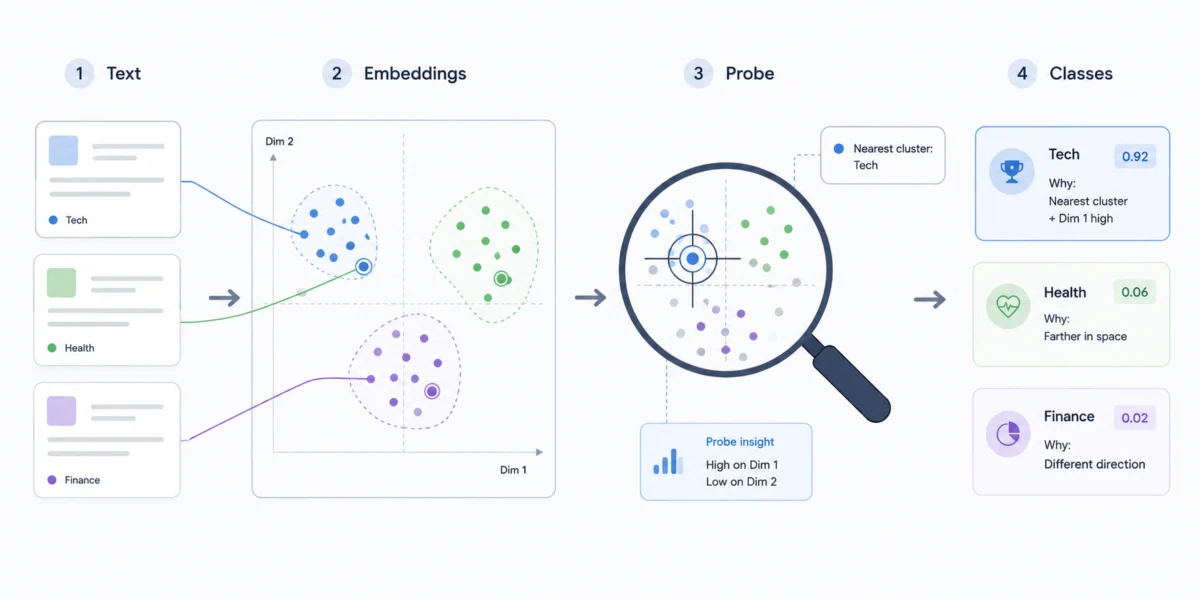

The rapid adoption of Large Language Models (LLMs) in corporate and research environments has fundamentally altered the landscape of natural language processing (NLP). While these models—ranging from proprietary architectures like GPT-4 to open-weight alternatives hosted locally—offer unprecedented accuracy in text classification, they introduce a critical challenge: the "black box" problem. As organizations increasingly rely on LLMs to convert raw text into dense numerical vector representations, or embeddings, the inability to discern how these models arrive at specific semantic conclusions poses significant risks for industries requiring high levels of transparency, such as finance, healthcare, and legal services.
To address this, developers are increasingly turning to diagnostic methodologies—specifically probing classifiers, UMAP visualization, and SHAP (SHapley Additive exPlanations) values—to bridge the gap between raw machine output and human-understandable logic. By applying these techniques, practitioners can effectively audit the internal representations of LLMs, ensuring that the semantic information captured by these models is both robust and ethically aligned.
The Evolution of Text Classification
Historically, text classification relied on manual feature engineering, where experts identified specific keywords or linguistic markers to categorize information. The transition to deep learning architectures, such as Recurrent Neural Networks (RNNs) and Transformers, shifted this burden to automated feature extraction. While these modern systems offer superior performance, they operate within high-dimensional vector spaces that are inherently opaque.
When an LLM processes a document, it maps the text into a latent space of hundreds or thousands of dimensions. Each dimension holds a numerical value representing a specific linguistic or contextual feature. The difficulty lies in the fact that these dimensions are not human-interpretable. Consequently, when an LLM classifies a movie review as "positive," it is often unclear which specific semantic patterns within the embedding space led to that determination.
Establishing a Diagnostic Framework
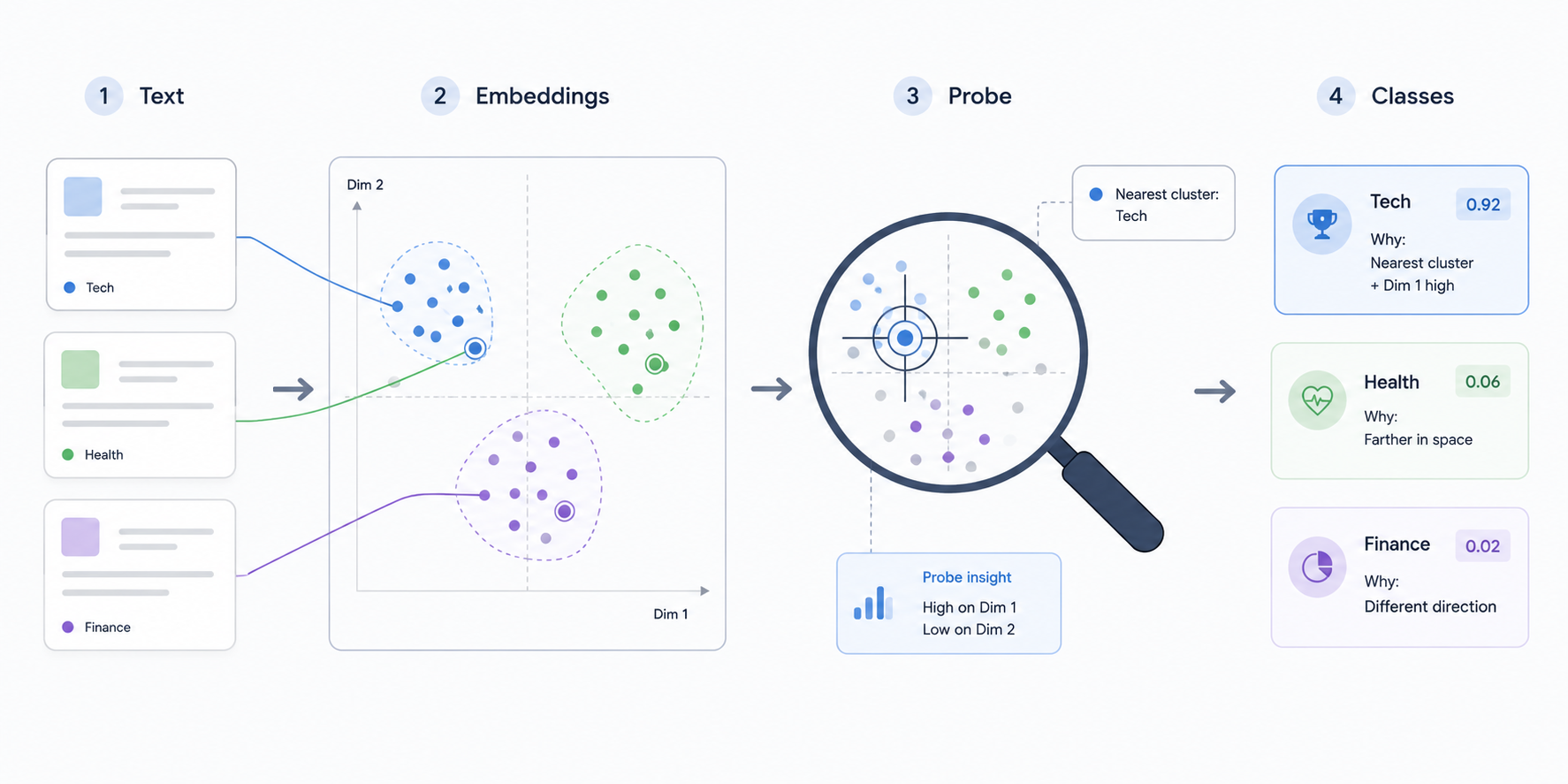
The deployment of a probing classifier serves as a quantitative stress test for LLM embeddings. By training a simple, interpretable model—such as a logistic regression classifier—on top of frozen LLM embeddings, developers can evaluate the "quality" of the information being extracted. If a linear, shallow model achieves high accuracy using only these embeddings as input, it confirms that the LLM has successfully distilled the necessary semantic signals into a linearly separable format.
For instance, utilizing the IMDB movie review dataset, which consists of 50,000 highly polarized reviews, provides a standardized benchmark for this process. By sampling 1,000 reviews and generating embeddings via the all-minilm model—a lightweight, high-performance architecture—researchers can create a controlled environment to test how effectively the LLM captures sentiment.
Chronology of Implementation
The practical execution of this diagnostic pipeline follows a rigorous, multi-step process:
- Infrastructure Configuration: Modern workflows utilize tools like Ollama to host LLMs locally. This ensures data privacy and eliminates API costs. The configuration requires pointing the Scikit-LLM framework to a local server endpoint, effectively turning a standard workstation into a private inference engine.
- Data Preparation and Stratification: To avoid bias, datasets must be balanced. In the case of the IMDB review corpus, extracting an equal number of positive and negative samples ensures that the probing classifier is not skewed by class imbalances.
- Embedding Generation: The conversion of natural language into vector space occurs via the
GPTVectorizerclass. During this phase, the model parses the text, transforming linguistic nuances into dense numerical arrays. - Probing and Evaluation: Once the vectors are generated, the logistic regression model is applied. Achieving a classification report with F1-scores exceeding 0.75 suggests that the embedding space is well-structured for binary sentiment analysis.
- Dimensionality Reduction: Techniques like UMAP (Uniform Manifold Approximation and Projection) are then employed to visualize the high-dimensional data in a two-dimensional plot. This spatial representation allows for the identification of natural clusters, confirming whether the LLM distinguishes between opposing sentiments in its internal manifold.
Visualizing Latent Spaces with UMAP
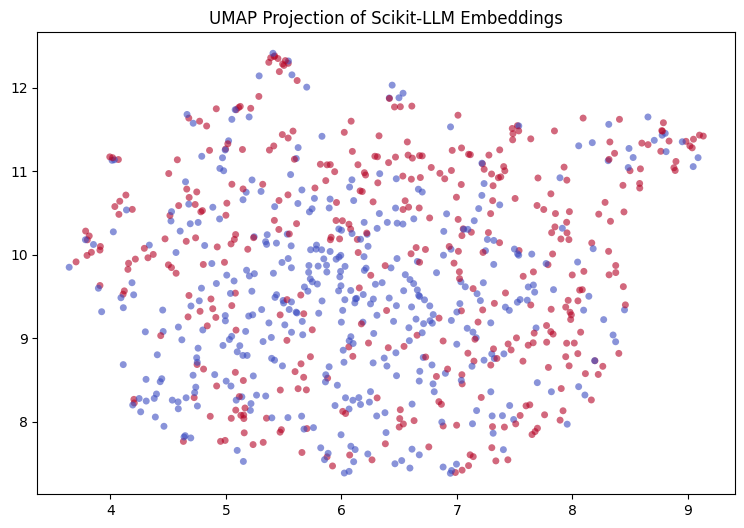
UMAP has become a standard tool for exploring high-dimensional data because it preserves both the local and global structure of the embedding space. In a successful model, one would expect to see a clear separation between positive and negative reviews. If the UMAP plot shows significant overlap, it indicates that the LLM’s internal representations are "noisy" or that the model lacks the semantic depth required to differentiate between the nuances of the two classes. Observations from recent experiments suggest that even with smaller, efficient models, distinct "northern" and "southern" clusters often emerge, validating the utility of these lightweight architectures for production environments.
Decoding Decisions with SHAP
While visualization offers a macro-view, SHAP values provide granular, feature-level insights. SHAP is based on cooperative game theory, assigning an "importance" value to each dimension within the embedding vector. By analyzing these values, developers can pinpoint specific latent dimensions that consistently trigger positive or negative predictions.
In practice, a SHAP summary plot might reveal that "Dimension 208" is a primary indicator for negative sentiment, while "Dimension 139" acts as a strong signal for positivity. This capability is transformative; it allows engineers to move beyond asking "Is this model accurate?" to "Why is this model accurate?" This level of granularity is essential for compliance in regulated sectors, where "black box" decisions are often legally untenable.
Implications for Future AI Development
The integration of probing classifiers and explainability tools represents a maturing of the AI lifecycle. As organizations shift from experimental AI to mission-critical applications, the focus must move from raw model performance to model interpretability.
Data scientists and AI engineers are increasingly recognizing that an accurate model is only as valuable as its reliability. By maintaining an audit trail of how text is interpreted—verified by probing models and SHAP analysis—developers can identify potential biases within LLMs before they reach the production stage. For example, if a probing model discovers that an LLM is relying on specific keywords associated with demographic identifiers rather than actual sentiment, developers can implement targeted fine-tuning or prompt-engineering adjustments to mitigate that bias.
Furthermore, the rise of "Small Language Models" (SLMs) and efficient embedding techniques indicates a shift toward more sustainable, transparent AI. Using locally hosted models via Ollama and Scikit-LLM allows for consistent, repeatable experiments that do not rely on the fluctuating logic of cloud-based APIs. This democratization of AI auditing tools empowers smaller organizations to maintain the same standards of transparency as large tech conglomerates.
Conclusion
The quest for interpretable AI is not merely a technical challenge but a foundational requirement for the long-term viability of machine learning. The methodology outlined—combining Scikit-LLM for vectorization, logistic regression for probing, and UMAP/SHAP for visualization—provides a comprehensive toolkit for demystifying LLM behavior. As these models continue to evolve, the ability to inspect, analyze, and validate their internal reasoning will remain the primary differentiator between successful, responsible AI integration and the risks of unchecked automation. By adopting these transparent, evidence-based practices, the industry can ensure that the next generation of intelligent systems remains both powerful and accountable to the humans they are designed to serve.
