
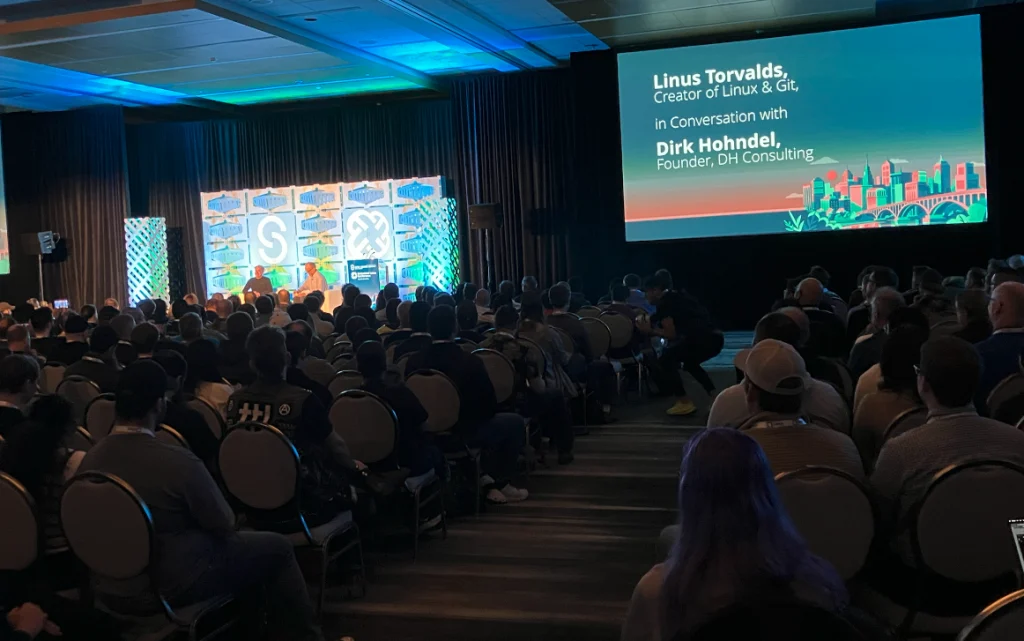

The future of programming in the age of artificial intelligence was a central theme at the recent Open Source Summit North America, held in Minneapolis. During his keynote address, Linux and Git creator Linus Torvalds offered a candid perspective on the burgeoning role of AI in software development, asserting that while AI is a powerful tool for boosting productivity, it will not fundamentally replace the need for human programmers. Torvalds’ remarks provided a grounded counterpoint to more hyperbolic claims about AI’s transformative capabilities in the coding world.
Torvalds drew parallels between the advent of AI and previous technological leaps in programming history, such as the transition from machine code to assembly languages and then to high-level languages facilitated by compilers. He emphasized that just as these earlier innovations dramatically increased efficiency without eliminating the need for human oversight and expertise, AI is poised to function as a sophisticated assistant rather than a wholesale replacement.
AI as a Productivity Multiplier, Not a Substitute
“AI is a great new tool, but it’s a tool,” Torvalds stated emphatically to the assembled audience. He expressed frustration with claims that AI writes a significant percentage of code, likening it to programmers boasting about compilers writing their code. “When I see people saying, ‘Hey, 99% of our code is written by AI,’ I literally get angry, because those same people – I can pretty much guarantee – that 100% of their code is written by compilers. But they never say that.”
His argument centers on the essential role of human understanding in creating robust, long-lasting software. While AI can generate source code based on prompts, Torvalds stressed that building serious projects intended to endure for decades requires developers to possess a deep comprehension of the generated code, the underlying system architecture, and the broader implications of their design choices. Simply providing prompts, he indicated, is insufficient for complex, mission-critical development.
Historical Context: From Machine Code to AI
Torvalds, as the original architect of the Linux kernel, has witnessed firsthand the evolution of software development methodologies. He recalled his early days of programming, working directly with raw machine language before the advent of assemblers and compilers. The introduction of higher-level languages and compilers, he noted, represented a monumental shift that amplified programmer productivity by orders of magnitude.
He posited that AI could potentially increase productivity by a factor of ten. However, he also offered a comparative perspective, suggesting that the productivity gains from AI might be considered “10 times less” than the transformative impact compilers had, a calculation based on his estimation that compilers have boosted programming efficiency by a thousand-fold over time. This nuanced comparison underscores his view of AI as a powerful augmentation rather than a revolutionary replacement for fundamental programming skills.
The Human Element: Understanding Complexity is Key
Torvalds’ core message is that effective use of AI in programming necessitates a strong foundation of technical knowledge. “People who know what they’re doing to understand systems will be able to prompt tools to write good code,” he explained. Conversely, he warned, “People who don’t understand the complexity of systems will also prompt systems and write processes that will fail. So, I think you do want to understand how it all works.” This highlights a critical dependency: AI tools are only as effective as the human expertise guiding them. The ability to conceptualize, design, and debug complex systems remains a uniquely human capability.

Challenges in Open Source: The Deluge of AI-Generated Contributions
Beyond the conceptual implications for programming, Torvalds also addressed the practical challenges AI presents within the open-source ecosystem. One significant issue is the dramatic increase in AI-generated pull requests, many of which contain subtle bugs or incomplete fixes. The sheer volume of these contributions can overwhelm project maintainers, especially those with limited resources.
The Linux kernel project, with its extensive history and dedicated team, has been able to manage this influx. However, Torvalds pointed out that many smaller or less resourced open-source projects face significant strain. “Of all the projects that people maintain that are not the Linux kernel, that maybe is somebody’s head project that they’ve been working on for a decade or more, and they have only one person or three people [to patch bugs and create fixes], they get really burned out,” he observed. This phenomenon, often termed "maintainer burnout," is exacerbated by the "drive-by" nature of some AI-generated bug reports, where the contributor disappears after flagging an issue, leaving the burden of investigation and correction solely on the maintainer.
Maintainer Burnout and the Social Burden of AI
The Linux project, with over 35 years of accumulated code, benefits from AI’s ability to uncover long-dormant bugs. However, the process of verifying and integrating these findings requires substantial human effort. Torvalds described instances where AI reports a bug, but the reporter is unresponsive to follow-up questions, leading to frustration and burnout. “Sometimes, obviously, AI reports a bug, and when you ask for more information, the person has done that drive-by and doesn’t even answer your question. So, that’s the real burnout issue,” he stated.
Furthermore, Torvalds raised concerns about companies leveraging AI to identify and publicize bugs in open-source projects for reputational gain, without contributing the necessary code patches. “These companies enjoy spending a lot of money and a lot of tokens on pointing out the above, and strangely, none of these came with a patch, even though all of these were in open source code,” he asserted. While acknowledging that AI finding bugs is beneficial in the short term, he stressed that integrating these new findings requires significant time and resources for verification and remediation.
AI’s Impact on Kernel Development and Contribution Metrics
The recent Linux kernel release preparations, specifically for version 7.1, saw an unusual surge in pull requests. Initially, Torvalds believed this indicated heightened community interest. However, it became apparent that a significant portion of this increase was attributable to AI-assisted contributions. Despite this, Torvalds framed AI as a positive force for kernel development, noting that difficult processes have been augmented by these tools. He reported a roughly 20% overall increase in submissions for the current Linux kernel release, a metric that includes both human and AI-assisted contributions.
During the Q&A session, when asked about specific AI tools being used by Linux project maintainers for reviewing pull requests and vulnerability reports, Torvalds mentioned “Sashiko.” However, he reiterated that even with such tools, human oversight remains paramount. The implementation and review of proposed fixes still demand considerable manpower across the project.
The Evolving Landscape of Programming and the Demand for Expertise
In the broader context of the tech industry, which has seen significant layoffs in recent times, the nature of programming is indeed evolving. However, Torvalds’ insights suggest that the demand for skilled human programmers, particularly those with deep system understanding and the ability to leverage AI effectively, will persist in the near to mid-term. The ability to critically analyze, guide, and integrate AI-generated code, along with the fundamental problem-solving skills required for complex software engineering, will continue to be highly valued. AI is changing how programming is done, but the core requirement for human ingenuity and expertise remains.
