
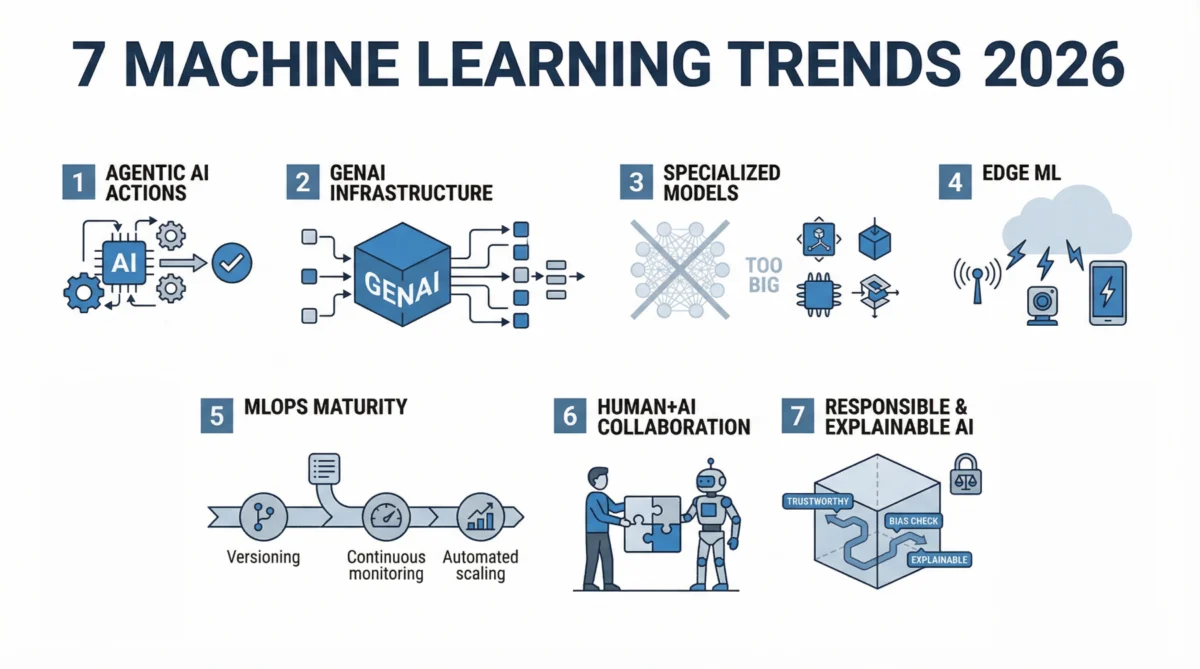

In 2026, the landscape of machine learning has undergone a profound transformation, evolving decisively from its earlier incarnation as a predominantly prediction-focused technology into a deeply integrated, action-oriented force that directly drives real-world workflows across industries. This strategic pivot marks a critical phase in the industrialization of artificial intelligence, where the emphasis has shifted from merely generating insights to executing complex tasks autonomously, reshaping operational paradigms and redefining human-computer interaction. The journey to this point has been marked by rapid technological advancements, significant investment, and a growing understanding of how to leverage AI for tangible, measurable outcomes.
The Evolving Ecosystem of AI: A Decade of Disruption and Integration
A mere two years prior, the prevalent perception of machine learning systems largely confined them to analytical back-ends, quietly processing data to yield predictions that still required human intervention for subsequent action. These systems, often nestled behind dashboards, served primarily as sophisticated advisors. However, the boundary between prediction and action has demonstrably blurred, if not entirely dissolved, in 2026. Machine learning is no longer a passive query engine; it is an active participant, frequently initiating and completing tasks without explicit, real-time human permission. This monumental shift did not materialize overnight but rather emerged from a period of intense experimentation and refinement.
The years 2023 and 2024 were characterized by an aggressive pursuit of raw capability. The industry fixated on developing larger models, achieving higher benchmark scores, and showcasing increasingly impressive demonstrations of AI’s potential. Companies raced to integrate AI into their product offerings, often driven by the imperative to prove technical feasibility. What followed, predictably, was a period of introspection and a stark reality check. Many of these initial, hurried implementations struggled in production environments. They proved to be prohibitively expensive to operate, challenging to maintain, and frequently disconnected from the intricate realities of existing business workflows. The chasm between impressive demos and practical, scalable deployment became glaringly apparent.
By 2025, a critical reorientation began. The focus decisively moved from mere outputs to concrete outcomes. Machine learning systems are now engineered with the explicit expectation of completing entire tasks, rather than simply assisting with components of them. For instance, a customer support AI model in 2026 does not merely suggest a reply; it resolves the entire ticket, end-to-end. Similarly, a data pipeline transcends flagging anomalies; it autonomously triggers predefined corrective actions. This subtle yet fundamental distinction dictates an entirely new approach to system architecture and development.
The financial commitment mirroring this transformation is staggering. Global AI spending is projected to reach an unprecedented $2.02 trillion by 2026, according to Plunkett Research. Concurrently, the machine learning market itself is on track for substantial growth, estimated to climb toward $1.88 trillion by 2035, as reported by Itransition. These figures represent far more than speculative investments; they underscore a market deeply entrenched in deploying systems that are already indispensable to core business operations. What truly distinguishes machine learning in 2026 is not merely the raw power of these models, but their pervasive and profound integration into the very fabric of enterprise. AI is no longer an experimental feature relegated to the periphery; it is an intrinsic component of the workflow, influencing decisions, automating processes, and often managing them from inception to completion.
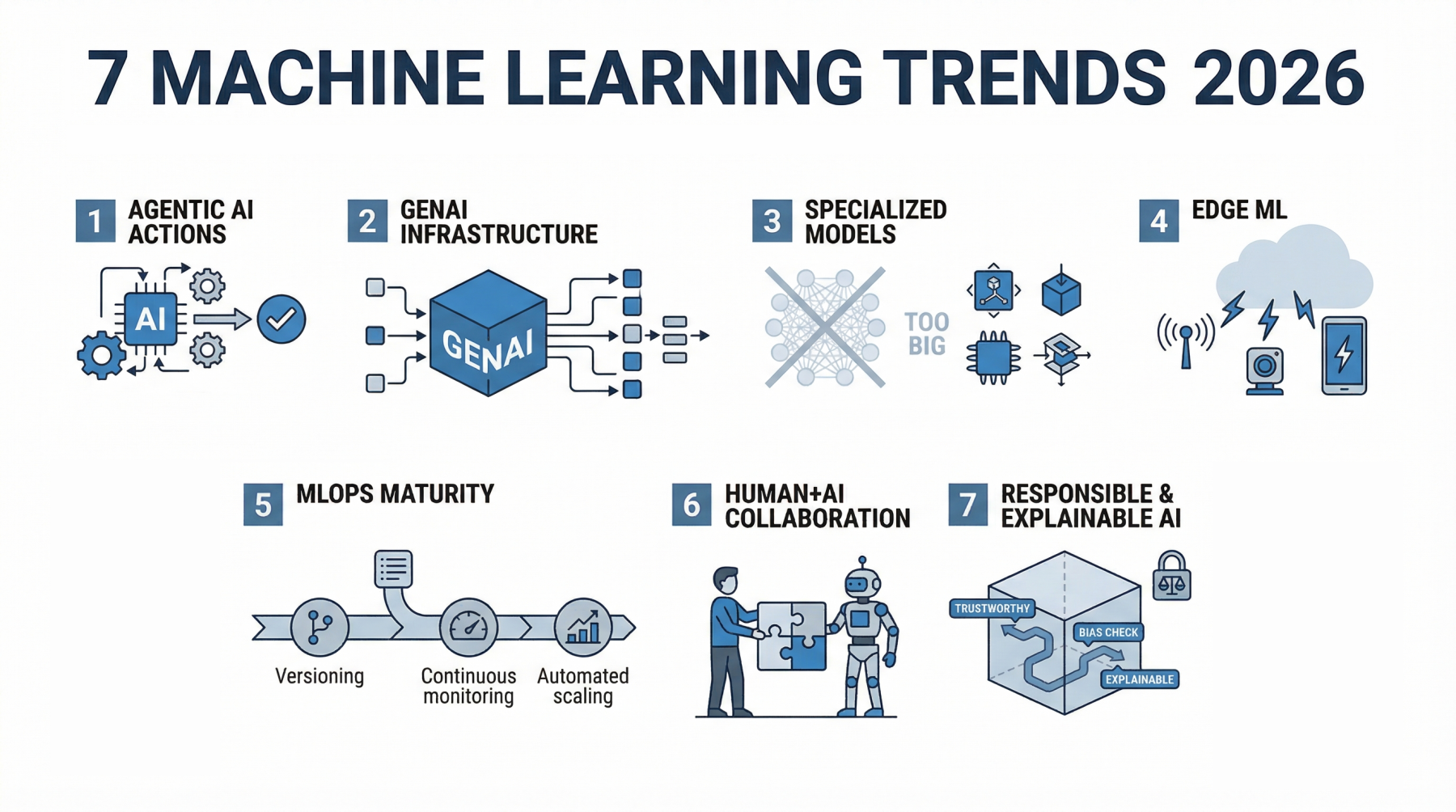
This widespread adoption and integration are underpinned by several key trends, each contributing to the robust, action-oriented nature of contemporary machine learning.
Trend 1: Agentic AI’s Ascendancy – From Assistants to Autonomous Decision-Makers
For a considerable period, machine learning systems functioned primarily as passive assistants, processing inputs and generating outputs, with the ultimate responsibility for action resting with human operators or other external systems. This foundational model has now largely been superseded. Agentic AI has fundamentally redefined this role, empowering systems to autonomously plan, decide, and execute complex, multi-step tasks from initiation to conclusion.
The distinction from traditional machine learning is stark. A conventional model might accurately predict customer churn or categorize support tickets. While valuable, its utility is bounded. An agentic system, however, extends this capability significantly. It identifies a high-risk customer, formulates the optimal retention strategy, drafts a personalized communication, and triggers the outreach sequence. Here, the output transcends a mere prediction; it manifests as a decisive action. This advanced capability is facilitated by their architecture, allowing agentic systems to decompose overarching goals into granular tasks, execute them sequentially, and dynamically adapt based on real-time feedback. They can seamlessly integrate data from disparate sources, invoke external APIs, generate contextually relevant responses, and refine their decisions through iterative learning. This operational model closely mirrors human problem-solving, a significant departure from the linear operation of traditional models.
The practical applications of agentic AI are already pervasive across diverse sectors. In customer support, advanced AI agents are resolving entire ticket lifecycles without requiring human escalation. In industrial operations, these systems are optimizing inventory management by harmonizing demand forecasts with intricate supply chain constraints. Within healthcare, agentic AI assists in summarizing extensive patient records and recommending evidence-based next steps, significantly reducing the administrative burden on clinicians, thereby freeing them to focus on critical patient care.
The rapid market trajectory of agentic AI underscores its importance. The AI agents market is projected to reach an estimated $93.2 billion by 2032, a testament to its burgeoning potential. Furthermore, reports indicate that up to 40% of enterprise applications are anticipated to incorporate AI agents by the close of 2026. This level of adoption signals not merely a passing trend but a paradigm shift in the fundamental design and function of enterprise software. This evolution arguably represents the most pivotal transformation in machine learning currently underway, as the ability of systems to act autonomously fundamentally reconfigures model design, infrastructure requirements, and even user interface philosophies, all converging around the core principle of intelligent autonomy.
Trend 2: Generative AI as Foundational Infrastructure, Not a Standalone Feature
The early days of generative AI saw its integration as a headline-grabbing novelty—a chatbot here, a content generator there. While impressive, these implementations often remained isolated, serving as distinct features rather than integral components of broader systems. This phase has concluded. In 2026, generative AI has shed its "add-on" status to become an indispensable layer of underlying infrastructure, powering everyday workflows with unprecedented efficiency and creativity.
This integration is evident in its application across diverse professional domains. In software development, generative AI is now seamlessly embedded within integrated development environments (IDEs), actively assisting developers in writing, reviewing, and refactoring code in real time. For business operations, it autonomously generates comprehensive reports, condenses lengthy meeting transcripts, and extracts critical insights from vast datasets, largely obviating the need for manual analysis. The fundamental difference lies not just in enhanced capability, but in its strategic placement within the core workflow.
The imperative for robust production-readiness has also driven generative AI beyond mere experimentation. Early adopters dedicated the preceding two years to exploring its potential; now, the focus is squarely on reliability, cost-effectiveness, and consistency. Generative models are undergoing rigorous fine-tuning, often hybridized with traditional machine learning systems, and meticulously integrated with structured data sources. This hybrid approach allows generative AI to excel at unstructured tasks like text generation and complex reasoning, while traditional models continue to handle precise prediction and optimization.
The impact of this deep integration is quantitatively measurable. Organizations are reporting up to a 30% reduction in workload after integrating generative AI into their operational workflows, as highlighted by Forbes Tech Council. Such significant efficiency gains are not attributable to isolated features but to a comprehensive, systemic integration. The industry conversation has evolved from questioning the adoption of generative AI to identifying areas where its infrastructure-level integration is still lacking, and which workflow segments continue to operate without its transformative influence.
Trend 3: The Ascendance of Smaller, Specialized Models
For an extended period, progress in machine learning was simplistically equated with scale: larger models, more parameters, greater data volumes, and consequently, superior performance. This philosophy propelled the industry towards the development of colossal systems, demanding prodigious computational resources, exorbitant budgets, and intricate infrastructure.
However, 2026 heralds a significant rebalancing. Smaller, highly specialized models are rapidly gaining prominence, not for their general impressiveness, but for their unparalleled practicality and efficiency. These models are purpose-built for specific tasks, meticulously trained on narrowly focused datasets, and rigorously optimized for real-world deployment rather than solely for benchmark superiority.
Small Language Models (SLMs) exemplify this trend. Unlike their larger, general-purpose counterparts that aim to tackle every conceivable task, SLMs are architected to deliver exceptional performance within a constrained, specific domain. This might encompass legal document analysis, nuanced customer support dialogues, or efficient internal knowledge retrieval. In such specialized contexts, a compact model possessing deep contextual understanding frequently surpasses the performance of a larger, more generalized model.
The operational advantages of SLMs are compelling. They are significantly more economical to operate, exhibit faster response times, and are considerably easier to deploy. Capable of running on local servers or even directly within end-user applications, they mitigate reliance on extensive external cloud infrastructure. This decentralized deployment strategy reduces latency and grants organizations greater autonomy over performance, security, and data privacy.
The metric of success has also evolved. The inquiry has shifted from "how powerful is this model in general?" to "how effectively does it perform in this specific, critical context?" A model that consistently delivers accurate and reliable results for a single, business-essential task often proves more valuable than a vast model that performs acceptably across numerous tasks but lacks the requisite precision where it truly matters. This paradigm shift underscores a renewed focus on efficiency, where companies prioritize models that yield robust results with substantially lower operational expenditures. The immense costs associated with training and maintaining gargantuan models are increasingly difficult to justify for every use case. Specialized, smaller models offer a superior balance between performance and economic viability, particularly when deployed at scale.
This fundamental reorientation represents a move away from raw scale as the primary objective towards practical usability. In essence, it signifies building models that are precisely tailored to the problem at hand, rather than attempting to create a universal solution. In 2026, model size is no longer a marker of prestige; the true measure of success is return on investment, and specialized models are unequivocally demonstrating their superior value proposition.
Trend 4: Machine Learning’s Shift to the Edge – Powering IoT and Real-Time Intelligence
For many years, the operational locus of most machine learning systems resided firmly within cloud data centers. Data was collected, transmitted to centralized servers for processing, and then returned as predictions. While functional, this model entailed significant trade-offs: inherent latency, escalating bandwidth costs, and mounting concerns regarding data privacy and security.
In 2026, this paradigm is undergoing a fundamental restructuring. An increasing number of machine learning models are being deployed closer to the data’s point of generation, marking the widespread adoption of edge machine learning. In practice, this means that instead of streaming raw video feeds, voluminous sensor data, or user inputs to distant cloud infrastructure, models execute directly on the device itself or in close proximity to it. A security camera can instantaneously detect anomalous activity, a mobile application can process voice or image data in real-time, and industrial machinery can monitor its own performance and react proactively without the delays inherent in a round trip to a remote server.
The core differentiator between cloud-centric and edge machine learning is speed and granular control. Cloud systems offer immense power and scalability, but they inevitably introduce delays. Edge systems virtually eliminate this delay, as computation occurs locally. For applications demanding immediate responses—such as autonomous navigation, critical healthcare monitoring, or intelligent infrastructure management—this real-time capability is paramount.
The necessity for real-time inference is particularly acute in domains where even marginal delays can have catastrophic consequences. Autonomous systems, surgical robotics, and predictive maintenance in high-stakes environments rely on decisions being made precisely as events unfold, not seconds later.
Furthermore, a growing emphasis on data privacy and sovereignty is propelling this trend. Transmitting vast quantities of raw data, especially that containing sensitive personal or proprietary information, to the cloud raises significant compliance and ethical concerns. Edge machine learning enables the majority of this processing to occur locally, ensuring that only curated, anonymized, or absolutely necessary insights are transmitted. This drastically reduces data exposure and simplifies compliance with stringent regulatory frameworks like GDPR or CCPA.
The sheer scale of connected devices further underscores the inevitability of edge AI. The number of IoT devices is projected to reach an astounding 39 billion by 2030, according to Forbes. With such an exponential proliferation of devices generating continuous data streams, a purely cloud-based processing model becomes both economically inefficient and logistically impractical. The current trend is not a complete abandonment of cloud computing but rather a strategic redistribution of computational responsibility, with an increasing proportion of critical decisions being made at the very edge of the network.
Trend 5: MLOps and LLMOps – The New Mandate for Operational Excellence
Building a rudimentary machine learning model has arguably never been easier, thanks to the proliferation of open-source tools, readily available pre-trained models, and accessible APIs, enabling prototypes to be operational within hours. The true challenge, however, begins post-prototype: reliably operating these systems in a production environment. This is precisely where the discipline of MLOps (Machine Learning Operations) becomes indispensable.
MLOps encompasses the entire lifecycle following model development: robust versioning, continuous monitoring, seamless deployment, scalable infrastructure management, and iterative updates. With the advent of increasingly complex models, particularly generative AI, this domain has expanded to include LLMOps (Large Language Model Operations) and even AgentOps, each layer introducing novel operational complexities. These include sophisticated prompt management, nuanced response evaluation, meticulous tool integration, and orchestrating multi-step execution paths, all demanding careful handling.
The transition from isolated experimentation to large-scale production deployment has starkly exposed the operational gaps that were previously easy to overlook. A model performing admirably in controlled testing environments can behave unpredictably under real-world conditions due to data drift, evolving user behaviors, or compounding minor errors that can rapidly scale. Without rigorous MLOps practices, these critical issues often remain undetected until they directly impact end-users or business performance.
Organizations in 2026 are now treating machine learning systems with the same operational rigor applied to mission-critical software infrastructure. This entails comprehensive performance tracking over time, meticulous management of diverse model versions, and the establishment of automated pipelines that facilitate updates without disrupting existing services. Crucially, it also necessitates building robust safeguards: exhaustive output logging, sophisticated anomaly detection, and the implementation of resilient fallback mechanisms to mitigate failures.
Scaling remains another significant pressure point. A model designed for a handful of users can catastrophically fail under heavy demand, leading to increased latency, spiraling costs, and inconsistent performance. MLOps practices are pivotal in managing these challenges by optimizing model serving strategies and ensuring efficient resource utilization. The unequivocal reality in 2026 is that machine learning is no longer a peripheral project but an intrinsic component of core systems. A failure in the ML layer often translates directly to a product failure, underscoring why operational maturity in AI is rapidly becoming a decisive competitive advantage. Teams capable of consistently deploying, monitoring, and improving models will achieve faster innovation cycles and build more reliable systems, while those lacking this operational prowess will find themselves perpetually addressing issues rather than delivering value. In this evolving landscape, merely knowing how to construct a model is insufficient; the true differentiator lies in the ability to operate it reliably at scale.
Trend 6: Human + AI Collaboration as the Default Mode of Work
Early narratives surrounding artificial intelligence frequently centered on themes of replacement—jobs eliminated, roles automated, and entire functions rendered obsolete. However, a far more pragmatic reality has firmly taken hold in 2026: the overwhelming majority of value derived from AI stems from synergistic collaboration, rather than outright substitution.
AI is increasingly perceived not merely as a tool but as an intelligent co-worker, fundamentally altering how work is performed. Instead of humans interacting with software to execute fixed tasks, individuals are now working alongside systems capable of suggesting, generating, reviewing, and refining outputs in real time. The human operator provides strategic direction, furnishes essential context, and retains ultimate decision-making authority, while the AI efficiently manages the heavy computational and repetitive lifting.
In the medical field, this collaboration manifests as systems that meticulously summarize patient histories, highlight critical risk factors, and propose potential diagnostic or treatment pathways, enabling clinicians to dedicate their expertise to complex judgment and empathetic patient interaction. Marketing teams are leveraging AI to rapidly generate a diverse array of campaign concepts, test innumerable variations, and analyze performance metrics with unprecedented speed, far exceeding the capabilities of manual processes. In engineering, developers are engaged in a dynamic partnership with AI systems to write, review, and debug code, accelerating development cycles and enhancing code quality.
The most striking outcome of this collaboration is not just the dramatic increase in speed, but the profound evolution of professional roles. Tasks that historically consumed hours are now completed in minutes, fundamentally reallocating human effort. Instead of focusing on execution, individuals are increasingly dedicating their time to higher-order functions: strategic planning, critical validation, and creative problem-solving.
The measurable impact of AI-assisted workflows on productivity is significant across diverse industries, with numerous organizations reporting substantial efficiency gains as these systems become interwoven into daily operations. Crucially, these gains are not realized by removing humans from the loop, but by intelligently augmenting and transforming their roles within it. This paradigm shift also necessitates the development of new skill sets. The ability to articulate precise questions, guide AI outputs effectively, and critically evaluate results is becoming as vital as traditional technical expertise. Individuals proficient in collaborating with AI systems are demonstrating superior agility and delivering enhanced outcomes. The early notion of humans competing with AI is steadily losing relevance; the decisive advantage now lies in mastering collaborative interaction with AI and discerning where uniquely human judgment remains indispensable.
Trend 7: Responsible and Explainable AI Takes Center Stage
As machine learning systems become inextricably embedded in critical decision-making processes across society, a paramount question has emerged: can we unequivocally trust the actions and outputs of these systems? For an extended period, many advanced models operated as opaque "black boxes," generating accurate results but obscuring the underlying reasoning. While acceptable in low-stakes scenarios, this opacity becomes a significant liability when these same systems are deployed in sensitive domains such as finance, healthcare, human resources, or law enforcement.
This is precisely where explainable AI (XAI) assumes critical importance. XAI focuses on rendering model decisions transparent and interpretable. Rather than merely presenting an output, an XAI-enabled system can articulate which specific inputs most significantly influenced a given decision and quantify the strength of that influence. This capability empowers human teams to rigorously validate results, identify and rectify errors, and cultivate greater confidence in the system’s overall behavior.
Concurrently, regulatory frameworks are rapidly catching up with the pace of AI adoption. Governments and regulatory bodies worldwide are introducing comprehensive guidelines and mandates that compel companies to demonstrate greater accountability for the design and deployment of their AI systems. This includes stringent requirements regarding data collection practices, model training methodologies, and the fairness of decision-making processes. Compliance is no longer solely a legal consideration; it is intrinsically woven into the very fabric of product development.
The issues of bias and fairness are also receiving intensified scrutiny. Machine learning systems learn from the data they are fed, and if that data inherently reflects existing societal biases, the model will inevitably amplify and perpetuate them. In practical terms, this can lead to inequitable outcomes in critical areas such as loan approvals, hiring decisions, or risk assessments. Addressing these systemic biases necessitates more than just technical fixes; it demands meticulous data curation, continuous monitoring of model performance for discriminatory patterns, and clear organizational accountability for the outcomes produced.
Companies are increasingly prioritizing responsible AI practices, driven not only by regulatory pressures but also by evolving user expectations. Consumers and citizens demand transparency regarding decisions that directly affect their lives. If an AI system denies a request or flags a risk, a clear, understandable explanation is now expected and often legally mandated. This escalating focus on responsible AI is evident across both industry best practices and public policy initiatives. Ethical considerations are no longer peripheral discussions; they are fundamental design principles integrated from the initial stages of system development.
The rationale is straightforward: without public trust, widespread AI adoption will inevitably falter. Regardless of a system’s computational power or predictive accuracy, its utility is severely diminished if people are hesitant to rely on its judgments. In 2026, building technically proficient models constitutes only a part of the challenge; constructing systems that are transparent, understandable, and ultimately trustworthy is equally, if not more, crucial for their successful and ethical deployment.
The Dawn of Action-Oriented AI: A New Era
The year 2026 stands as a watershed moment in the evolution of machine learning. It is no longer merely a collection of sophisticated tools or a suite of experimental features; it has fundamentally permeated the operational backbone of organizations, silently powering critical decisions, automating complex tasks, and engaging in sophisticated collaboration with human professionals. The overarching emphasis has irrevocably shifted from the pursuit of building ever-larger or flashier models to the pragmatic goal of creating systems that are demonstrably autonomous, seamlessly integrated into existing processes, and capable of delivering profound, measurable impact in the real world.
The transformative trends explored—the rise of agentic AI, the infrastructural embedding of generative AI, the strategic triumph of specialized models, the expansion of machine learning to the network edge, the mandatory adoption of MLOps and LLMOps, the pervasive integration of human-AI collaboration, and the paramount importance of responsible and explainable AI—are not isolated developments. Rather, they represent a cohesive, synergistic evolution, collectively establishing a new standard for machine learning systems. This standard dictates that AI must be reliable, effective, and deeply meaningful, operating at the very core of business operations and daily life. Machine learning in 2026 signifies a mature discipline where the focus transcends merely building smarter models; it is now unequivocally about building intelligent systems that actively and reliably perform the work.
