
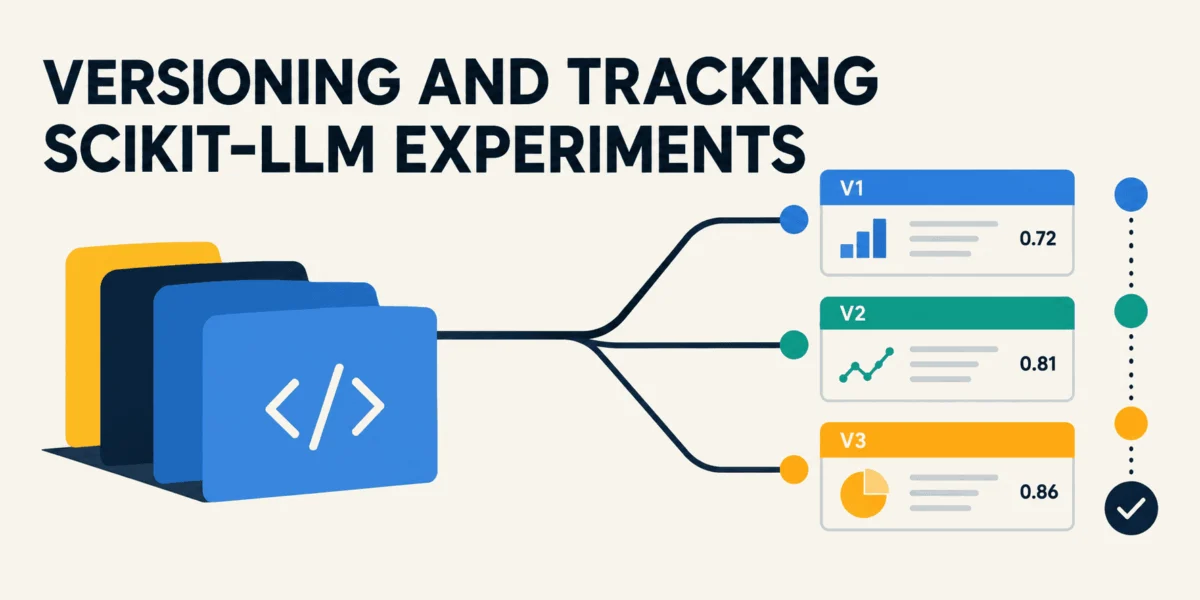

The integration of Large Language Models (LLMs) into standard machine learning workflows has introduced a critical challenge: the necessity for rigorous versioning, reproducibility, and lifecycle management. As data science teams increasingly move beyond experimental notebooks and into production-grade environments, the standard "trial and error" approach to LLM deployment is proving insufficient. By combining the Scikit-LLM library—which bridges the gap between scikit-learn’s intuitive API and generative AI models—with MLflow, an open-source platform for the machine learning lifecycle, practitioners can now implement robust, auditable, and scalable pipelines that maintain consistency even as underlying model architectures evolve.
The Evolution of LLM Integration
Historically, machine learning pipelines relied on static algorithms where parameters and hyperparameters were easily tracked through simple configuration files. The emergence of LLMs, however, has fundamentally altered this landscape. LLMs are not merely models; they are complex systems with distinct backends, prompt engineering layers, and varied tokenization strategies. A shift from a small model, such as Orca-Mini, to a more robust architecture, like Falcon, constitutes a "breaking change" in a pipeline, requiring precise tracking to ensure that performance metrics remain consistent and that models can be rolled back in the event of failure.
The industry has recognized this shift. According to recent surveys by the Linux Foundation and various AI research consortiums, over 65% of enterprises struggling with AI adoption cite "model lineage and version control" as their primary obstacle. Without a unified registry, teams often suffer from "notebook drift," where the logic used to train a model is lost, and the exact weights or configuration files become untraceable.
Setting the Foundation for Reproducible Experiments
To mitigate these risks, developers must adopt a standardized setup that enforces logging from the very first line of code. The initial step in building a production-ready LLM pipeline involves installing the necessary infrastructure. Using pip install "scikit-llm[gpt4all]" mlflow provides the essential connectivity required to execute local, private LLMs without the latency or privacy concerns associated with cloud-only APIs.
Configuring the environment requires more than simple installation; it necessitates the initialization of a centralized tracking database. By setting the MLflow tracking URI to a local SQLite database, teams create an immediate, searchable audit log. This is the cornerstone of the "Scikit-LLM-Versioning" experiment framework, where every training run, regardless of its success or failure, is recorded with its associated hyperparameters, model file identifiers, and environment snapshots.
Chronology of a Managed Pipeline
The lifecycle of an LLM-based classifier typically follows a three-phase progression: the Baseline Phase, the Iterative Upgrade Phase, and the Registration Phase.
In the Baseline Phase, developers define the initial model, typically utilizing a smaller, more efficient model to establish a performance floor. For instance, utilizing the Orca-Mini model allows for rapid testing of zero-shot classification logic. During this stage, the code snippet initiates a formal MLflow run. Crucially, this block uses mlflow.log_param to document the specific model backend and file path. This metadata is essential for future forensic analysis, allowing engineers to verify exactly which version of the model was used for a specific prediction set.
The Iterative Upgrade Phase represents the transition from prototype to refinement. When a developer decides to swap the backend—for example, upgrading to a Falcon-based architecture—they do not simply overwrite the old code. Instead, they trigger a new, separate MLflow run. This separation is vital. It allows for a direct "apples-to-apples" comparison between the Orca-Mini performance metrics and the Falcon performance metrics. By utilizing the cloudpickle serialization format, the pipeline ensures that the entire object state is preserved, overcoming the limitations of standard pickle files which often fail to capture complex, multi-layered LLM dependencies.
Auditing and Data-Driven Model Selection
One of the most significant advantages of this architecture is the ability to query the entire experimental history via the MLflow search API. By exporting run logs into a pandas DataFrame, team leads can perform a real-time audit of all attempts. This data-driven approach removes the subjectivity often associated with model selection.
A typical audit report might reveal a mix of FINISHED and FAILED runs. While this might appear messy at first glance, it is actually a vital diagnostic tool. A high frequency of FAILED runs for a particular model configuration can signal incompatibility with specific hardware or library versions. By analyzing the params.llm_model_file column alongside the status column, engineers can identify which LLM configurations are stable enough for deployment and which require further optimization.
Moving to the Model Registry
The final step in this lifecycle is the transition from an "experiment" to a "registered model." This is where the distinction between a sandbox and a production environment is solidified. Using mlflow.register_model, the highest-performing pipeline—determined by metrics such as accuracy, F1-score, or inference latency—is promoted to the registry.
This promotion process provides several benefits:
- Immutable Versioning: Once a model is registered, it receives a version number (e.g., Version 1). This ensures that upstream applications always pull the correct, tested artifact.
- Lifecycle States: Models can be tagged as "Staging," "Production," or "Archived," allowing for a clear, automated deployment path.
- Reproducibility: If a production system reports an anomaly, developers can pull the exact model version from the registry, re-instantiate it, and debug it in a local environment.
Implications for Enterprise AI
The broader implication of this workflow is the institutionalization of "AI Governance." As regulatory bodies worldwide begin to scrutinize the output of LLMs, the ability to trace a model’s lineage back to its original training data and configuration becomes a legal and operational necessity.
By automating the tracking of LLM-based pipelines, organizations reduce the "human-in-the-loop" errors that occur when developers manually keep track of model files in local directories. Furthermore, this approach enables a culture of experimentation. Because developers know their work is being safely logged and versioned, they are more likely to test diverse models and prompt strategies, knowing they can easily revert to a previous, known-good state.
Conclusion and Best Practices
The integration of Scikit-LLM with MLflow is not merely a convenience; it is a fundamental shift toward professionalizing generative AI development. For those building these systems, the mandate is clear: prioritize the tracking of your metadata as much as the training of your models.
To maintain a healthy pipeline, teams should adopt the following best practices:
- Always use persistent storage: Ensure your MLflow database is backed up regularly.
- Granular logging: Log every parameter that affects model output, including prompt templates, system instructions, and temperature settings.
- Automated Promotion: Integrate the "search and register" logic into your CI/CD pipelines to ensure that only models meeting a pre-defined accuracy threshold are ever registered for production.
As the industry moves toward more complex and agentic AI systems, the infrastructure for versioning and tracking will become the primary differentiator between successful, resilient AI applications and those that remain perpetually experimental. By adopting the methodologies outlined here, practitioners can navigate the volatility of the LLM landscape with confidence, precision, and an unwavering commitment to reproducible results.
