

Network security has evolved from a supplementary IT requirement into a core operational pillar for modern enterprises. As organizations increasingly adopt hybrid work models, cloud computing, and sprawling Internet of Things (IoT) ecosystems, the perimeter of the corporate network has expanded exponentially. This dynamic shift has transformed networks and enterprise servers into primary targets for sophisticated cyberthreats, making robust access control and meticulous policy management mandatory. At the heart of managing this complex security landscape within Windows Server environments lies the Network Policy Server (NPS), Microsoft’s native implementation of a Remote Authentication Dial-In User Service (RADIUS) server and proxy.
To fully grasp the operational mechanics of NPS, IT administrators must first understand the fundamental protocols that govern it, evaluate its core functions, and implement industry-standard deployment frameworks. This comprehensive analysis explores the history of network authentication, the architectural triad of Authentication, Authorization, and Accounting (AAA), the operational roles of NPS, and best practices for modern enterprise management.
Understanding the Evolution and Importance of Network Policy Management
The necessity for centralized policy management stems from the exponential growth of digital communication and remote connectivity. Historically, organizations relied on perimeter-based security models that assumed everything inside the corporate firewall was trustworthy. However, the proliferation of remote workers, bring-your-own-device (BYOD) policies, and third-party vendor integrations has dismantled the traditional network perimeter.
In response, cybersecurity frameworks have shifted toward Zero Trust architectures, which operate on the principle of "never trust, always verify." Centralized policy management platforms like NPS serve as the enforcement mechanism for these Zero Trust principles. By establishing a single source of truth for who is connecting to the network, what devices they are using, and what resources they are permitted to access, organizations can drastically reduce their attack surface. Without centralized oversight, administrators are forced to manage access permissions locally on individual switches, routers, and firewalls—a decentralized approach that inevitably leads to configuration drift, administrative oversight, and critical security vulnerabilities.
The Foundation: The RADIUS Protocol and AAA Architecture
To understand how NPS functions, one must examine the RADIUS protocol, which has served as the backbone of network access control for over three decades. Developed in 1991 by Livingston Enterprises (later acquired by Lucent Technologies and subsequently integrated into industry standards), RADIUS was designed to solve a fundamental networking problem: how to centrally manage access for dial-up users across multiple remote access servers.
Although dial-up connectivity has largely faded into technological history, the underlying architecture of RADIUS proved exceptionally resilient and adaptable. Today, it remains the global standard for managing network access across virtual private networks (VPNs), enterprise wireless access points (WAPs), and Ethernet switches utilizing 802.1X port-based authentication.
The operational framework of RADIUS is built upon the AAA model:
Authentication: This is the foundational step in network access control, responsible for verifying the identity of a user or device attempting to connect to the network. When a client initiates a connection request—such as logging into a corporate VPN—they must present credentials, typically a username and password, a digital certificate, or a multi-factor authentication (MFA) token. The RADIUS client (the network access server) forwards these credentials to the RADIUS server, which cross-references them against an authoritative user database, such as Active Directory Domain Services (AD DS). If the credentials match, identity is confirmed; if not, access is immediately rejected.
Authorization: Once identity is established, the authorization phase determines what the authenticated entity is permitted to do within the network ecosystem. Authentication confirms who you are, while authorization defines your boundaries. For example, a network administrator requires unrestricted access to core infrastructure servers, whereas a temporary contractor should be strictly quarantined to a guest VLAN with internet-only access. RADIUS servers evaluate user group memberships, time-of-day restrictions, and device compliance attributes to dynamically assign appropriate VLANs, access control lists (ACLs), or firewall rules.
Accounting: The final component of the AAA triad is accounting, which records the consumption of network resources. Accounting data tracks session start and stop times, data transfer volumes, specific services accessed, and termination causes. In enterprise environments, this telemetry is vital for internal auditing, capacity planning, regulatory compliance (such as HIPAA, PCI-DSS, and GDPR), and forensic investigations following a security incident.
The Client-Server Mechanics of RADIUS Operations
RADIUS operates entirely on a client-server architecture, relying on UDP (User Datagram Protocol) for transport communication. In this topology, the network access server (NAS)—such as a Cisco switch, a Fortinet firewall, or a remote access gateway—acts as the RADIUS client. The NPS instance functions as the RADIUS server.
When a user attempts to authenticate, the NAS packages the user’s credentials into a RADIUS Access-Request packet and transmits it to the NPS server over a designated port (traditionally UDP port 1812 for authentication and 1813 for accounting, though legacy ports 1645 and 1646 are occasionally encountered). The NPS server processes the request against its internal policy database and returns a cryptographically secured response packet: either Access-Accept, Access-Reject, or Access-Challenge (the latter is frequently utilized for multi-factor authentication workflows where a second verification factor is required).
The Core Purpose and Functional Scope of NPS
As Microsoft’s enterprise-grade RADIUS implementation, NPS bridges the gap between operating system directory services and network hardware infrastructure. Its primary objective is to centralize and automate the enforcement of network access policies across heterogeneous hardware environments.
Through centralized authentication and authorization, NPS eliminates the administrative overhead of maintaining local user accounts on network hardware. When an organization integrates NPS with Active Directory, user lifecycle management becomes seamless; when an employee departs the organization and their AD account is disabled, their network access is instantly revoked across all VPNs, wireless networks, and wired switch ports simultaneously.
Furthermore, NPS facilitates policy-based network management. Administrators can craft granular access rules dictated by a wide array of conditions, including client IP addresses, user group memberships, connection methods (e.g., wireless versus wired), certificate attributes, and device health metrics.

The Three Distinct Operational Roles of NPS
To deploy NPS effectively, network architects must understand the three distinct operational roles the server can fulfill within an enterprise infrastructure:
-
NPS as a RADIUS Server
In its most common deployment, NPS acts as a standalone RADIUS server that directly processes authentication, authorization, and accounting requests originating from network access servers. It validates credentials against local or domain databases and applies predefined network policies to determine access privileges. This role is essential for securing enterprise Wi-Fi networks utilizing WPA2/WPA3-Enterprise, securing remote VPN gateways, and enforcing 802.1X authentication on physical switch ports. -
NPS as a RADIUS Proxy
In large-scale or multi-tenant enterprise environments, NPS can function as a RADIUS proxy. Rather than processing authentication requests locally, a proxy server receives requests from network access servers and forwards them to other designated RADIUS servers based on pre-configured routing rules. This capability is indispensable for organizations with complex administrative boundaries, partner networks, or multi-forest Active Directory topologies. Furthermore, acting as a proxy allows NPS to provide essential enterprise reliability features, including load balancing across multiple backend RADIUS servers and automatic failover mechanisms if a primary authentication server becomes unresponsive. -
NPS as a Network Policy Server
Beyond handling authentication packets, NPS acts as a policy decision point. It evaluates connection requests against a prioritized list of network policies, ensuring that access is granted only under explicit, compliant conditions. This role also historical ties to Network Access Protection (NAP), allowing administrators to enforce health policies that verify whether connecting devices run up-to-date antivirus software, active firewalls, and mandatory operating system patches before granting entry to the corporate network.
Strategic Benefits of Implementing NPS in Enterprise Environments
The integration of Network Policy Server into an organization’s IT infrastructure yields substantial operational and security advantages:
Enhanced Security Posture: By removing hardcoded credentials from network devices and mandating encrypted, tokenized, or certificate-based authentication, NPS drastically reduces the risk of credential interception and unauthorized lateral movement.
Administrative Efficiency: Centralizing access control within Windows Server minimizes the time IT staff spend managing disparate network device configurations. Policy changes made once in NPS instantly propagate across the entire enterprise infrastructure.
Scalability and Flexibility: NPS integrates natively with Microsoft Active Directory and supports a vast array of Extensible Authentication Protocol (EAP) types, including Protected EAP (PEAP), EAP-TLS (Transport Layer Security), and EAP-MSCHAP v2, accommodating everything from simple password authentication to highly secure public key infrastructures (PKI).
Comprehensive Auditing Capabilities: Detailed accounting logs generated by NPS provide security operations centers (SOC) with the telemetry required to monitor user behavior, detect anomalous connection attempts, and satisfy rigorous compliance mandates.
Industry Best Practices for NPS Deployment and Management
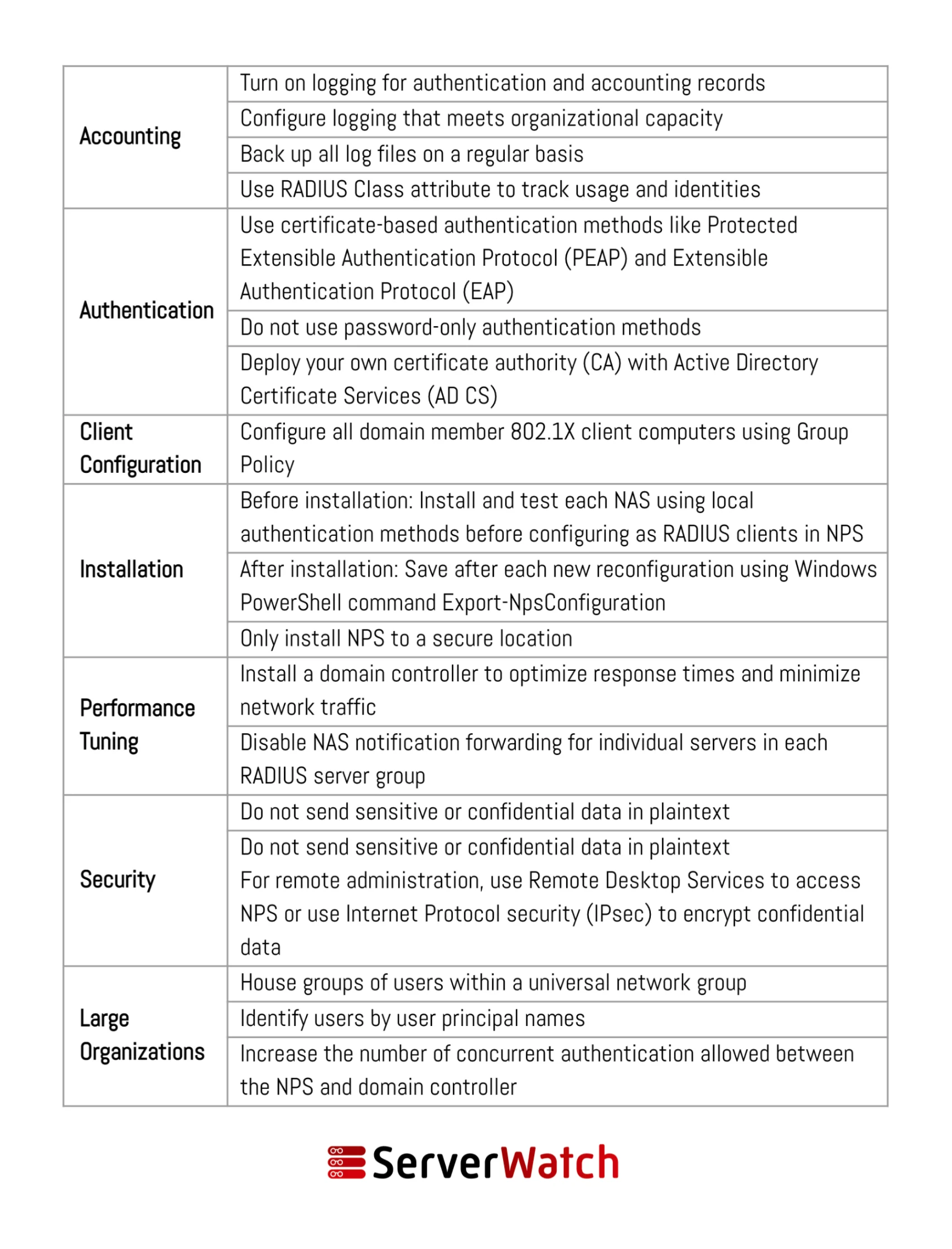
To ensure high availability, optimal performance, and resilience against cyberattacks, Microsoft and enterprise security architects recommend adhering to established best practices when deploying and managing NPS:
Deploy Redundant NPS Infrastructure: Because authentication is a mission-critical service, relying on a single NPS instance introduces a catastrophic single point of failure. Organizations should deploy a minimum of two clustered or load-balanced NPS servers across separate hardware hosts or virtualization domains to ensure continuous uptime.
Secure RADIUS Shared Secrets: Communication between RADIUS clients and the NPS server relies on pre-shared secrets for packet encryption and integrity verification. Administrators must utilize cryptographically strong, complex shared secrets that are rotated periodically and never reused across different network devices.
Restrict RADIUS Client Subnets: To prevent unauthorized devices from attempting to authenticate against the NPS server, administrators should strictly define allowed client IP addresses or subnets within the NPS console, rejecting all unlisted connection attempts by default.
Implement Comprehensive Logging and Monitoring: Enable detailed accounting and event logging. Regularly export NPS logs to a centralized Security Information and Event Management (SIEM) platform to monitor for brute-force attacks, authentication anomalies, and policy violations.
Regularly Update Certificates: If utilizing certificate-based authentication methods like EAP-TLS, ensure that internal Certificate Authority (CA) root and intermediate certificates are monitored for expiration and that revocation checking (CRL/OCSP) is properly configured and operational.
Bottom Line: The Integral Role of NPS in Modern Network Management
As cyberthreats grow increasingly sophisticated and enterprise perimeters continue to dissolve, Network Policy Server remains an indispensable asset for IT administrators and security professionals alike. By centralizing authentication, authorization, and accounting through a robust RADIUS architecture, organizations can enforce rigorous access policies without sacrificing operational agility. Implementing NPS not only hardens corporate networks against unauthorized intrusion but also streamlines administrative workflows, ensuring that network resources remain accessible exclusively to verified users and compliant devices. For organizations seeking to optimize their authentication infrastructure, pairing a well-configured NPS deployment with advanced testing and monitoring tools guarantees sustained performance, high availability, and unwavering adherence to enterprise security standards.
