

Visual design software giant Canva has spent over a decade democratizing graphic creation for millions of individuals, small businesses, and enterprise teams. Founded 13 years ago, the platform disrupted an industry plagued by steep learning curves, expensive licenses, and fragmented toolsets. By centralizing design workflows into an accessible web-based platform, Canva scaled rapidly, eventually surpassing an Annual Recurring Rate (ARR) of $4 billion by the close of 2025 and achieving a massive $42 billion private market valuation.
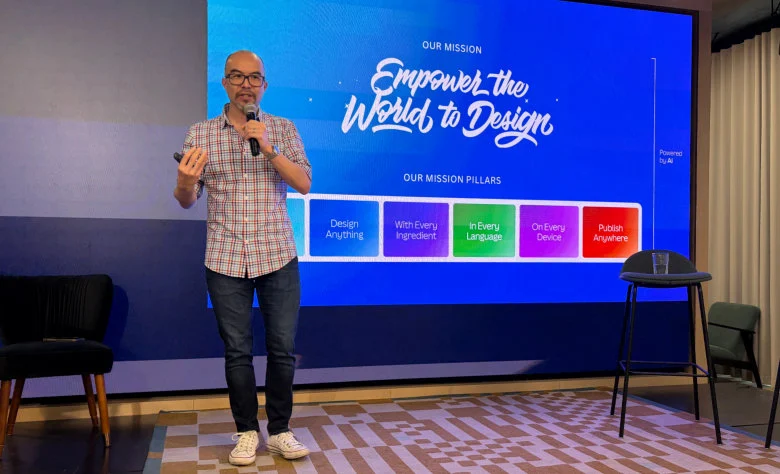
However, the meteoric rise that defined the company’s early years has encountered a complex new reality shaped by the generative artificial intelligence boom. While AI has reinforced Canva’s core mission, it has simultaneously introduced unprecedented operational challenges, shifted investor expectations, and brought forth a new wave of nimble, AI-native competitors. This delicate juncture in the company’s trajectory was highlighted during a recent visit to London by Cameron Adams, Canva co-founder and Chief Product Officer, as part of the company’s AI Vision event series.
The Genesis of Canva AI 2.0 and the Unforeseen Surge in Demand
Earlier this year, Canva rolled out a comprehensive re-architecture of its platform, introducing Canva AI 2.0. The strategic goal was to embed agentic AI at the very heart of the ecosystem, allowing users to automate complex design processes and interact with tools fluidly. According to company leadership, the initiative aimed to democratize AI capabilities in the exact manner Canva had previously democratized foundational graphic design.
The market response was immediate and overwhelming. Canva currently boasts a global user base of approximately 250 million active users. When Canva AI 2.0 became available, millions of users gravitated toward the new features simultaneously. Internal engagement metrics revealed that individuals utilizing the AI-driven tools were three times more likely to continue using AI than standard users, resulting in an active user base of roughly 75 million interacting with the new functionalities.
While this high engagement signaled a powerful product-market fit, it exposed a critical vulnerability: infrastructure strain and unsustainable tokenomics. The computational overhead required to power generative AI tasks for tens of millions of users simultaneously created a severe financial burden. Operating costs escalated sharply, transforming high user engagement into a volatile economic challenge.
Investor Jitters, Growth Projections, and Valuation Pressures
The sudden realization of soaring inference costs forced Canva’s leadership to temporarily throttle the broader rollout of the AI platform in mid-2025. This pause, implemented to regain control over backend infrastructure and system expenses, directly impacted the company’s short-term financial outlook.
According to financial disclosures reported by the Australian Financial Review, Canva’s Q2 update in early August downgraded its full-year revenue growth projections from an anticipated 30 percent down to 20 percent. While a 20 percent growth rate remains robust for a tech vendor operating at a multi-billion-dollar scale, the sudden downgrade triggered immediate jitters across the investment landscape. Reports subsequently surfaced indicating that certain private market investors sought to offload shares on the secondary market at steep discounts—reportedly up to 29 percent below the company’s peak $42 billion USD valuation.
Despite persistent speculation regarding an initial public offering (IPO), Canva’s founders have maintained a deliberate stance, indicating they are under no immediate pressure to take the company public. Instead, leadership prioritized internal operational remediation over capital market maneuvers.
Engineering Resilience: Achieving a Ninety Percent Reduction in Task Costs
Faced with severe cost inflation, Canva initiated an aggressive four-month engineering overhaul. The primary objectives were clear: optimize system architecture, decouple computational reliance on expensive third-party foundational models, and drastically reduce the cost-per-task metric.
According to Adams, the engineering and product teams executed a multi-vector optimization strategy. This included evaluating and hybridizing in-house models with external foundational architectures, categorizing user intent to route specific workflows to the most cost-effective models, and renegotiating global server and compute distribution agreements.
The turnaround proved successful. Canva managed to reduce its per-task AI generation costs by 90 percent while preserving the underlying quality and responsiveness of the user experience. This dramatic efficiency gain allowed the company to resume its rollout plans, ultimately extending Canva AI 2.0 capabilities to its vast tier of free users without destabilizing corporate margins.
Expanding the Ecosystem: The Rollout of ProSuite and Affinity Integration
Concurrent with its AI infrastructure remediation, Canva continued to aggressively expand its product portfolio. Since the beginning of the year, the platform has integrated over 100 updates across its flagship Visual Suite.
A major milestone in this expansion was the introduction of ProSuite, a dedicated collection of professional-grade tools tailored for advanced designers and creative enterprises. ProSuite unifies several powerful acquisitions and platforms, including the Affinity design platform, the Cavalry animation tool, the Flourish data visualization software, and the Leonardo generative AI platform. By integrating these specialized applications with streamlined enterprise workflows, Canva has solidified its positioning within professional corporate environments. Building upon this momentum, the company announced that a long-awaited iPad version of the updated Affinity platform is scheduled for release in November.
The Enterprise Proposition and the Threat of Stealth Churn
Canva’s enterprise business has experienced substantial momentum, doubling over the past year as major corporations adopt its unified visual workflow engine. However, the enterprise software market is rapidly evolving. The emergence of foundation model agents—such as Anthropic’s Claude, OpenAI’s ChatGPT, and Google’s Gemini—provides corporate users with alternative entry points for executing tasks that previously required specialized software interfaces.
Industry observers have noted that enterprise buyers are increasingly experimenting with conversational AI agents as primary orchestrators for data analysis and content generation. This shift introduces the phenomenon of "stealth churn," a concept highlighted by SaaS expert and SaaStr founder Jason Lemkin. Stealth churn occurs when power users and early adopters quietly migrate to AI-native alternatives while broader corporate adoption numbers continue to mask the underlying disengagement at the edges. Because overall top-line revenue and new user acquisition remain strong, such subtle defections often go unnoticed until they materialize as broader market trends 12 to 18 months later.
Canva’s leadership contends that while foundation models provide a useful starting point, they lack the contextual memory, collaborative frameworks, and brand-governance infrastructure required for enterprise execution. Adams emphasized that while users may initiate a design prompt within an external LLM, they invariably require a centralized platform to refine, share, scale, and govern those creative assets across diverse corporate departments—from marketing and sales to human resources and internal communications.
Combating Homogeneity in Generative AI Content
Another prominent challenge facing the digital design ecosystem is the rising dissatisfaction with the generic visual style produced by standard foundational AI models. Mass-market generative tools often yield homogenized imagery characterized by recognizable stylistic tropes that lack authentic brand identity.
To address this limitation, Canva has focused on fusing its collaborative creative platform with specialized AI capabilities designed to foster individual expression and distinctive visual branding. By embedding multi-step workflows rather than relying solely on single-prompt text boxes, the platform aims to support complex organizational processes—ranging from initial brainstorming and team collaboration to automated multi-format scaling—ensuring that human creativity remains firmly at the center of the design lifecycle.
Broader Market Implications and Future Outlook
Canva’s recent trajectory serves as an instructive case study for the broader software-as-a-service (SaaS) industry as it grapples with the economic realities of artificial intelligence. The transition from traditional software monetization to high-compute token economics has introduced volatile financial parameters that even rapidly growing enterprises struggle to forecast accurately.
As Canva prepares for its next phase of growth, it must navigate the dual challenges of managing sophisticated AI infrastructure costs and differentiating its value proposition against a rapidly proliferating field of AI-native competitors. While the company’s platform architecture, collaborative environment, and enterprise momentum position it favorably, the changing nature of user interaction—moving from screen-based software navigation to agentic conversational interfaces—will require continued strategic adaptation. For enterprise buyers and technology vendors alike, the current market landscape underscores the critical need for rigorous evaluation of AI unit economics, platform stickiness, and true operational value beyond the initial hype cycle.
