
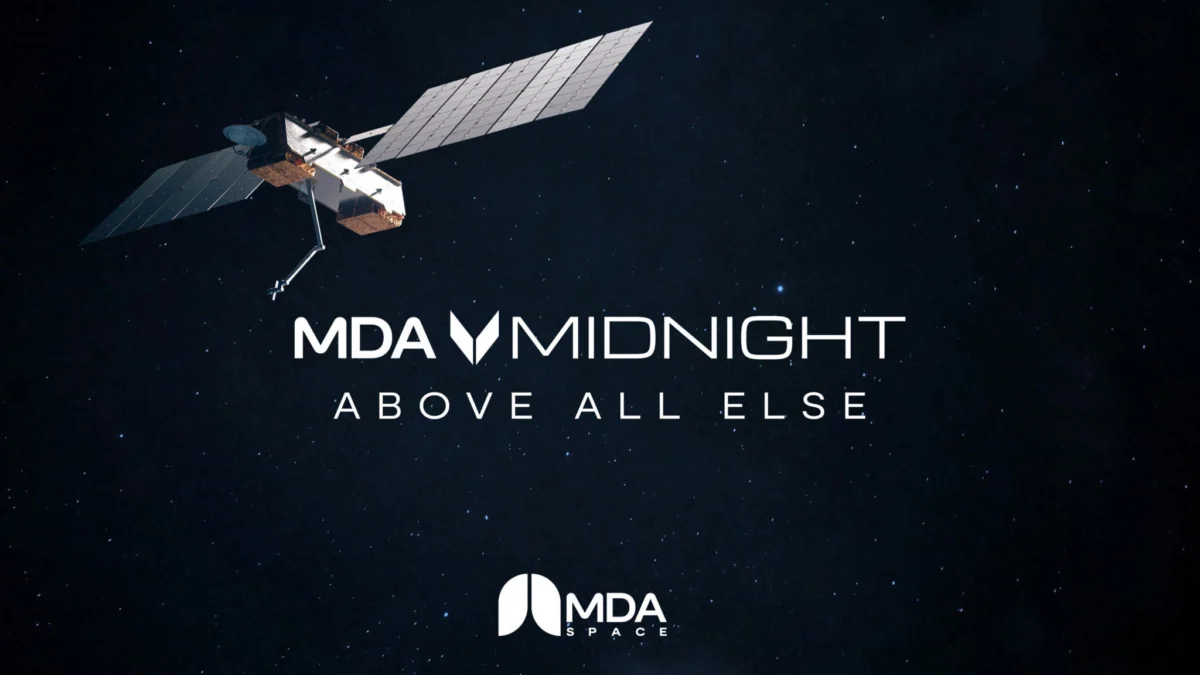

In a significant move that signals a paradigm shift in the management of orbital assets, Toronto-based MDA Space officially introduced MDA Midnight, a sophisticated on-orbit servicing platform, during the opening sessions of the Space Symposium on Monday morning. The announcement comes at a pivotal moment for the global space industry, as the transition from passive observation to active space domain management becomes a strategic priority for both sovereign nations and commercial enterprises. Designed to operate at the intersection of logistics and defense, Midnight represents a leap forward in Rendezvous and Proximity Operations (RPO), offering a suite of capabilities intended to protect, maintain, and sustain critical infrastructure in the increasingly congested and contested environment of Earth’s orbit.
The MDA Midnight platform is engineered to function as a multi-purpose orbital vehicle capable of executing complex maneuvers in close proximity to other spacecraft. According to the company’s technical briefing, the primary mission of Midnight is to detect, identify, counter, and deter threats to space assets. By integrating high-resolution sensing with robotic manipulation, the platform aims to transform the current state of Space Domain Awareness (SDA)—which largely relies on ground-based tracking—into a proactive, space-based "Space Control" capability. This shift allows operators to not only see what is happening in orbit but to interact with and influence the environment in real-time.
A Comprehensive Suite of On-Orbit Capabilities
The first mission of the MDA Midnight platform is slated to be a comprehensive demonstration of its versatile operational profile. MDA Space has outlined a rigorous set of objectives for this inaugural flight, which will serve as a proof-of-concept for the platform’s diverse service offerings. These capabilities are divided into four primary categories: inspection, defense, logistics, and end-of-life management.
In terms of inspection and diagnostic services, Midnight is designed to approach resident space objects (RSOs) to perform high-fidelity visual and sensor-based assessments. This allows operators to verify the health of a satellite, diagnose mechanical failures, or identify external interference that cannot be characterized from the ground. Beyond simple observation, the platform is equipped to detect and attribute electronic countermeasures. As electronic warfare becomes a more prevalent threat in the space domain, the ability to identify the source of jamming or spoofing signals and implement mitigation strategies is a critical requirement for military and government clients.
The platform also features advanced robotic interfaces for physical interaction. This includes the ability to capture and release cooperative satellites—those designed with compatible docking or grappling points—as well as the capacity to relocate assets to different orbital slots. Furthermore, MDA Space highlighted satellite refueling as a core future capability, addressing one of the most significant limitations of modern spaceflight: the finite lifespan of satellites due to fuel depletion. By extending the operational life of high-value assets, Midnight offers a clear economic incentive for commercial telecommunications and Earth observation operators.
Finally, Midnight addresses the growing concern of orbital debris and "zombie" satellites. The platform is designed to grapple non-operational assets and perform controlled de-orbiting maneuvers. This capability is essential for maintaining the long-term sustainability of the space environment, particularly in high-traffic orbits where a single collision could trigger a catastrophic chain reaction of debris.
Leveraging a Legacy of Robotic Excellence
The development of Midnight does not occur in a vacuum; rather, it is the culmination of decades of expertise in space robotics. MDA Space is perhaps best known for its contribution to the Space Shuttle and International Space Station (ISS) programs through the development of the Canadarm, Canadarm2, and the Special Purpose Dexterous Manipulator (Dextre). This heritage provides the company with a unique advantage in the emerging on-orbit servicing, assembly, and manufacturing (OSAM) market.
Holly Johnson, Vice President of Robotics and Space Operations at MDA Space, emphasized that the company’s flight controller team possesses millions of hours of experience in planning and conducting complex on-orbit operations. "At MDA Space, our technology and our team have a proven track record of executing free-flyer captures and robotic maintenance in the harshest environments," Johnson stated during the unveiling. "As we bring this leadership to serve space defense customers, we are actively seeking military partnerships to collaborate on upcoming mission profiles and timing, as well as commercial payload partners to augment our suite of on-orbit capabilities."
Technologically, Midnight leverages two of MDA’s most recent and advanced product lines: the Skymaker robotic suite and the Aurora satellite bus platform. Skymaker is a modular, scalable robotic system designed for a variety of space applications, ranging from small-scale lunar exploration to large-scale orbital assembly. The Aurora platform, a software-defined satellite bus, provides the necessary power, propulsion, and communication infrastructure to support the intensive demands of RPO. By combining these modular technologies, MDA Space has created a platform that is both highly capable and adaptable to specific mission requirements.
The Geopolitical and Strategic Context
The unveiling of MDA Midnight coincides with a period of heightened strategic focus on space as a "fifth domain" of warfare, alongside land, sea, air, and cyber. Canada’s federal government recently underscored this shift by declaring space launch and space operations as a key sovereign capability. This policy alignment reflects a broader trend among NATO allies to secure their space-based assets, which are vital for everything from global positioning and timing to secure military communications and missile warning systems.
In the United States, there has been a growing chorus of experts and policymakers calling for the formal recognition of space as a critical infrastructure sector. Proponents argue that the modern economy and national security apparatus are so dependent on space-based services that any disruption would have devastating terrestrial consequences. The introduction of a "Space Control" platform like Midnight directly addresses these concerns by providing a physical layer of protection for these assets.
The concept of "Space Control" is often categorized into two areas: offensive and defensive. While MDA Space has framed Midnight primarily as a defensive and logistical tool, the technology inherent in RPO is inherently dual-use. The ability to approach and manipulate a satellite for repair is technically similar to the ability to approach and disable a satellite. This duality places MDA Space at the forefront of the conversation regarding space norms and the "rules of the road" for orbital proximity operations. By marketing the platform as a means of "turning space domain awareness into actionable decision-making," MDA is positioning itself as a key enabler for "tactically responsive space"—a concept championed by the U.S. Space Force that emphasizes the ability to rapidly deploy or maneuver assets in response to emerging threats.
Market Outlook and Industry Implications
The market for on-orbit servicing and space control is projected to grow exponentially over the next decade. According to various industry analyses, the OSAM market could be worth several billion dollars by the early 2030s, driven by the proliferation of mega-constellations and the increasing value of geostationary (GEO) assets. MDA Space is entering a competitive landscape that includes established aerospace giants and well-funded startups, such as Northrop Grumman with its Mission Extension Vehicles (MEV) and Astroscale, which focuses on debris removal.
However, MDA’s integrated approach—combining its own satellite bus with its world-leading robotics—gives it a vertical integration advantage that few competitors can match. Furthermore, the company’s status as a Canadian champion allows it to act as a bridge between U.S. defense requirements and international commercial markets.
The implications for the broader satellite industry are profound. For years, satellites were viewed as "disposable" assets; once they ran out of fuel or suffered a mechanical failure, they were abandoned. The arrival of platforms like Midnight changes the financial modeling of space missions. Operators can now consider "life-extension" as a viable alternative to the costly process of building and launching a replacement satellite. This shift toward a "circular economy" in space not only improves the return on investment for operators but also mitigates the growing problem of space congestion.
Conclusion and Future Trajectory
As MDA Space moves forward with the development and deployment of the Midnight platform, the industry will be watching closely to see how it navigates the complex regulatory and diplomatic challenges associated with RPO. The success of the first demonstration mission will be a bellwether for the viability of active space defense and the broader on-orbit servicing sector.
By bridging the gap between historical robotic expertise and the future of space defense, MDA Space is positioning itself as a central player in the next era of space exploration and security. The Midnight platform is more than just a satellite; it is a statement of intent regarding how space will be managed in the 21st century. As space becomes increasingly crowded and contested, the ability to act—not just watch—will be the defining characteristic of a leading space power. With Midnight, MDA Space is providing the tools necessary to ensure that the space domain remains a stable, secure, and productive environment for all stakeholders.
