
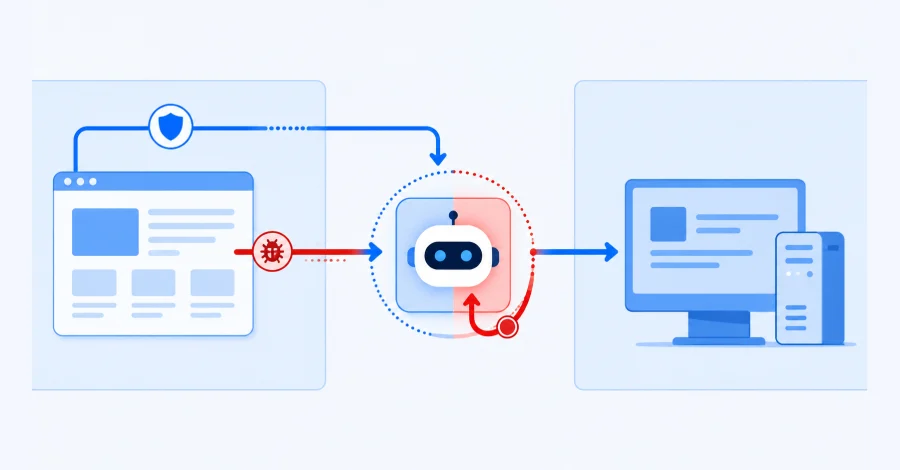

Microsoft researchers have unveiled a critical exploit chain, dubbed "AutoJack," that weaponizes AI browsing agents, turning them into potent delivery mechanisms for remote code execution (RCE). This sophisticated attack vector, detailed in a recent publication, demonstrates how an attacker can manipulate an AI agent to load a malicious webpage, subsequently leveraging that page’s JavaScript to access a privileged local service and spawn processes on the host machine. The revelation underscores a growing concern within the cybersecurity community regarding the nascent field of AI agent security and the inherent risks associated with granting these autonomous entities broad system access.
The AutoJack exploit stands out due to its operational simplicity and high impact: once an attacker successfully coaxes the AI agent into opening a specially crafted web page, no further credentials, sign-in screens, or user interactions are required. The initial compromise can be achieved through various common methods, including a planted malicious link, a manipulated URL field within the agent’s interface, or even a subtle prompt injection. This ease of execution, coupled with the potential for direct system compromise, elevates AutoJack to a significant threat for developers and organizations utilizing specific configurations of AI agent frameworks.
The Genesis of AutoJack: AutoGen Studio and its Vulnerable Pre-Releases
At the heart of the AutoJack vulnerability lies AutoGen Studio, an open-source prototyping interface developed by Microsoft Research for its AutoGen multi-agent framework. AutoGen, designed to facilitate the creation of complex, multi-agent AI applications, has garnered significant attention for its flexibility and power. AutoGen Studio serves as a user-friendly environment for developers to experiment with and deploy these agents. However, the rapid pace of open-source development and iterative releases inadvertently introduced a critical security flaw.
The core of the issue resides not in the most widely adopted stable release of AutoGen Studio but in specific pre-release builds. Microsoft’s initial statement correctly noted that the vulnerable Model Context Protocol (MCP) WebSocket surface “was never included in a PyPI release” for the stable build, specifically version 0.4.2.2. A standard pip install autogenstudio command would typically pull this stable release, leaving users unaffected. This distinction is crucial, as it limits the immediate widespread exposure to users who might have, intentionally or unintentionally, opted for less stable, developmental versions.

However, further investigation, including independent verification by The Hacker News, confirmed that the vulnerable handler did indeed ship to PyPI in two specific pre-release builds: 0.4.3.dev1 and 0.4.3.dev2. These versions, while not installed by default without the --pre flag or explicit version pinning, contained the MCP WebSocket route that allowed for unauthenticated command execution. The presence of this handler, which directly took commands from requests without authentication, meant that anyone who specifically installed these pre-release versions was exposed to the AutoJack exploit. As of the reporting, these vulnerable pre-release builds had not been "yanked" from PyPI, meaning they remained available for download, albeit under specific conditions.
A Deeper Look: How the AutoJack Exploit Chain Unfolds
The AutoJack exploit is a meticulously crafted chain that leverages three distinct weaknesses within the MCP WebSocket implementation present in the aforementioned pre-release versions of AutoGen Studio. Understanding these weaknesses is key to appreciating the severity of the attack and the broader implications for AI agent security.
-
The Localhost Trust Fallacy: The first critical flaw stems from a misconfigured trust boundary. The MCP WebSocket was designed to trust connections originating from
localhost. This check is typically intended to prevent a standard web browser, when pointed at a malicious external site, from directly interacting with local services. However, the design failed to account for the unique operational context of an AI browsing agent. When such an agent, running on the same machine as AutoGen Studio, loads an attacker’s web page, it effectively inherits thelocalhostidentity. This allows the malicious page, rendered by the agent, to bypass thelocalhostcheck and initiate communication with the privileged local service, effectively nullifying this intended security measure. -
Authentication Middleware Bypass: The second weakness compounded the first. The authentication middleware responsible for securing AutoGen Studio’s various paths was configured to skip MCP paths. This decision was based on the assumption that the MCP handler itself would implement robust token verification. Unfortunately, this critical verification step was never implemented within the handler. As a result, the MCP WebSocket accepted unauthenticated connections irrespective of the overall authentication mode configured for AutoGen Studio. This oversight created a direct conduit for any entity that could reach the MCP WebSocket, including a malicious webpage loaded by a local AI agent, to interact with it without proving its identity or authorization.
-
Unrestricted Command Execution: The final, and arguably most devastating, component of the chain was the endpoint’s ability to directly execute commands. The MCP endpoint was designed to take a command straight from a request parameter and run it, critically lacking any form of an allowlist or validation mechanism to restrict which executables could be launched. This meant that once the malicious webpage, via the unauthenticated
localhost-privileged WebSocket, sent a command, the AutoGen Studio process would execute it directly.
When these three weaknesses are chained together, the outcome is a powerful remote code execution vulnerability. An attacker only needs to entice a local AI agent to render a carefully crafted web page. That page’s JavaScript can then establish an unauthenticated connection to the local MCP WebSocket, leveraging the perceived localhost trust, and inject an arbitrary command. This command is then executed on the host machine under the security context and privileges of the account running AutoGen Studio, granting the attacker substantial control over the compromised system.
Microsoft demonstrated the proof of concept using a "Web Content Summarizer" agent. When this agent was fed an attacker-controlled URL, it triggered the exploit, resulting in calc.exe (the Windows calculator application) popping up on the developer’s desktop, launched directly by the AutoGen Studio process. While calc.exe is a benign demonstration, it clearly illustrates the ability to execute any arbitrary command, highlighting the potential for far more malicious activities, such as data exfiltration, malware deployment, or system takeover.
Timeline of Discovery and Mitigation Efforts
The discovery of AutoJack represents a proactive security effort by Microsoft researchers, rather than a reaction to an active campaign. Upon identifying the exploit chain, the findings were promptly reported to the Microsoft Security Response Center (MSRC). This internal coordination facilitated a rapid response from the AutoGen Studio maintainers.
The vulnerability was addressed and hardened in the main branch of the AutoGen GitHub repository through commit b047730 (associated with Pull Request #7362). This critical fix implements several key changes:
- The fixed handler no longer reads the command directly from the URL. Instead, command parameters are now stored server-side and accessed via a one-time session ID, with unknown or expired IDs being refused.
- MCP routes are now routed through the normal authentication path, ensuring that they are no longer bypassed.
- Crucially, explicit authentication and authorization checks are now enforced for these privileged operations.
Despite the swift action on the source code, the hardening changes had not yet landed in a new, stable PyPI release at the time of reporting. This means that users who had installed the vulnerable pre-releases still lacked an official patched version to upgrade to via pip. The recommended course of action for these users is to pull directly from the GitHub main branch at or after commit b047730 to ensure they are running the secure version.

Scope of Impact and User Guidance
It is important to reiterate that the AutoJack vulnerability does not affect all users of AutoGen Studio.
- Unaffected Users: Anyone who performed a standard
pip install autogenstudiowould have received the stable 0.4.2.2 release, which does not contain the MCP route and is therefore not vulnerable. - Affected Users: Only those who explicitly installed one of the pre-release versions (0.4.3.dev1 or 0.4.3.dev2), typically by using the
--preflag withpip installor by pinning the version directly, are exposed to this exploit.
Given that no active exploitation in the wild has been reported, the immediate risk is contained to a specific subset of developers and researchers experimenting with bleeding-edge versions. However, the potential for future exploitation, particularly if these pre-release versions remain in use or become more widely adopted without proper patching, is significant.
For affected users, Microsoft and cybersecurity experts strongly recommend the following mitigation strategies:
- Immediate Source Update: If you are running pre-release versions 0.4.3.dev1 or 0.4.3.dev2, update your installation by pulling the latest code directly from the AutoGen GitHub main branch at or after commit
b047730. This is the most effective and comprehensive fix. - Architectural Separation: Avoid running AutoGen Studio on the same machine as any browsing or code-execution agent that interacts with untrusted external content. The exploit chain critically relies on both components sharing the same
localhostenvironment. Separating them breaks this crucial link. - Isolation through Virtualization/Containerization: For environments where AutoGen Studio and agents must coexist, isolate them within separate containers or virtual machines (VMs). This creates a stronger security boundary, preventing the
localhosttrust bypass from impacting the host system or other sensitive processes. - Principle of Least Privilege: Run AutoGen Studio under a low-privilege account. In the event of a compromise, this minimizes the potential damage an attacker can inflict, restricting their access to sensitive system resources.
Broader Implications for AI Agent Security
The AutoJack exploit serves as a stark reminder of the evolving security landscape introduced by the proliferation of AI agents. Microsoft researchers explicitly state that the pattern observed in AutoJack is not unique to AutoGen Studio and is likely to manifest in other agent frameworks. The fundamental challenge lies in the convergence of an AI agent’s ability to browse the open web (and thus encounter untrusted content) with its privileged access to local services.

This isn’t the first time Microsoft has highlighted such architectural vulnerabilities. The "localhost as a trust boundary" fallacy has been a recurring theme in recent AI security research.
- ChatGPhish (May 2026): A vulnerability where ChatGPT’s page summaries could be manipulated to create highly effective phishing vectors. While different in mechanism, it underscored how AI’s interaction with web content can be weaponized.
- Semantic Kernel RCE Research (May 2026): Tracked as CVE-2026-26030 and CVE-2026-25592, this research also by Microsoft detailed Remote Code Execution vulnerabilities in AI agent frameworks, making similar arguments about the dangers of relying on
localhostchecks for security.
These incidents collectively underscore several critical principles for securing the next generation of AI applications:
- Beyond Localhost: Developers must abandon the notion that
localhostprovides an inherent trust boundary when AI agents are involved. Any agent capable of interacting with external content must be treated as a potential conduit for malicious input, regardless of its local origin. - Robust Authentication and Authorization: All control planes and privileged services accessed by AI agents must implement strong, explicit authentication and authorization mechanisms. Assuming a handler will perform these checks or skipping them based on perceived
localhostorigin is a recipe for disaster. - Strict Allowlisting for Process Execution: Any AI framework that offers the ability to execute local commands must implement a strict allowlist of approved executables and parameters. Unrestricted command execution is an open invitation for RCE.
- Principle of Least Privilege for Agents: AI agents should operate with the absolute minimum necessary privileges. Granting them the same permissions as a developer’s session is a significant security risk. Agents should have distinct, limited identities.
- Secure-by-Design Philosophy: As AI agents become more sophisticated and integrated into critical workflows, security must be a foundational consideration from the outset of development, not an afterthought. This includes threat modeling, secure coding practices, and continuous security auditing.
The AutoJack exploit serves as a critical lesson and a call to action for the entire AI development ecosystem. While the immediate threat is contained, the underlying patterns of vulnerability highlight a systemic challenge in securing rapidly evolving AI technologies. Proactive measures, adherence to fundamental cybersecurity principles, and continuous vigilance will be paramount in ensuring that AI agents remain tools for innovation rather than vectors for compromise. The cybersecurity community, developers, and framework maintainers must collaborate to build a resilient and secure future for artificial intelligence.
