
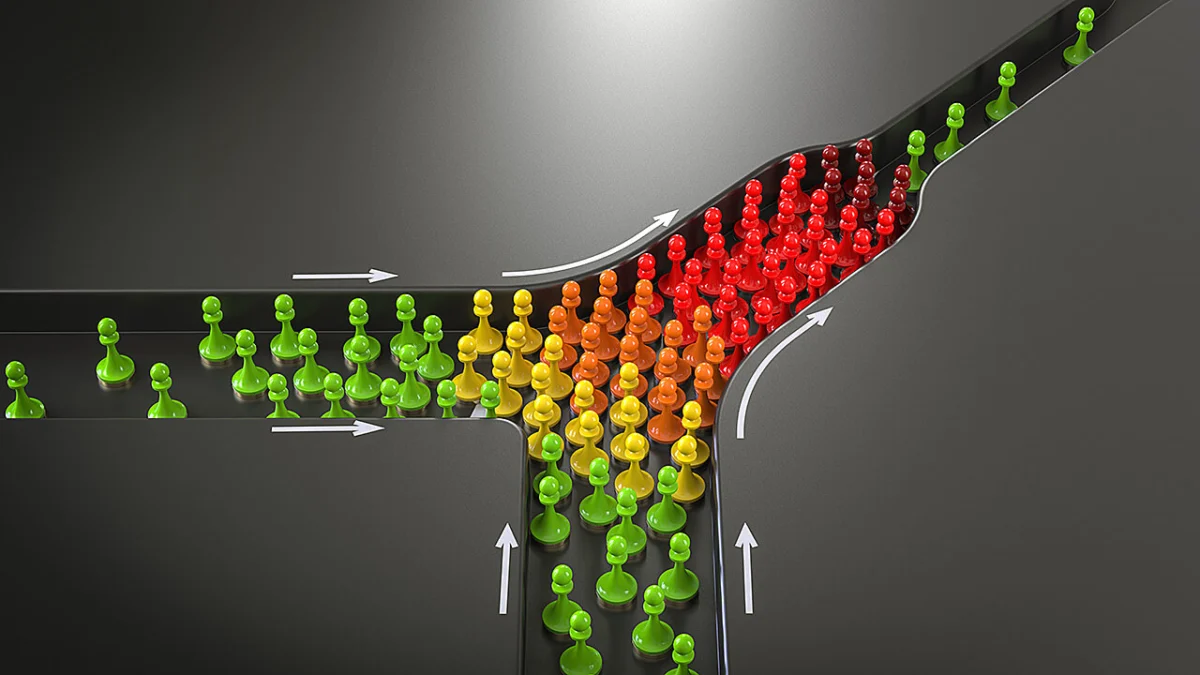

Less than 48 hours after unveiling Kimi K3, an advanced open-weight AI model, Moonshot AI has been forced to temporarily suspend new subscriptions due to an unprecedented surge in demand that has exhausted its available GPU infrastructure. This situation highlights a critical bottleneck in the rapidly expanding AI landscape: inference demand is now significantly outpacing the available computing power, particularly as models are tasked with increasingly complex and resource-intensive operations. While existing users will continue to have access, Moonshot AI is actively working to expand its infrastructure and will gradually reopen subscriptions in staggered batches.
The Unforeseen Surge: Demand Outstrips Supply
The swift popularity of Kimi K3 has presented Moonshot AI with a challenge of success. The company announced on X, formerly Twitter, "Kimi K3 has received far more love than we expected, and our GPUs are feeling it." This statement underscores the company’s surprise at the model’s reception and the immediate strain it placed on their computational resources. The influx of new users and the intensive usage patterns have pushed their current capacity to its limits, necessitating the pause in new sign-ups to ensure a stable and responsive experience for their existing user base.
This incident is not an isolated event but rather a symptom of a broader industry-wide trend. As AI models evolve to handle more sophisticated tasks, including lengthy coding sessions and complex agentic workflows, the demand for inference capabilities has escalated beyond initial projections. Companies across the AI spectrum, from established giants like OpenAI and Anthropic to emerging players like Moonshot AI, are grappling with this capacity crunch. This reality is driving strategies such as rationing access and moving away from offering unlimited usage, as the underlying infrastructure struggles to keep pace with the exponential growth in AI model adoption and application.
The official statement from Moonshot AI elaborated on the situation: "Over the past 48 hours, demand has pushed close to the limits of our current capacity. To protect the experience of existing subscribers, we’re temporarily pausing new subscriptions and will be adding capacity as fast as we can and will reopen new subscription spots in batches." This measured approach aims to balance the desire to onboard new users with the imperative to maintain service quality and avoid performance degradation.
Open Weights, Closed Capacity: The Inference Dilemma
Kimi K3, boasting an impressive 2.8 trillion parameters, is positioned as one of the largest open-weight models slated for release, with its public weight drop scheduled for July 27. In benchmark evaluations, K3 has demonstrated remarkable performance, notably topping both OpenAI’s GPT-5.6 Sol and Anthropic’s Claude Fable 5 on Arena.ai’s Frontend Code Arena. While its performance on the broader Artificial Analysis Intelligence Index shows it trailing slightly behind these leading models, scoring 57 compared to Fable 5’s 60 and Sol’s 59, its competitive capabilities are undeniable.
However, the "open weights" aspect of Kimi K3, which allows anyone to deploy the model, introduces a unique set of challenges. The responsibility and cost of hosting and running these powerful models fall on the deployer. Coding tasks, in particular, are notoriously resource-intensive, often requiring significantly more GPU time than standard conversational AI interactions. This extended processing time makes it increasingly difficult to maintain low latency, especially as a large number of developers begin to utilize the model concurrently.
Peter Lee, a semiconductor analyst at Citigroup, highlighted this in a research note, stating, "Agent tasks are not one-off question answering; they continuously generate, read, and process tokens during ongoing tasks." This continuous engagement with tokens means that agentic workflows, while powerful, place a sustained demand on computational resources. Lee further explained that as developers build more complex agentic workflows, the drive for lower inference costs can paradoxically lead to higher total resource consumption. This shifts the primary bottleneck from raw compute power to server memory, a critical consideration for infrastructure planning.
Moonshot AI’s subscription freeze serves as a stark indicator that maintaining sufficient inference capacity to support large-scale developer adoption might be as formidable a challenge as developing the AI model itself. The economics of running these models at scale are coming under increasing scrutiny, forcing a re-evaluation of how access is managed and priced.
China’s Chip Constraints Amplify the Crunch
For AI companies operating within China, such as Moonshot AI, the global capacity crunch is further exacerbated by regional infrastructure realities and geopolitical factors. Unlike many Western tech giants that possess extensive in-house data center infrastructure, Chinese AI developers often rely on renting computing power from major cloud providers like Alibaba Cloud, Tencent Cloud, and Huawei Cloud.
The current capacity constraints underscore the mounting difficulties faced by Chinese AI developers due to ongoing US export controls. These restrictions limit access to NVIDIA’s most advanced AI chips, which are considered the gold standard for AI model training and inference. Consequently, companies like Moonshot AI are compelled to depend on a combination of older-generation chips and domestically produced alternatives. This reliance on less advanced hardware necessitates a strong focus on software optimization and highly efficient resource utilization to bridge the performance gap with their international counterparts. The struggle to secure cutting-edge hardware adds another layer of complexity to the already challenging task of scaling AI operations.
The Pressure on Token Economics and Infrastructure Investment
The global scramble for computing power has ignited a significant boom in data center construction across China. Major technology players are making substantial investments to bolster their AI infrastructure. Alibaba, for instance, has pledged over $53 billion towards AI and cloud infrastructure development over the next three years. Similarly, ByteDance is reportedly considering an expenditure of up to $70 billion this year, primarily focused on AI data centers and related facilities. These massive investments reflect the urgent need to build out the foundational hardware required to support the burgeoning AI ecosystem.
The economic model for most AI companies hinges on charging customers based on the number of tokens processed by a model, making token pricing a crucial metric for operational costs and profitability. According to Bernstein Research, Moonshot AI has set competitive pricing for Kimi K3, charging $3 per million input tokens and $15 per million output tokens. This positions Kimi K3 as approximately 40% cheaper than Anthropic’s Opus 4.8 and about 70% less expensive than Claude Fable 5. Such aggressive pricing is likely intended to attract a wider user base and gain market share, but it also places immense pressure on maintaining cost-effective inference operations.
Gavin Baker, founder of Atreides Management, commented on the broader implications of this trend, stating on X, "A world where there are only [two to three] dominant frontier labs with 90 percent inference margins is net negative for every other layer while being awesome for those [two to three] labs." Baker’s assertion suggests that the current market dynamics, characterized by a few dominant players, could stifle innovation and competition. He argues that models like Kimi K3, Grok 4.5, and Muse 1.1 have the potential to reallocate value away from the model development layer and towards the chip manufacturers, cloud service providers, and the software companies that build the essential infrastructure supporting AI models.
For developers and businesses relying on AI, Moonshot AI’s temporary subscription freeze serves as a critical architectural warning. The era of assuming unlimited and inexpensive API access to advanced AI models is rapidly drawing to a close. This shift necessitates a more strategic approach to AI integration, with a greater emphasis on optimizing resource utilization, understanding the cost implications of different AI workloads, and potentially exploring on-premise or hybrid deployment strategies where feasible. The demand for AI capabilities is undeniable, but the infrastructure to meet that demand is proving to be a significant and evolving challenge.
