
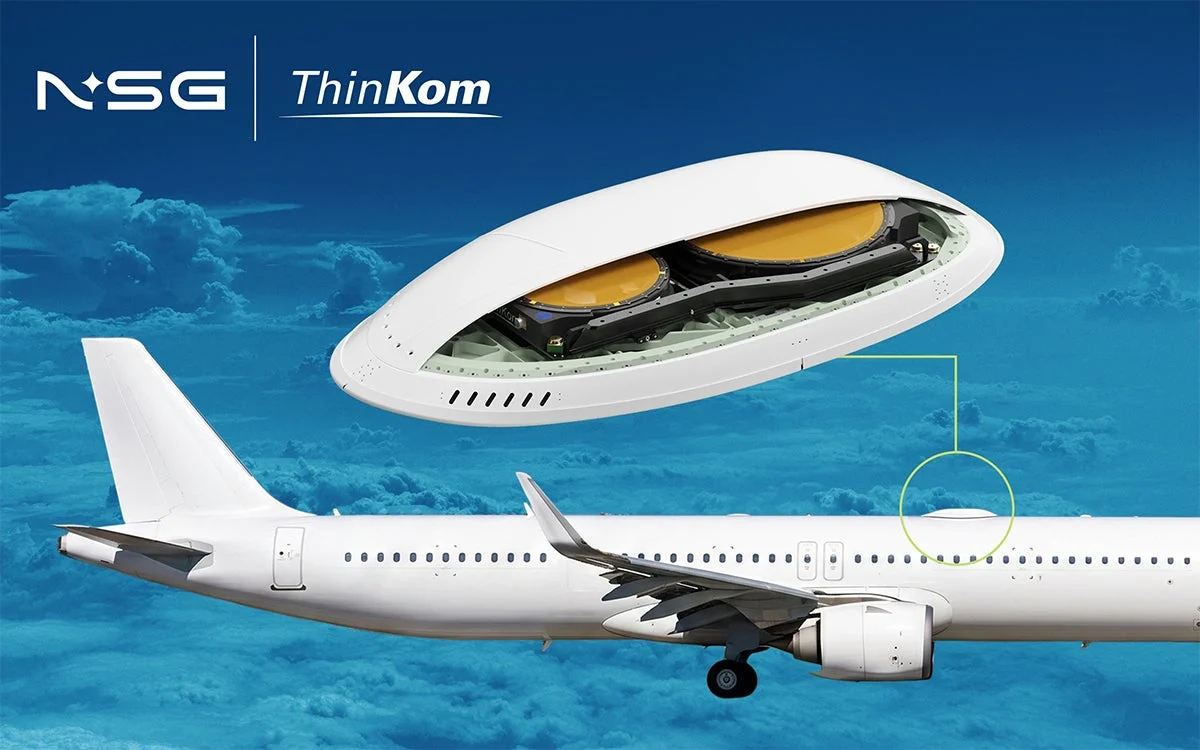

Neo Space Group (NSG), a Saudi Arabian-based global satellite communications provider, has officially selected ThinKom Solutions’ ThinAir Ka2517 multi-orbit, phased array antenna for a large-scale installation across the narrow-body fleets of several prominent airlines, including national carrier Saudia and the newly established Riyadh Air. The move represents a significant step in the modernization of Middle Eastern aviation, aiming to provide passengers with seamless, high-speed internet access that leverages both Geostationary (GEO) and Medium Earth Orbit (MEO) satellite constellations.
The partnership, announced on Tuesday, establishes a comprehensive ecosystem for In-Flight Connectivity (IFC) by integrating ThinKom’s hardware with SES’s Open Orbits platform. Under this agreement, the ThinAir Ka2517 antennas will be deployed on Saudia’s existing Airbus A320 fleet, where installations are currently underway. Furthermore, the technology will be integrated into Riyadh Air’s incoming Airbus A321neo fleet, which will arrive from the manufacturer with the solution pre-installed. This strategic collaboration is supported by NSG’s Skywaves traffic management platform and turnkey installation kits provided by Rave Aerospace.
Technical Specifications and the Multi-Orbit Advantage
The selection of the ThinAir Ka2517 antenna is a testament to the industry’s shift toward multi-orbit capabilities. Unlike traditional mechanically steered antennas, the ThinAir Ka2517 utilizes ThinKom’s proprietary Variable Inclination Continuous Transverse Stub (VICTS) phased array technology. This design allows the antenna to maintain a low profile on the aircraft fuselage, reducing aerodynamic drag and fuel consumption while providing the agility required to switch between satellite constellations.
Last month, the Ka2517 achieved a critical milestone by receiving certification for the SES Open Orbits platform. This certification ensures that the hardware can communicate effectively across SES’s diverse satellite fleet, which includes high-throughput GEO satellites and the advanced O3b and O3b mPOWER MEO constellations. The ability to toggle between orbits is vital for modern IFC; GEO satellites provide broad, consistent coverage over large geographic areas, while MEO satellites offer significantly lower latency and higher data throughput, essential for bandwidth-heavy activities such as video streaming, cloud computing, and real-time gaming.
Jeff Sare, Chief Commercial Officer at ThinKom, emphasized the technical superiority of the system, noting that the flight-proven antennas are designed to bring unmatched throughput and spectral efficiency to the aviation sector. By harnessing the power of SES’s multi-constellation services, the system ensures that passengers experience fiber-like connectivity even while cruising at 35,000 feet.
Strategic Framework: Neo Space Group and the Skywaves Ecosystem
The deployment is orchestrated by Neo Space Group, a company backed by Saudi Arabia’s Public Investment Fund (PIF). NSG has rapidly positioned itself as a central player in the global satellite services market, aiming to bridge the digital divide and enhance the connectivity infrastructure of the Middle East and beyond.
A key component of this project is the Skywaves traffic management platform. NSG acquired the foundation for this platform last year through the strategic acquisition of Display Interactive, a French-based provider of in-flight entertainment and connectivity (IFEC) solutions. By integrating Skywaves into the ThinKom-SES framework, NSG can manage data traffic dynamically, optimizing bandwidth allocation based on the aircraft’s location, passenger demand, and the available satellite capacity. This end-to-end management ensures a consistent quality of service (QoS) that has historically been difficult to maintain on long-haul or high-density flight paths.
The inclusion of Rave Aerospace as the provider of turnkey installation kits further streamlines the rollout. By offering a standardized package for the antenna’s integration, the partners can minimize aircraft downtime, allowing airlines to upgrade their fleets with minimal disruption to scheduled operations.
Chronology of Development and Certification
The road to this multi-airline deployment has been marked by several key milestones that highlight the maturity of the technology and the strategic planning of the involved parties:
- September 2023: Neo Space Group announces the acquisition of Display Interactive, signaling its intent to become a vertically integrated player in the IFC market.
- Early 2024: NSG begins testing the Skywaves platform, integrating it with various satellite backbones to ensure hardware-agnostic performance.
- October 2024: The ThinAir Ka2517 antenna officially receives certification for SES Open Orbits, confirming its ability to operate across GEO and MEO (O3b mPOWER) constellations.
- November 2024: ThinKom confirms that its ThinAir product line has surpassed 2,000 installations globally, reinforcing its position as a market leader in phased array technology.
- Late 2024/Early 2025: Installation begins on Saudia’s Airbus A320 fleet, while Riyadh Air finalizes its A321neo delivery specifications with Airbus to include the Ka2517 as a line-fit option.
Regional Context: Saudi Arabia’s Vision 2030 and the Aviation Boom
The adoption of ThinKom’s technology by Saudia and Riyadh Air is deeply rooted in the broader economic transformation of Saudi Arabia. Under the Vision 2030 initiative, the Kingdom is investing hundreds of billions of dollars to become a global hub for logistics, tourism, and aviation.
Riyadh Air, the nation’s newest carrier, is a cornerstone of this strategy. With a mandate to connect Riyadh to over 100 destinations worldwide by 2030, the airline is positioning itself as a premium, digitally-native carrier. For Riyadh Air, providing top-tier connectivity is not merely an ancillary service but a core part of its brand identity. By choosing a multi-orbit solution from the outset, the airline avoids the "technology debt" of legacy systems that rely solely on older GEO satellites.
Saudia, meanwhile, is undergoing a massive fleet modernization program. As the traditional flag carrier, it faces increasing competition from regional giants. Upgrading its narrow-body A320 fleet with ThinKom antennas allows it to offer a competitive product on short-to-medium haul routes, which are often the most underserved in terms of high-quality Wi-Fi.
The reach of NSG and ThinKom extends beyond the borders of Saudi Arabia. NSG has already secured contracts with Thai Airways, Uzbekistan Airways, and Turkish Airlines—all of which have opted for the Ka2517 antenna. This suggests a growing consensus among international carriers that ThinKom’s VICTS technology offers the best balance of performance, reliability, and future-proofing.
Market Implications and the Future of IFC
The aviation industry is currently witnessing a "connectivity arms race." As passengers increasingly expect the same level of internet performance in the air as they do on the ground, airlines are moving away from closed, proprietary systems toward "Open Architecture" models like SES Open Orbits.
The ThinKom-NSG-SES partnership illustrates several critical trends in the market:
- Multi-Orbit Dominance: The industry is moving toward a hybrid model. While Starlink has disrupted the market with its Low Earth Orbit (LEO) constellation, established players are countering with multi-orbit solutions that combine the high capacity of GEO with the low latency of MEO and LEO. The Ka2517 is specifically designed to thrive in this multi-layered environment.
- Shift to Phased Array: Mechanical "gimbal" antennas are increasingly seen as obsolete due to their height and maintenance requirements. Phased array and VICTS antennas are becoming the standard for new narrow-body and wide-body deliveries.
- Sovereign Connectivity: Through NSG, Saudi Arabia is building its own "connectivity stack." By controlling the traffic management (Skywaves) and the service orchestration, the Kingdom reduces its reliance on third-party Western providers, ensuring data sovereignty and regional economic benefits.
Conclusion and Industry Outlook
The selection of ThinKom’s ThinAir Ka2517 by Neo Space Group for Saudia and Riyadh Air marks a pivotal moment in the evolution of in-flight connectivity. By combining ThinKom’s hardware excellence with SES’s multi-orbit satellite network and NSG’s localized management expertise, the partnership provides a blueprint for the future of the "connected cabin."
As the first A320s with these systems take to the skies and Riyadh Air prepares for its commercial debut, the aviation industry will be watching closely. The success of this deployment could accelerate the adoption of multi-orbit phased array systems across the global fleet, eventually making high-speed, low-latency internet a standard feature of air travel rather than a luxury. For the Middle Eastern aviation market, this is more than just a technological upgrade; it is a strategic investment in the digital infrastructure required to support the next generation of global travelers.
