
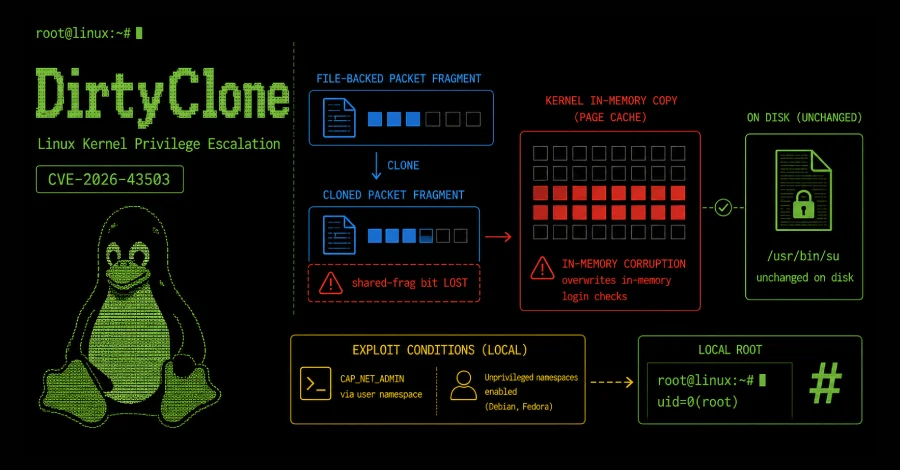

A critical new local privilege escalation vulnerability, dubbed "DirtyClone" and tracked as CVE-2026-43503, has been publicly disclosed, allowing a local attacker to gain root privileges on affected Linux systems. Discovered and detailed by JFrog Security Research, this flaw belongs to the "DirtyFrag" family of vulnerabilities, which exploit weaknesses in the Linux kernel’s networking stack, specifically concerning how file-backed memory is handled during network packet processing. On June 25, 2026, JFrog Security Research released a comprehensive working exploit walkthrough, marking the first public demonstration of this particular variant and underscoring the severity of the issue for a wide range of Linux deployments.
Rated with a high CVSS score of 8.8, DirtyClone leverages a subtle but profound error within the kernel’s memory management when copying network packets internally. The vulnerability permits a local user to corrupt file-backed memory through a specially crafted, cloned network packet. This corruption can be strategically directed to overwrite critical system binaries, such as /usr/bin/su, allowing an attacker to bypass authentication checks and obtain root access. The underlying cause stems from two helper functions failing to correctly preserve a safety flag that designates a packet’s memory as shared with a file on disk. This missing flag is the lynchpin of the vulnerability, transforming a performance optimization into a dangerous write primitive.
Technical Deep Dive: The Mechanics of DirtyClone
At its core, DirtyClone exploits a fundamental design choice in the Linux kernel’s networking stack: zero-copy networking. This optimization allows the kernel to use existing file-backed memory pages directly as network packet data, avoiding redundant data copying and improving performance. However, this efficiency relies on strict adherence to a "contract" where every operation involving these memory pages must correctly track their shared status. The DirtyFrag family of vulnerabilities, including DirtyClone, arises when this contract is inadvertently broken.
Specifically, DirtyClone targets scenarios where the kernel internally copies a network packet. During this process, certain helper functions, notably __pskb_copy_fclone() and skb_shift(), are meant to handle sk_buff (socket buffer) fragments. These fragments can sometimes point directly to pages of file-backed memory. The vulnerability occurs because these helper functions fail to propagate a crucial "shared-frag" bit (or similar safety flag) that indicates the memory is linked to a file on disk. Without this flag, the kernel treats the file-backed memory as generic packet data, susceptible to in-place modifications intended for transient network buffers.
An attacker leverages this by first loading a privileged binary, such as /usr/bin/su (which allows users to execute commands as another user, typically root), into memory. The attacker then manipulates the system to wire these specific memory pages, containing the su binary’s code, into a network packet. Subsequently, the kernel is forced to clone this packet. The cloned packet is then routed through an IPsec tunnel controlled by the attacker. During the decryption phase within this tunnel, the kernel performs an in-place modification operation on what it mistakenly believes is temporary packet data. Instead, it overwrites the in-memory copy of the su binary’s login checks with attacker-chosen bytes. The next time any user attempts to execute su, the compromised in-memory version executes, granting immediate root access without requiring a password.
A particularly insidious aspect of DirtyClone is its stealth. Since the modification occurs only in the kernel’s in-memory copy of the binary, the actual file on disk remains untouched. This means traditional file-integrity tools, which monitor changes to filesystems, will not detect the compromise. Furthermore, the attack leaves no direct audit trail on the filesystem. A simple system reboot restores the original, uncompromised binary from disk, effectively wiping away evidence of the in-memory manipulation. By the time system administrators might consider checking file integrity or audit logs, the attacker would have already achieved persistent root access through other means.

Exploitation Requirements and Affected Systems
Exploiting DirtyClone requires the CAP_NET_ADMIN capability, which allows a user to configure network interfaces and routing tables, crucial for setting up the malicious IPsec tunnel. On many popular Linux distributions, including Debian and Fedora, unprivileged user namespaces are enabled by default. This default configuration is a significant enabler for the exploit, as it allows a local, unprivileged user to create a new namespace and, within that isolated environment, obtain CAP_NET_ADMIN. This effectively lowers the bar for exploitation from a privileged local user to any standard local user.
The page cache, where the file-backed memory resides, is shared at the host level. Consequently, any modifications made to this shared memory within an unprivileged user namespace will affect every process running on the machine, including those outside the namespace, thereby achieving system-wide privilege escalation.
JFrog Security Research has confirmed successful exploitation on various systems running default namespace configurations, including Debian, Ubuntu, and Fedora. The vulnerability poses a significant risk to several types of environments:
- Multi-tenant servers: Where multiple users share computing resources.
- CI/CD runners: Systems that execute untrusted code in automated pipelines.
- Container hosts: The underlying systems running Docker, Podman, or other container runtimes.
- Kubernetes clusters: Especially those allowing untrusted workloads or where host-level access can be gained.
In these environments, the ability for an unprivileged user to create namespaces makes them prime targets for DirtyClone. However, it’s important to note that Ubuntu 24.04 and later versions introduce restrictions on namespace creation via AppArmor. This security measure effectively blocks the default exploit path, providing a crucial layer of defense against DirtyClone for newer Ubuntu installations.
Chronology of Discovery and Patching
The DirtyFrag class of vulnerabilities represents a persistent challenge for Linux kernel developers, and DirtyClone is the latest manifestation of this ongoing issue. The timeline leading to the public disclosure and patching of CVE-2026-43503 highlights the collaborative efforts within the open-source community:
- May 16, 2026: Hyunwoo Kim, a prominent researcher in the DirtyFrag series, submitted a broader multi-site patch to the
netdevmailing list. This patch aimed to address several remaining frag-transfer helper functions that could potentially lose the shared-frag bit, indicating an awareness of the systemic nature of the problem. - May 21, 2026: The combined fix, encompassing Hyunwoo Kim’s broader patch and potentially other related adjustments, was officially merged into the Linux kernel mainline. This crucial commit, identified as
48f6a5356a33, directly addressed the underlying flaw. - May 23, 2026: The merged fix was assigned the Common Vulnerabilities and Exposures (CVE) identifier CVE-2026-43503, officially recognizing it as a distinct security vulnerability.
- May 24, 2026: The patched kernel was released as part of Linux v7.1-rc5, the fifth release candidate for the upcoming Linux kernel version 7.1. This made the fix available to kernel developers and distribution maintainers.
- June 25, 2026: JFrog Security Research published their detailed analysis and a working exploit walkthrough for DirtyClone. This public demonstration served as a critical alert to the broader cybersecurity community, validating the vulnerability’s exploitability and immediate threat.
- June 26, 2026: News articles and advisories began to circulate widely, informing the public about DirtyClone and urging immediate action.
The "DirtyFrag" Family: A Recurring Challenge

DirtyClone is not an isolated incident but the fourth recent privilege escalation vulnerability stemming from the same fundamental failure mode within the Linux kernel: file-backed memory being incorrectly treated as generic packet data, leading to in-place network operations writing where data should have been copied. Each previous fix in the DirtyFrag series addressed a specific code path where the shared-frag bit was lost, but inevitably, other paths remained open, leading to new variants.
The original problem is not merely a single faulty helper function; it’s a systemic "contract problem" within the kernel’s architecture. Every code path responsible for moving skb fragments must rigorously preserve the shared-frag bit, every single time. The kernel’s zero-copy networking, while a performance boon, becomes a critical security liability when this contract is violated. A single dropped flag anywhere in the complex chain of fragment transfers can transform an optimization into a potent arbitrary write primitive, allowing an attacker to manipulate kernel-managed memory.
Security researchers emphasize that the DirtyFrag class of vulnerabilities is likely not exhausted. Any function that moves fragment descriptors without correctly propagating the shared-frag flag represents a potential new CVE. This necessitates an ongoing, meticulous auditing process covering every path that interacts with skb_shinfo()->flags during fragment transfer operations to ensure comprehensive protection.
Official Responses and Mitigation Strategies
In response to CVE-2026-43503, major Linux distributions have rapidly deployed patches and issued advisories:
- Ubuntu: Has published USN-8373-1, detailing the update available for various supported kernel versions.
- Debian: Has updated its security tracker for CVE-2026-43503, providing information on affected packages and available fixes.
- SUSE: Has released advisories for its SUSE Linux Enterprise products, urging users to apply the necessary kernel updates.
- Red Hat: Maintains a Bugzilla tracking entry (ID 2480902) for the vulnerability, indicating their ongoing efforts to provide patches across their product lines.
The primary and most effective remediation is to install the distribution’s kernel update. The fix has been backported from upstream Linux v7.1-rc5 to stable and Long Term Support (LTS) branches, making it available for a wide array of systems. Users are strongly advised to update their kernels immediately to protect against this vulnerability.
For systems where immediate patching is not feasible, two temporary workarounds can help reduce the attack surface, though they are not full fixes:
- Restrict Unprivileged User Namespaces: On Debian and Ubuntu systems, administrators can set the kernel parameter
kernel.unprivileged_userns_clone=0. This disables the creation of unprivileged user namespaces, thereby blocking the most common exploit path that allows local users to obtainCAP_NET_ADMIN. Other distributions may use different mechanisms to restrict user namespace creation. - Blacklist IPsec and RxRPC Modules: An alternative involves blacklisting the
esp4,esp6, andrxrpckernel modules. This can be achieved by addingblacklist esp4,blacklist esp6, andblacklist rxrpcto/etc/modprobe.d/blacklist.conf(or a similar configuration file) and regenerating the initramfs. However, this workaround has significant drawbacks: it breaks IPsec and AFS (Andrew File System) functionality and is only effective if these features are loadable modules rather than compiled directly into the kernel.
These workarounds are temporary controls and should not be considered permanent solutions. They introduce functional limitations and may not cover all potential attack vectors if the modules are compiled into the kernel. The only robust solution remains applying the official kernel patch.

Broader Implications and Future Outlook
The discovery of DirtyClone highlights the intricate challenges in securing complex, high-performance operating system kernels like Linux. The recurring nature of the DirtyFrag family underscores that even seemingly minor logical flaws in memory management and networking can have catastrophic security consequences. It serves as a stark reminder that performance optimizations, such as zero-copy networking, must be meticulously scrutinized for their security implications, especially when interacting with fundamental system resources like file-backed memory.
The ongoing battle against such vulnerabilities requires continuous vigilance from both security researchers and kernel developers. The open-source development model, with its transparency and collaborative review processes, is instrumental in identifying and addressing these deep-seated issues. However, the sheer volume and complexity of kernel code mean that vulnerabilities can hide in plain sight for extended periods.
For system administrators and organizations, DirtyClone reinforces the critical importance of a proactive patch management strategy. Keeping systems updated with the latest security patches is the most effective defense against known vulnerabilities. Furthermore, implementing defense-in-depth strategies, such as restricting unprivileged user namespaces where possible, deploying robust host-based intrusion detection, and segmenting networks, can help mitigate the impact of future zero-day exploits or vulnerabilities that bypass initial defenses.
As the Linux kernel continues to evolve and integrate new features and performance enhancements, the lessons learned from the DirtyFrag series will undoubtedly influence future development and security auditing practices. The contract regarding skb_shinfo()->flags and fragment transfers must be universally honored across all relevant code paths to prevent future incarnations of this pervasive and dangerous class of vulnerabilities.
