
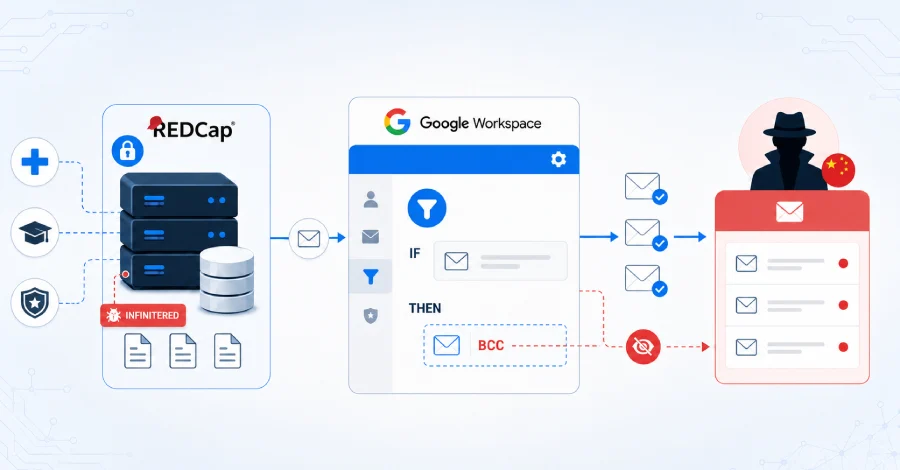

A sophisticated, China-linked espionage group successfully infiltrated North American medical, academic, and military research networks for over a year, systematically exfiltrating sensitive research and defense-related email communications. The covert operation leveraged a backdoor implanted on critical REDCap research servers to steal login credentials, but its most insidious innovation was the re-engineering of the victims’ own Google Workspace rules to silently copy targeted messages to attacker-controlled inboxes. This revelation comes from a detailed report published this week by Google’s Threat Intelligence Group (GTIG), which attributes the campaign with high confidence to a cluster it tracks as UNC6508.
The campaign, spanning from at least September 2023 and continuing through November 2025, represents a significant breach of intellectual property and national security interests across the United States and Canada. The targeted entities included a diverse array of organizations: clinical providers, academic centers engaged in cutting-edge research, military health institutions, patient advocacy groups, and health regulatory bodies. Google’s disclosure, while not naming specific victims, underscores the persistent and evolving threat posed by state-sponsored actors to vital sectors involved in innovation and defense.
The Discovery and Attribution by Google’s Threat Intelligence Group
Google’s Threat Intelligence Group (GTIG) first flagged the activities of UNC6508 in a broader report released in February, which detailed state-backed attacks against the defense sector. That initial report introduced both the actor and their use of the REDCap backdoor but withheld specific details about the victims or the full scope of their exfiltration tactics. The latest report provides a more comprehensive exposé, shedding light on the full operational cycle of UNC6508, from initial compromise to the innovative data theft method.
GTIG’s attribution of this campaign to a China-linked entity, UNC6508, with "high confidence" is based on a confluence of factors including observed tactics, techniques, and procedures (TTPs), the infrastructure used, and the specific intelligence collection priorities. This level of confidence typically implies robust forensic evidence, intelligence correlations, and pattern-of-life analysis associated with known Chinese state-sponsored cyber espionage operations. The group’s persistent targeting of medical and military research aligns with China’s strategic objectives to advance its domestic technological capabilities and military modernization efforts, often through illicit acquisition of foreign intellectual property and sensitive defense information.
Upon discovering the full extent of the intrusion and the novel exfiltration methods, Google took swift action, notifying the affected organizations and actively disrupting the group’s command-and-control infrastructure. This proactive intervention is crucial in mitigating ongoing espionage and preventing further data loss, although the full impact of the data already exfiltrated remains a significant concern for national security and research integrity.

Infiltration Vector: Exploiting REDCap Servers
The initial point of compromise for UNC6508 was Research Electronic Data Capture, or REDCap, a widely utilized web-based platform designed for building and managing online databases and surveys for clinical and translational research. Developed by Vanderbilt University, REDCap is deployed by thousands of academic institutions, hospitals, and non-profit organizations globally, making it a lucrative target for adversaries seeking access to sensitive medical and scientific data. Its ubiquity in research environments, often exposed to the internet for legitimate data collection, presents a broad attack surface.
UNC6508 specifically targeted externally facing REDCap servers, implying that these servers were accessible from the public internet, a common configuration for research collaboration. While Google’s report did not pinpoint a specific Common Vulnerabilities and Exposures (CVE) or name the exact initial access vector, GTIG observed the group actively probing older, potentially vulnerable versions of the REDCap software. This suggests a strategy of exploiting known security flaws in unpatched systems, a perennial weakness in cybersecurity defenses where organizations fail to update software promptly. The absence of a named CVE could indicate a zero-day exploit, a novel attack method, or a combination of misconfigurations and older vulnerabilities that collectively allowed initial access.
Approximately three months after establishing initial access, UNC6508 deployed a custom malware dubbed INFINITERED. This sophisticated malware was designed to trojanize REDCap’s own system files, effectively embedding itself within the legitimate operational framework of the research platform. The specific functionalities of INFINITERED, while not fully detailed in the public report, likely included capabilities for persistence, data collection, and enabling further lateral movement within the compromised networks. The earliest known instance of a REDCap server compromise by this group dates back to September 2023, with the campaign’s activities observed continuing into November 2025, indicating a prolonged and patient operational tempo.
Once established on the REDCap server, UNC6508 meticulously performed internal reconnaissance and credential discovery. This phase involved mapping the internal network, identifying critical systems, and, crucially, extracting database and service account credentials. These stolen credentials served as the keys for lateral movement, allowing the attackers to pivot from the compromised REDCap server deeper into the internal network. The ultimate goal of this credential harvesting was to gain elevated privileges, culminating in the compromise of a domain administrator account – the "keys to the kingdom" in most enterprise networks. With domain administrator rights, the group achieved unfettered access to critical infrastructure, including the organization’s email systems, setting the stage for their innovative exfiltration strategy.
The Novel Exfiltration Method: Abusing Google Workspace Content Compliance Rules
The most striking and novel aspect of UNC6508’s operation was their method of data exfiltration. Rather than deploying custom tools or establishing dedicated covert channels for data transfer, the group ingeniously abused a legitimate, built-in feature of Google Workspace: content compliance rules. These rules, also found in other cloud mail suites, are administrative tools designed to scan emails for specific keywords or patterns and then apply actions such as copying, forwarding, or quarantining messages to ensure regulatory compliance or internal policy adherence.

With domain administrator privileges, UNC6508 was able to create a new content compliance rule, notably misspelling "Patriot" as "Patroit" within the rule’s configuration. This rule was configured to monitor for an extensive list of nearly 150 keywords, search terms, and specific email addresses. When an outgoing or incoming message matched any of these criteria, the rule would silently BCC (Blind Carbon Copy) the message to an attacker-controlled Gmail address. Google has since identified and disabled this attacker-controlled inbox, mitigating the ongoing theft.
This method of exfiltration is particularly insidious because it leaves minimal forensic footprint. There is no malware on the mail server itself, no distinct exfiltration tool to detect, and no unusual network traffic patterns that would typically trigger alerts for data egress. The data theft appears as legitimate internal email processing, making it exceptionally difficult for traditional security monitoring tools to detect. MITRE ATT&CK, a globally accessible knowledge base of adversary tactics and techniques, already catalogs "email-forwarding-rule abuse" (T1114.003) as a known technique. However, GTIG highlighted that the use of domain content compliance rules for this purpose by a China-linked actor is a novel observation, signifying an evolution in sophisticated state-sponsored tactics. This strategic shift towards "living off the land" by leveraging legitimate system functionalities poses a significant challenge for defenders.
Targeted Information and Strategic Significance
The comprehensive list of keywords embedded in the exfiltration rule provided critical insight into UNC6508’s collection priorities, which are deeply aligned with China’s national strategic interests. The keywords mapped to several key areas:
- Geo-strategic policy: Indicating an interest in geopolitical strategies, international relations, and diplomatic communications from North American institutions.
- Military strategy and equipment: Suggesting a focus on defense planning, procurement, research and development of advanced weaponry, and military doctrines. This directly impacts national security.
- Advanced technology, including AI and uncrewed vehicles: Highlighting the pursuit of cutting-edge technological advancements, particularly in artificial intelligence, robotics, and drone technology, which are critical for future economic competitiveness and military superiority.
- Offensive cyber programs: Revealing an intent to gather intelligence on cyber warfare capabilities, tools, and strategies employed by North American defense and intelligence agencies.
- Medical research: A broad category encompassing a vast array of scientific inquiry, from novel drug development and vaccine research to epidemiological studies and public health policy.
One term, "chikungunya," stood out for its specificity. Chikungunya is a mosquito-borne viral disease that caused a significant outbreak in China’s Guangdong province in 2025, or had relevance in that timeframe. The inclusion of such a specific keyword underscores the group’s highly targeted intelligence requirements, likely seeking data on disease prevention, treatment, or epidemiological responses from leading North American medical research institutions. This specificity points to a direct link between the espionage efforts and pressing public health or biodefense concerns within China.
The implications of such targeted data theft are far-reaching. The compromise of military research can accelerate rival nations’ defense capabilities, potentially eroding a technological advantage. The theft of advanced technology research undermines years of investment and innovation, impacting economic competitiveness and national security. Medical research, especially related to infectious diseases, can provide critical insights into public health preparedness and potential biodefense strategies.
Broader Context of State-Sponsored Cyber Espionage

This incident is not an isolated event but rather fits into a broader pattern of state-sponsored cyber espionage, with China frequently identified as a major perpetrator. For years, intelligence agencies and cybersecurity firms have documented extensive campaigns originating from China targeting intellectual property, trade secrets, and government data from countries across the globe. Motivations typically range from economic gain (e.g., advancing the "Made in China 2025" initiative) to military modernization and strategic intelligence gathering.
Previous reports from various cybersecurity vendors and government agencies have highlighted the persistent nature of these threats. Actors like APT10 (Stone Panda), APT40 (Leviathan), and others have been linked to campaigns against defense contractors, technology firms, and healthcare organizations. The tactics evolve constantly, with adversaries continuously seeking new vulnerabilities and creative ways to bypass established defenses. The UNC6508 campaign exemplifies this evolution, demonstrating a move towards more subtle and harder-to-detect "living off the land" techniques. The long duration of the compromise – over a year – also indicates a high level of operational patience and stealth, characteristic of advanced persistent threats (APTs).
Implications for North American Research and Defense
The compromise of North American medical, academic, and military research networks carries profound implications. For academic and medical institutions, it represents a direct threat to intellectual property, patient privacy (if identifiable data was compromised, though the report focuses on research), and the integrity of scientific discovery. The theft of pre-publication research or proprietary methodologies can undermine years of costly research and development.
For military health institutions and defense-related entities, the exfiltration of sensitive defense emails and research can expose strategic vulnerabilities, operational plans, and technological advancements to an adversary. This intellectual property theft can directly impact national security, potentially altering the balance of power or accelerating the military capabilities of rival states. The long-term implications include erosion of competitive advantage, economic losses, and a decrease in trust and collaboration within the research community. Furthermore, the incident serves as a stark reminder that even seemingly innocuous research platforms can become conduits for high-stakes espionage.
Recommendations and Defensive Measures
Google’s report also includes crucial recommendations for organizations to defend against similar attacks, focusing on both the initial access vector and the sophisticated exfiltration method:

-
REDCap Server Hardening:
- Immediate Patching: All externally facing REDCap servers must be patched immediately to the latest secure versions.
- Legacy Version Removal: Crucially, organizations should remove older, vulnerable versions of REDCap entirely. REDCap’s architecture sometimes allows legacy versions to run alongside current builds, creating opportunities for "downgrade attacks" where attackers force the system to revert to a known-vulnerable state for exploitation. A clean, up-to-date installation is paramount.
- Vulnerability Scanning: Regular and thorough vulnerability scanning of all web-facing applications, especially research platforms like REDCap, is essential to identify and remediate weaknesses proactively.
-
Mail System Auditing (Google Workspace and Equivalents):
- Review Content Compliance Rules: Administrators must meticulously review all content compliance rules, mail-forwarding rules, and similar features within Google Workspace (or other cloud mail suites like Microsoft 365). Any rules that BCC or reroute emails to external, unauthorized addresses should be flagged for immediate investigation.
- Audit Admin Logs: It is insufficient to merely check the current state of rules. Organizations must scrutinize administrator audit logs to identify when these rules were created or modified. Anomalous changes, especially those preceding unusual activity, can indicate a compromise.
- Indicator of Compromise (IoC) Hunting: Organizations should use the indicators published by GTIG (e.g., specific file hashes, network artifacts associated with INFINITERED) to hunt for signs of the malware on their systems.
-
Enhanced Access Controls:
- Phishing-Resistant Multi-Factor Authentication (MFA): Implementing phishing-resistant MFA (e.g., FIDO2 security keys) for all administrator accounts is critical. The UNC6508 campaign hinged on gaining domain administrator access to set up the exfiltration rules. Robust MFA significantly raises the bar for attackers attempting credential theft and privilege escalation.
- Principle of Least Privilege: Ensure that administrator accounts only have the minimum necessary permissions required for their roles, limiting the potential damage if an account is compromised.
- Regular Password Rotation and Complexity: Enforce strong password policies for all accounts, especially privileged ones.
Expert Commentary and Future Outlook
Cybersecurity experts emphasize that this incident highlights a critical shift in adversary tactics. "The move from complex, custom-built exfiltration malware to leveraging legitimate, built-in cloud features is a game-changer for defenders," states a hypothetical cybersecurity analyst. "It underscores the need to not just monitor for malicious code, but to deeply understand and audit how legitimate administrative tools are being used, as they can become potent weapons in the hands of a sophisticated adversary."
This trend, often referred to as "living off the land," makes detection significantly harder because the activities blend seamlessly with normal network traffic and administrative operations. Organizations need to evolve their security strategies from purely signature-based detection to advanced behavioral analytics and meticulous auditing of cloud configurations and administrator actions.
While Google has disrupted UNC6508’s infrastructure and disabled the specific Gmail address used for exfiltration, the group’s initial access vector to the REDCap servers remains unconfirmed. This gap in understanding poses a continuing challenge, as the same or similar vulnerabilities could be exploited again. The long duration of the campaign and the breadth of targeted organizations serve as a stark reminder of the persistent and evolving nature of state-sponsored cyber espionage. The incident underscores that the battle for intellectual property and national security is increasingly fought in the digital realm, requiring constant vigilance, rapid adaptation, and proactive defense strategies from all institutions holding valuable data.
