
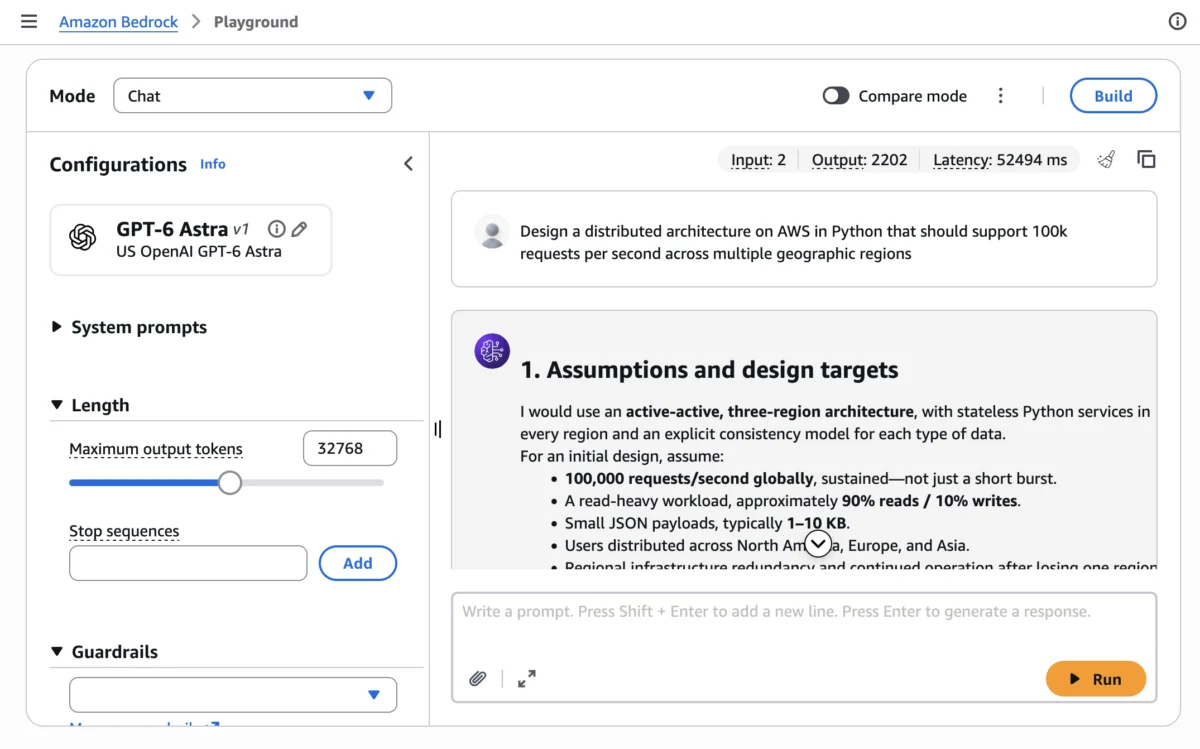

The crisp autumn air of mid-September in New York City often signals a time of transition, yet within the technology sector, it frequently marks the acceleration of enterprise product deployments and platform innovations. Against this backdrop of seasonal shifts, Amazon Web Services (AWS) has announced a significant expansion of its artificial intelligence capabilities with the general availability of OpenAI’s GPT-6 Astra on Amazon Bedrock. This strategic integration brings OpenAI’s most sophisticated foundational model to date directly into the managed environments of enterprise cloud architecture, bridging the gap between frontier-level generative intelligence and corporate-grade security, scalability, and governance.
The deployment of GPT-6 Astra on Amazon Bedrock is designed to address the evolving demands of enterprise workflows that require deep reasoning, contextual understanding, and advanced automation. As organizations increasingly move beyond basic text generation and conversational querying toward complex multi-step agents and autonomous computer interaction, the technical requirements placed upon cloud infrastructure have grown exponentially. By hosting GPT-6 Astra within the Bedrock ecosystem, AWS and OpenAI aim to provide corporate users with a streamlined pathway to implement advanced artificial intelligence without compromising compliance, data privacy, or operational oversight.
Core Technical Capabilities and Architectural Specifications
At the center of this release is GPT-6 Astra, which represents a substantial leap forward in capability compared to its predecessors. Engineered to handle demanding business workflows, the model introduces refined reasoning and judgment mechanisms, professional-grade writing and design outputs, and advanced computer and browser interaction functionalities. These enhancements enable the model to execute tasks that traditionally required significant human intervention, ranging from comprehensive legal contract analysis to end-to-end software development and deployment verification.
A defining technical characteristic of GPT-6 Astra is its expansive context window, which supports up to 1 million input tokens. This massive capacity allows developers and enterprise users to upload entire software codebases, extensive multi-volume legal contracts, or comprehensive enterprise document repositories into a single session. The model can process these vast volumes of information concurrently, reconcile competing inputs across disparate documents, and generate synthesized outputs with high fidelity.
Integration with Amazon Bedrock allows organizations to invoke GPT-6 Astra through standardized, secure APIs, or to configure dedicated workplace productivity environments such as ChatGPT Work and Codex to utilize the underlying model. Furthermore, OpenAI has introduced specialized enterprise plugins for ChatGPT Work alongside this launch. These plugins are engineered to extend Astra’s browser-use capabilities across standard corporate software applications, allowing the model to interact with web-based enterprise tools, retrieve data from legacy databases, and execute routine digital workflows under the supervision of human operators.
Enterprise Security, Governance, and Data Privacy Frameworks
The integration of advanced external models into corporate cloud environments consistently raises critical questions regarding data sovereignty, security, and intellectual property protection. To mitigate these concerns, the deployment of GPT-6 Astra on Amazon Bedrock leverages the established security infrastructure of AWS. Organizations utilizing the model benefit from granular access controls, comprehensive audit logging of model invocation activity, and robust data encryption standards managed through AWS Identity and Access Management (IAM) and AWS Key Management Service (KMS).
Crucially, the partnership framework stipulates that customer inference data processed through GPT-6 Astra on Amazon Bedrock is not utilized by OpenAI to train or fine-tune foundational models. This policy provides a vital guarantee for enterprises operating in regulated sectors—such as finance, healthcare, and legal services—where proprietary data leakage or regulatory non-compliance presents severe commercial and legal risks. By enforcing these strict data isolation boundaries, AWS and OpenAI seek to lower the adoption barrier for risk-averse organizations hesitant to integrate external generative artificial intelligence tools into their core operational pipelines.
Background Context and Chronology of the AWS Launch Calendar
The introduction of GPT-6 Astra on Amazon Bedrock is the culmination of a multi-year strategy by AWS to establish Amazon Bedrock as a multi-model orchestration hub rather than a proprietary single-model platform. When Amazon Bedrock was initially launched, its core value proposition was to offer developers a centralized API to access foundational models from various leading artificial intelligence laboratories, including Anthropic, Meta, Cohere, AI21 Labs, and Stability AI, alongside Amazon’s proprietary Titan models.
Over the subsequent development cycles, the platform underwent continuous expansion to incorporate increasingly complex reasoning models, multimodal capabilities, and agentic frameworks. The roadmap leading up to the current deployment saw incremental releases focused on reducing latency, improving throughput, and enhancing Retrieval-Augmented Generation (RAG) integrations. The addition of OpenAI’s flagship model to this roster represents a pivotal expansion of the platform’s ecosystem, reflecting the fluid and collaborative nature of modern cloud and artificial intelligence partnerships where traditional competitors frequently intersect to meet enterprise demand.
The timeline of the current release schedule highlights the systematic cadence of AWS engineering deployments. Throughout the late summer and early autumn quarters, AWS has systematically updated its product suites, focusing heavily on edge computing, desktop productivity tools such as Amazon Quick, and advanced orchestration layers for AI agents. Industry analysts note that this aggressive release schedule is intended to capture market share during the traditional corporate budget planning season, positioning cloud providers to secure enterprise commitments for the upcoming fiscal year.
Industry Implications and Analytical Perspectives
The general availability of GPT-6 Astra on Amazon Bedrock carries significant implications for the broader enterprise software and cloud computing markets. From an architectural perspective, it reinforces the trend toward model agnosticism in enterprise IT strategies. Rather than locking organizations into a single proprietary ecosystem, cloud providers are increasingly incentivized to serve as comprehensive clearinghouses for the world’s most advanced artificial intelligence technologies, competing primarily on the quality of their security, data governance, and integration tools.

Furthermore, industry observers point to the emphasis on advanced computer and browser use as a signal of the broader maturation of generative artificial intelligence. The market is shifting rapidly from conversational chat interfaces to autonomous or semi-autonomous software agents capable of executing complex business processes across multiple software applications. By providing a secure, governed environment for models capable of executing such workflows, AWS and OpenAI are directly targeting operational efficiency gains across back-office administration, software engineering, and customer relationship management.
However, technology analysts also emphasize that the successful deployment of models with 1-million-token context windows and advanced agentic capabilities will require organizations to invest heavily in internal governance and workforce training. As artificial intelligence models assume greater autonomy over digital workflows, the need for robust validation frameworks, human-in-the-loop oversight systems, and continuous monitoring becomes paramount to prevent systematic errors or unintended operational disruptions.
Future Outlook and Ecosystem Development
As the integration of GPT-6 Astra on Amazon Bedrock rolls out to global enterprise customers, attention within the developer community is already turning toward future iterations of cloud-native artificial intelligence infrastructure. Ecosystem participants are increasingly focusing on how multi-agent systems will interact across disparate cloud environments, and how security frameworks will evolve to manage autonomous agents operating with elevated system privileges.
AWS has indicated that it will continue to expand the feature set surrounding Amazon Bedrock, with upcoming releases expected to focus on enhanced latency optimization, finer-grained cost-management controls for high-token-count workloads, and deeper integration with AWS Lambda and Amazon SageMaker for custom model fine-tuning and evaluation. Through these ongoing developments, the cloud provider aims to maintain its competitive edge in a rapidly evolving technological landscape where the line between cloud infrastructure and cognitive computation continues to blur.
Developers and enterprise architects seeking to implement GPT-6 Astra within their current infrastructure can access detailed documentation, API specifications, and configuration guides through the official AWS Machine Learning blog and the Amazon Bedrock developer portal. As organizations evaluate the potential of these advanced capabilities to transform their operational models, the autumn launch cycle on AWS provides a clear indication of the trajectory of enterprise artificial intelligence for the foreseeable future.
