

As artificial intelligence models, proprietary training data, and high-performance workloads become the primary engines of economic value, the imperative to secure the underlying silicon has shifted from a best-practice recommendation to a non-negotiable mission. Modern data center architectures are no longer monolithic; they are increasingly heterogeneous environments where CPUs, high-speed accelerators, SmartNICs, data processing units (DPUs), and specialized memory controllers must interact in a seamless but secure ecosystem. This architectural evolution delivers unprecedented computational performance, but it simultaneously introduces a critical vulnerability: the challenge of establishing, verifying, and maintaining trust across a sprawling, multi-vendor device landscape.
The traditional security paradigm—which often relied on protecting the operating system layer—is no longer sufficient. Contemporary threat actors are increasingly motivated to penetrate the lower layers of the system stack, targeting the very firmware and hardware logic that underpin the OS. Consequently, security must now be rooted in silicon. It must begin with a Root of Trust (RoT) that establishes immutable device identity, verifies the integrity of boot code, protects sensitive cryptographic assets, and enables reliable attestation throughout a device’s entire operational lifecycle.
The Evolution of the Root of Trust
The industry’s movement toward open-source silicon standards represents a significant departure from the proprietary, siloed security models of the past decade. For years, hardware Roots of Trust were tailored to the specific requirements of individual vendors. While these purpose-built implementations provided high levels of security for specific products, they created a fragmented ecosystem. For cloud service providers and infrastructure operators, this fragmentation meant managing dozens of different security interfaces, trust models, and lifecycle management protocols.
This lack of interoperability created a "trust gap." As data centers grew in complexity, the effort required to reconcile disparate hardware security mechanisms became an operational bottleneck. To address this, the industry began exploring Caliptra—an open-source silicon Root of Trust architecture specifically designed for data center-class devices. By defining common mechanisms for device identity, measured boot, and attestation, Caliptra provides a standardized language for silicon trust, allowing cloud and semiconductor companies to align their security postures without sacrificing the unique performance characteristics of their respective hardware.
A Chronology of Open Silicon Security
The momentum behind open-source hardware security has accelerated rapidly since the project’s inception. Following the initial proposal for an open-source, vendor-neutral silicon Root of Trust, major semiconductor and hyperscale cloud providers began to coalesce around the Caliptra specification.
- 2022-2023: Initial architecture development and the release of the specification, focusing on defining the block-level requirements for integration into SoCs (Systems on Chip).
- Late 2023-2024: The establishment of a formal conformance process, where vendors began submitting their architectures for evaluation against the Caliptra integration checklist. This period marked the shift from conceptual design to prototype silicon integration.
- 2025-Present: The focus has shifted toward production readiness. Organizations are moving past the "adoption" phase, seeking ways to integrate these foundations into commercial-grade hardware that must satisfy rigorous security certifications, such as FIPS 140-3 and SESIP (Security Evaluation Standard for IoT Platforms).
This shift signifies a maturation of the market. It is no longer enough for a chip to be "Caliptra-compliant" in theory; it must be demonstrably secure in the high-stakes, multi-tenant environments of modern AI-driven data centers.
The Complexity of Operationalization
While selecting an architecture like Caliptra is a significant strategic milestone, engineering teams often discover that the real technical burden begins after the architectural choice is made. An open-source Root of Trust provides the foundation, but a production-ready system requires an entire stack of supporting infrastructure.
Development teams are currently grappling with several critical deployment challenges:
- System-Level Integration: Determining how to extend trust from the Root of Trust block across the entire SoC.
- Cryptographic Services: Defining how cryptographic keys and acceleration services are exposed to the software layer without creating new attack surfaces.
- Lifecycle Management: Establishing robust policies for device provisioning, decommissioning, and secure firmware updates in the field.
- Long-Term Maintenance: Developing a strategy for vulnerability remediation and the agility to upgrade cryptographic algorithms to counter future threats, including post-quantum computing requirements.
These challenges are not unique to any one project; they are the inherent complexities of operationalizing hardware security. As these realities have become clearer, the industry conversation has shifted from "How do we adopt a Root of Trust?" to "How do we deploy and maintain a sustainable security orchestrator?"
From Anchor to Orchestrator
The role of the Root of Trust is undergoing a fundamental transformation. Historically, it functioned as a static "anchor"—a piece of hardware that performed a check, verified a signature, and then went idle. In the era of AI and heterogeneous computing, the Root of Trust is evolving into a platform-wide "security orchestrator."

In this new role, the Root of Trust manages the state of the entire platform. It coordinates secure boot sequences across multiple firmware domains, monitors system-level health, and enforces security policies that span across memory, accelerators, and management subsystems. This shift is essential because, in a modern, multi-tenant data center, security cannot be localized. If one component is compromised, the orchestrator must have the visibility and control to isolate the threat and maintain the integrity of the remaining system. This broader visibility is becoming just as critical as the traditional, isolated security functions of the past.
Bridging the Gap: The Role of Integration Frameworks
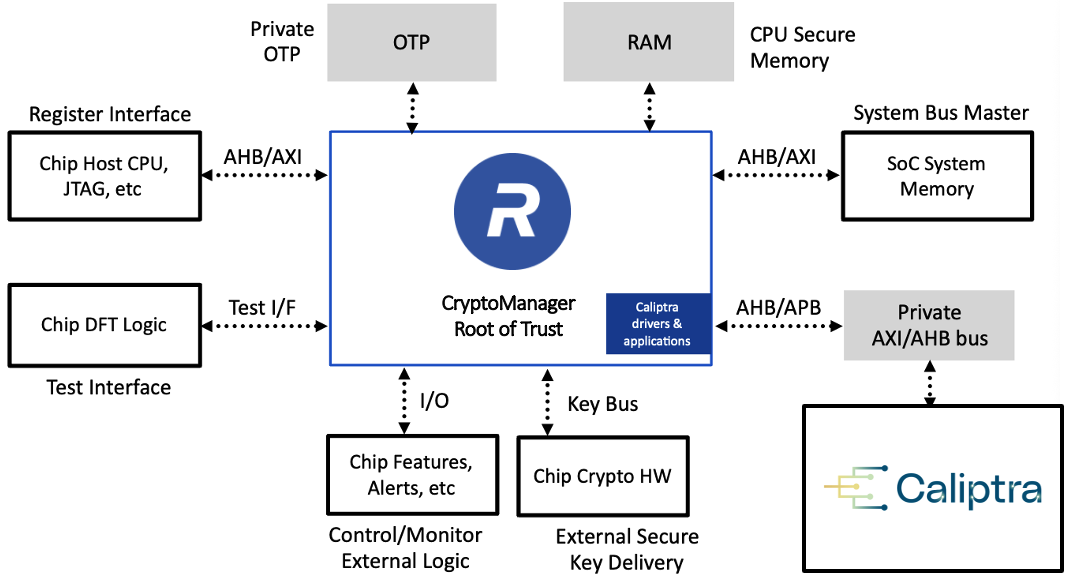
To address the gap between a foundational specification and a deployable, production-ready product, companies are increasingly turning to integration solutions that operate alongside the reference implementation. For example, the Rambus CryptoManager Root of Trust is designed to augment the Caliptra architecture rather than replace it.
This hybrid approach allows vendors to achieve the benefits of an open-source standard—ensuring they meet the required compliance checklists—while simultaneously deploying the specialized infrastructure needed for commercial success. Such solutions provide the secure execution environments, protected key storage, and advanced cryptographic agility that allow a product to evolve alongside changing security standards.
The data suggests that this "co-existence" model is gaining traction. According to recent industry assessments, the integration of specialized security management layers with open-source foundations reduces the time-to-market for new chips by allowing engineers to focus on product differentiation rather than rebuilding core security infrastructure from scratch.
Broader Implications for AI and Cloud Security
The implications of this industry-wide pivot are profound. As we look toward the future of secure AI, the ability to guarantee the integrity of the hardware running massive, multi-billion parameter models is paramount. Any "trust deficit" in the hardware layer could result in the leakage of proprietary model weights or the manipulation of training data, both of which pose significant risks to corporate intellectual property and national security.
The move toward standardized, production-ready Roots of Trust is a direct response to these risks. By creating a common framework for trust, the industry is lowering the barrier to entry for secure design, ensuring that even smaller players can deploy hardware that meets the high-security standards previously reserved for only the most elite military and aerospace applications.
However, the path forward is not without its difficulties. As systems become more complex, the threat of side-channel attacks and sophisticated fault-injection techniques grows. Future security designs must account for these threats at the silicon level, incorporating hardware-based countermeasures that are active throughout the device’s operational life.
Conclusion: The Future of Hardware Trust
The question facing the semiconductor industry is no longer whether common trust frameworks are beneficial; that has been largely answered by the broad adoption of Caliptra and similar open-source initiatives. The defining challenge of the next five years will be the "operationalization of trust."
Engineering teams are now tasked with moving from the elegance of a reference specification to the gritty, complex reality of a production-grade deployment. This requires a shift in mindset: seeing the Root of Trust not as a static component, but as a living, breathing orchestrator that must adapt to new cryptographic standards, withstand emerging physical attacks, and manage the security posture of an entire, heterogeneous SoC.
As the industry continues to refine these processes, the integration of open foundations with robust, commercial-ready security infrastructure will likely become the standard for all data center hardware. By bridging this gap, the semiconductor industry is not only building more secure chips—it is building the secure foundation upon which the next generation of artificial intelligence will operate. The transition is arduous, but it is the necessary next step in ensuring that the digital infrastructure of the future remains resilient in the face of an increasingly sophisticated threat landscape.
