
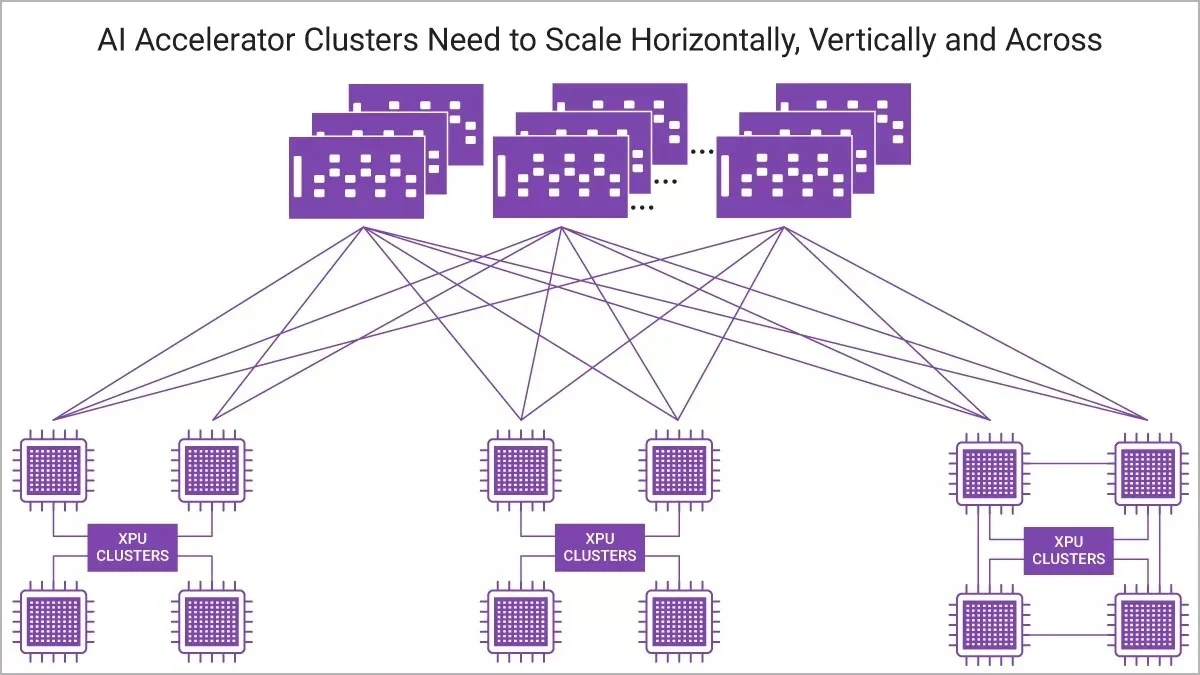

The rapid evolution of artificial intelligence infrastructure has fundamentally altered the definition of the data center network. In the current era of massive training clusters—which have scaled from a few hundred accelerators to massive deployments exceeding hundreds of thousands—the interconnect has transitioned from a background utility to a primary determinant of system performance. As AI models grow in complexity, the efficiency of these systems is increasingly measured not just by the raw teraflops of individual accelerators, but by the network’s ability to synchronize data across the entire fabric. When the network fails to deliver data with absolute precision, expensive compute resources sit idle, driving up the cost per token and delaying the training of next-generation large language models.
This architectural bottleneck has necessitated a comprehensive rethinking of the networking fabric itself. The industry’s response is ESUN—Ethernet for Scale-Up Networking—an open initiative defined by the Open Compute Project (OCP). ESUN represents a concerted effort to evolve Ethernet from its origins as a best-effort, general-purpose transport into a lossless, low-latency, and deterministic fabric specifically engineered for the unique communication patterns of AI accelerators.
The Tail-Latency Crisis in Massive AI Clusters
Standard Ethernet was originally designed for the diverse and often unpredictable traffic of the traditional cloud. It was built to be resilient, tolerating occasional packet loss, jitter, and retries because typical web applications and database queries can absorb these minor fluctuations. However, AI training workloads operate under an entirely different set of constraints. AI performance is gated by "tail latency," a phenomenon where the overall speed of a collective operation—such as an All-Reduce or All-to-All synchronization—is dictated by the slowest packet in the stream.
In a cluster of 100,000 GPUs, if 99.9% of packets arrive on time but 0.1% are delayed due to network congestion or packet loss, the entire synchronization step stalls. This creates a "bubble" in the compute pipeline, where thousands of high-performance accelerators wait for a single retransmitted packet. At the scale of modern AI, these inefficiencies do more than just slow down training; they translate into millions of dollars in wasted energy and infrastructure depreciation. For architects, the ultimate goal of a scale-up network is to become "invisible"—to allow a geographically distributed cluster of accelerators to function as if they were components of a single, unified machine.

The Limitations of Traditional Ethernet Architectures
While traditional Ethernet has incorporated congestion management tools over the decades—most notably Priority Flow Control (PFC) and Explicit Congestion Notification (ECN)—these were designed for the general-purpose data center. When applied to the tightly coupled, high-bandwidth environment of an AI "pod," standard Ethernet reveals three structural limitations:
- Overhead Inefficiency: Traditional Ethernet/IP headers are bulky, often ranging from 28 to 48 bytes. In AI workloads dominated by small, frequent synchronization messages, this overhead consumes a significant percentage of the available bandwidth.
- Latency Variability: The standard "best-effort" delivery model introduces jitter that is incompatible with the rigid synchronization requirements of deep learning training cycles.
- Recovery Lag: When a packet is lost in a traditional Ethernet environment, the recovery process typically involves high-layer protocols that take a significant amount of time to resolve, leading to the aforementioned tail-latency spikes.
These gaps have historically pushed some hardware vendors toward proprietary interconnects. While proprietary solutions can offer the necessary performance, they often lead to ecosystem fragmentation, vendor lock-in, and increased long-term costs. The industry’s shift toward ESUN represents a middle ground: maintaining the openness and scale of Ethernet while stripping away the legacy features that hinder AI performance.
The Chronology of ESUN: From Concept to OCP Standard
The development of ESUN did not happen in a vacuum. It is the result of several years of industry observation as hyperscalers reached the limits of traditional InfiniBand and standard Ethernet. The Open Compute Project (OCP) Networking group recognized that as AI moved from a niche research interest to the primary driver of data center CAPEX, a new sub-standard was required.
The ESUN working group was established to define a specification that could be adopted by silicon vendors, switch manufacturers, and IP providers. The philosophy was simple: evolve Ethernet where necessary, but preserve the elements that make it the world’s most successful networking standard. By maintaining the physical layer (PHY), the 1.6T and 800G ecosystem, and standard management tools, ESUN ensures that AI clusters can still leverage the massive manufacturing scale of the global Ethernet supply chain.
Technical Innovations: Redefining the Packet and the Link
The most significant physical change introduced by ESUN is the radical reduction of the packet header. By replacing the 28–48 byte IP header with a streamlined 4-byte ESUN header, the protocol significantly increases effective throughput. This is particularly impactful for the "chunky" traffic patterns of AI, where many small synchronization packets are sent in rapid succession.

Beyond header compression, ESUN introduces two critical mechanisms that bring determinism to the link layer:
Link-Level Retransmission (LLR)
In a standard network, if a packet is corrupted, the system relies on end-to-end protocols to detect the loss and request a resend. This process is slow. ESUN implements LLR, which allows for the immediate detection and retransmission of corrupted packets at the hardware level between two directly connected ports. This ensures that errors are corrected in nanoseconds rather than microseconds, preventing the error from propagating and causing a cluster-wide stall.
Credit-Based Flow Control (CBFC)
Traditional flow control (like PFC) is often reactive—it tells the sender to stop after a buffer has already reached a critical threshold. ESUN’s Credit-Based Flow Control is proactive. It ensures that a sender only transmits data when it knows the receiver has the specific buffer capacity to handle it. This creates a "lossless" environment where buffer overflows are architecturally impossible, eliminating the primary cause of packet drops in high-congestion AI fabrics.
Industry Response and the Role of Silicon IP
The success of any networking standard depends on the availability of silicon that supports it. To that end, the industry has seen a rapid response from semiconductor IP providers. Synopsys, for instance, has introduced what is recognized as the industry’s first complete ESUN IP solution. This includes both Layer 1 and Layer 2 components, ranging from the Physical Coding Sublayer (PCS) and Media Access Control (MAC) to the specialized ESUN logic required for LLR and CBFC.
The integration of these components into a single, pre-verified stack is critical for System-on-Chip (SoC) designers. As AI accelerators move toward 2-nanometer and 3-nanometer process nodes, the complexity of managing 1.6T and 2.4T data rates becomes immense. By providing a "drop-in" ESUN solution, IP vendors allow chip architects to focus on their core tensor processing logic while relying on a standardized, high-performance fabric for inter-chip communication.

Supporting Data: The Economic and Performance Impact
The transition to ESUN is driven by quantifiable performance gains. Preliminary industry analysis suggests that by moving to a deterministic, low-overhead fabric, AI clusters can see a 10% to 20% improvement in effective system utilization. In a cluster costing $500 million to build, a 15% improvement in utilization represents $75 million in "recovered" value.
Furthermore, the reduction in header overhead directly impacts power efficiency. In massive data centers, every bit transmitted consumes energy. By reducing the header size by over 80%, ESUN reduces the total energy required to move a gigabyte of synchronization data, contributing to the sustainability goals of major hyperscalers.
Broader Implications for the AI Ecosystem
The rise of ESUN marks a pivotal moment in the "Open vs. Proprietary" debate within the high-performance computing (HPC) sector. For years, proprietary interconnects held a performance lead that justified their higher cost and limited interoperability. ESUN closes this gap, offering a path for a diverse range of silicon players—from established giants to specialized AI startups—to compete on a level playing field.
Backed by more than 175 companies within the OCP ecosystem, including leading hyperscalers and silicon vendors, ESUN is positioned to become the backbone of the next generation of AI "mega-clusters." As models continue to scale toward trillions of parameters, the network will no longer be viewed as a separate entity from the compute; it will be the fabric that binds the world’s most powerful digital brains together.
Conclusion: The Path Toward 2.4T and Beyond
Looking ahead, the roadmap for ESUN is inextricably linked to the broader Ethernet roadmap. As the industry moves toward 2.4T Ethernet and beyond, the optimizations pioneered by the ESUN working group will likely become standard features for any high-performance networking environment. The convergence of compute, memory (through standards like CXL), and connectivity (through ESUN) is creating a new architectural foundation for the AI era—one where scale, efficiency, and openness are no longer mutually exclusive.

By solving the tail-latency problem and eliminating the inefficiencies of legacy protocols, ESUN ensures that the network will keep pace with the relentless growth of artificial intelligence, providing a predictable and scalable foundation for the innovations of the next decade.
