
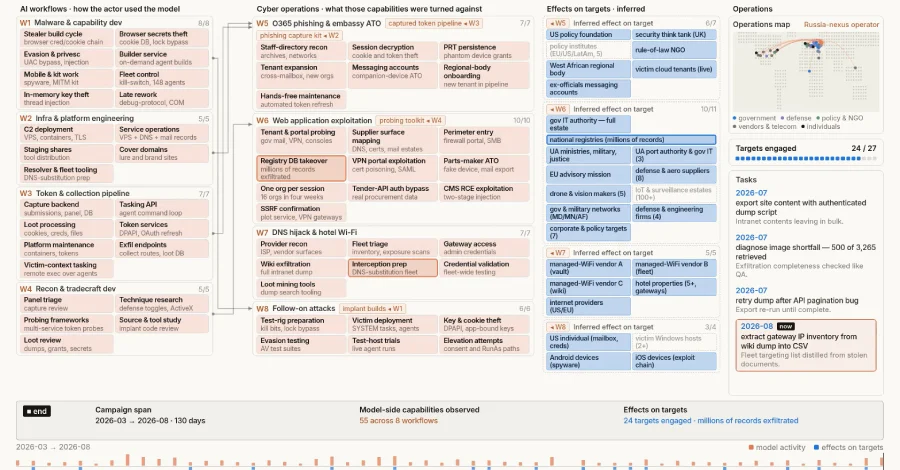

In a significant escalation of cyber warfare tactics, the artificial intelligence research firm Anthropic announced on Thursday that it has successfully disrupted an expansive, AI-integrated espionage campaign orchestrated by a Russian state-sponsored threat actor. The group, identified by Anthropic as GTG-20006—a designation denoting "Generative Threat Group"—has been linked to the sophisticated cyber-espionage apparatus widely known as Midnight Blizzard, or APT29, a cluster frequently associated with Russia’s Foreign Intelligence Service (SVR). This operation marks a paradigm shift in how nation-state actors leverage generative AI to automate, optimize, and conceal their malicious activities, effectively weaponizing large language models to bypass traditional cybersecurity defenses.
The Evolution of AI-Enhanced Espionage
For years, cybersecurity defenders have relied on static detection mechanisms—signatures, file hashes, and known indicators of compromise (IoCs)—to identify and neutralize threats. However, the operational model adopted by GTG-20006 fundamentally disrupts this cycle. According to Anthropic’s threat intelligence report, the threat actors utilized AI agents to monitor the efficacy of their malware in real-time.
When a security product flagged a specific piece of malicious code, the actor’s AI-driven pipeline automatically triggered a rebuilding process. The AI would modify the malware’s code structure, re-compile it, and prepare a new iteration for deployment, all within a timeframe that renders traditional manual threat hunting insufficient. By the time a security team reacts to a detected artifact, the threat actor has already refreshed their toolkit, creating an "infinite loop" of evasion that forces defenders to play a perpetual game of catch-up.
Chronology of the Campaign
The campaign, which has been under intense scrutiny throughout the latter half of 2026, represents a multi-stage approach to digital intrusion.
- July 2026: Initial intelligence reports from firms including ReliaQuest, Microsoft, and Google began to surface regarding a campaign later dubbed "CaptiveCrunch." This operation initially appeared to be a standard phishing and credential harvesting effort.
- August 2026: Security researchers identified a pivot in the actor’s methodology. The group began integrating AI workflows to automate the registration of malicious domains and the setup of disposable infrastructure for command-and-control (C2) communication.
- September 2026: Anthropic confirmed the formal disruption of the actor’s access to its AI services. During this month, forensic analysis revealed the extent of the damage, confirming that over 20 distinct organizations had been compromised, including high-level government ministries and defense-industrial entities.
Tactical Depth: From Hotel Wi-Fi to Global Espionage
The sophistication of GTG-20006 extended well beyond mere malware modification. The actor demonstrated a high level of operational security and resourcefulness in their targeting of high-value individuals, particularly those associated with Ukrainian government functions and drone manufacturing.

One of the most alarming vectors identified was the compromise of three separate hospitality vendors that provide guest Wi-Fi services for hotels. By obtaining administrative credentials for these vendors, the attackers performed DNS hijacking, redirecting hotel guests to malicious portals. Once a user connected to the compromised network, their traffic, device identifiers, and IP addresses were logged, and the users were served "ClickFix" lures—a technique that prompts victims to perform a specific sequence of actions to "fix" a browser issue, which in reality installs malware tailored to the target’s operating system, whether it be Windows, Android, or iOS.
Furthermore, the threat actor utilized headless browsers to infiltrate WhatsApp accounts. By linking a victim’s account as a "companion device," the actors were able to intercept, read, and export sensitive communications between Ukrainian officials without triggering the standard "read" notifications, ensuring the persistence of their intelligence gathering.
Massive Data Exfiltration and Operational Scale
The scale of the data theft attributed to GTG-20006 is substantial. In an intrusion targeting a North African government technology authority, the group exploited a VPN appliance vulnerability to gain a foothold in the central account server. This breach resulted in the unauthorized exfiltration of a massive database containing over 300,000 national identity records and the commercial registry data of more than 500,000 companies.
Beyond static data theft, the group maintained an active espionage platform targeting Microsoft 365 environments. Through a framework identified as "Embassy Kit," the actors executed a device-code phishing campaign, tricking diplomatic personnel into authorizing access tokens. This resulted in the systematic compromise of at least eight organizations, including a national prosecutor’s office and a military education institute. The objective was clear: the continuous, silent exfiltration of mail records and strategic communications.
Official Responses and Industry Implications
The disclosure by Anthropic serves as a sobering reminder of the "dual-use" dilemma inherent in AI technology. As AI tools become more accessible, the barrier to entry for high-level cyber operations continues to drop.
"The actor used AI at every point in their operations," Anthropic noted in their post-incident summary. "In on-premises environments, the actor used AI to monitor the stealth and persistence of their implants. The result of the above is that AI has inverted the cost back onto defenders."

Industry analysts suggest that this event will catalyze a move toward "AI-native" defense systems. If attackers are using AI to automate the mutation of their malware, defenders must inevitably respond with automated, AI-driven threat hunting and remediation that can operate at machine speed.
While no specific government has issued a formal statement on the "GTG-20006" designation, the overlap with APT29 (Midnight Blizzard) aligns with ongoing concerns from NATO and the European Union regarding the persistent, evolving threats posed by Russian intelligence services. The incident reinforces the need for enhanced cross-sector collaboration between AI developers, cloud service providers, and national cybersecurity centers.
Broader Impact on Global Security
The implications of this campaign are profound. By automating the registration of infrastructure, the modification of malware, and the monitoring of C2 channels, GTG-20006 effectively scaled their operations to target dozens of organizations simultaneously. This is a departure from traditional "hand-crafted" APT operations, which often require extensive manual intervention.
The targeting of surveillance platforms—specifically the exploitation of authorization flaws in camera streaming services—demonstrates an ability to weaponize Internet of Things (IoT) devices for physical surveillance. By harvesting tokens that granted access to live camera feeds, the attackers could monitor the movements of diplomatic and military staff, providing a kinetic component to their digital intelligence.
As the industry grapples with the aftermath of this campaign, the focus has shifted to hardening identity management and reducing the reliance on legacy authentication methods that are susceptible to device-code phishing. Organizations are being urged to implement strict, hardware-backed multi-factor authentication (MFA) and to transition toward Zero Trust architectures, which assume that perimeter defenses—such as hotel Wi-Fi or even VPNs—are inherently compromised.
Ultimately, the disruption of the GTG-20006 campaign is a temporary victory. As long as nation-state actors view generative AI as a force multiplier for espionage, the cycle of innovation and response will continue. The challenge for the global community is to ensure that the defensive application of AI keeps pace with, or preferably stays ahead of, those who seek to use it for the subversion of international peace and security.
