
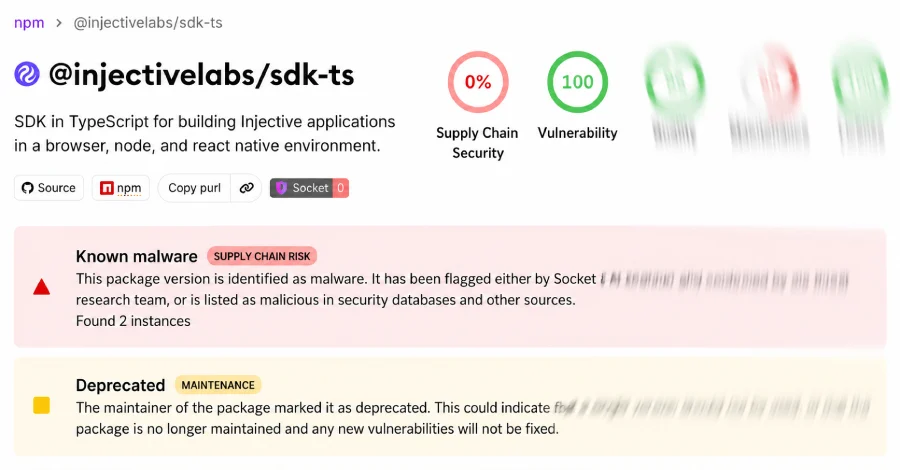

The digital asset ecosystem was recently rattled by a sophisticated software supply chain attack targeting the Injective Labs Software Development Kit (SDK), culminating in the publication of a malicious package on the npm registry. This insidious campaign aimed to surreptitiously exfiltrate cryptocurrency wallet private keys and mnemonic seed phrases from unsuspecting developers and users. The incident underscores the escalating vulnerabilities within the software supply chain, particularly for projects operating in high-value financial sectors like decentralized finance (DeFi) and blockchain.
Unpacking the Compromise: A Deceptive Telemetry Function
The core of the attack centered on the compromise of the Injective Labs SDK project’s GitHub repository. Threat actors, whose identities remain undisclosed as of this report, leveraged this access to inject malicious code into the legitimate codebase. This compromised version, specifically @injectivelabs/[email protected], was subsequently published to the widely used npm registry. Posing as an update, the malicious package harbored a deceptive "fake telemetry functionality" designed to steal sensitive data from cryptocurrency wallets.
The discovery of the malicious package and its subsequent deprecation on the npm registry on July 8, 2026, marked a critical intervention. However, the release artifacts associated with the compromised version remain accessible for download from GitHub, presenting an ongoing risk to developers who might inadvertently fetch the tainted code. This persistence highlights a common challenge in supply chain security: while a malicious package can be removed or deprecated from a registry, its artifacts often linger in other distribution channels or developer caches.
The Attack Vector: Exploiting Trust and Access
According to an analysis by software supply chain security firm Socket, the malicious functionality was introduced through commits made to the project’s official GitHub repository. Crucially, these commits were attributed to a GitHub account belonging to a developer with an established history of contributions to the repository. This detail suggests two primary scenarios: either the legitimate developer’s account was compromised, or the attack involved an insider threat. The former, a credential compromise, is a perennial risk, emphasizing the need for robust multi-factor authentication (MFA) and continuous monitoring of developer accounts. The latter, while less common, presents an even more challenging security paradigm, as insider access inherently bypasses many external defenses.
Further investigations by StepSecurity revealed that the malicious release was facilitated through the repository’s own trusted-publisher (OIDC) pipeline. This method of authentication allows automated systems, such as CI/CD pipelines, to publish packages without requiring static tokens, relying instead on OIDC (OpenID Connect) tokens issued directly by the cloud provider. The use of an OIDC pipeline, coupled with the malicious commits being authored and pushed under the identity of an existing, trusted maintainer ("thomasRalee"), paints a picture of a highly sophisticated attack. It implies that the threat actors not only gained access to a trusted developer’s GitHub account but potentially also manipulated or exploited the OIDC configuration to publish the malicious package, thereby leveraging the very mechanisms designed to enhance security and streamline development workflows.

A Deeper Dive into the Malware’s Modus Operandi
The malware embedded within the compromised package was crafted with a degree of subtlety, designed to evade immediate detection. Unlike many malicious packages that attempt to execute nefarious scripts during the installation phase (e.g., via postinstall scripts), this particular malware remained dormant until the library’s legitimate functionality was invoked by an unsuspecting developer. This delayed activation strategy helps the malware "fly under the radar" of automated security scanners that primarily focus on installation-time behaviors.
Specifically, the poisoned version of the SDK was found to modify legitimate functions responsible for generating private keys. It introduced a new function, trackKeyDerivation(), cloaked under the guise of collecting "anonymized usage metrics for SDK optimization." The description accompanying this purported telemetry function read: "Tracks which key derivation methods are used (hex vs mnemonic) and derives timing patterns to help the SDK team identify performance bottlenecks and understand adoption of different key formats across the ecosystem. All metrics are fire-and-forget and never block or affect key derivation."
However, this benevolent-sounding description was a facade. Socket’s analysis confirmed that parameters passed to the trackKeyDerivation() function included a hard-coded marker detailing the key derivation method, along with the actual sensitive information required to generate the private key. This captured material, comprising mnemonic phrases or private keys, was sufficient for the threat actor to regenerate the cryptocurrency wallet’s master key at their end, granting them full control over any associated digital assets.
As OX Security succinctly put it, the malware added "crypto wallet stealing logic to a crypto wallet package." Every instance where a legitimate user created or utilized logic that read mnemonic phrases – essentially the master key for any crypto wallet – the malware would intercept and transmit this critical data to a remote server.
Exfiltration and Evasion Techniques
To further reduce the likelihood of detection through network traffic analysis, the exfiltration mechanism was designed with a specific optimization. Rather than sending each intercepted key derivation event individually, the malware appended multiple key derivations over a two-second window into a single queue. These batched packets of sensitive data were then transmitted as a single HTTPS POST request to an external server identified as "testnet.archival.chain.grpc-web.injective[.]network." This batched approach made the outbound traffic less noisy and potentially harder to distinguish from legitimate application telemetry or background network activity. The choice of a domain that closely mimics legitimate Injective infrastructure also served to camouflage the malicious traffic.
Broader Ripple Effects: Transitive Dependencies and Ecosystem Vulnerability

The impact of this attack extended beyond direct users of the @injectivelabs/sdk-ts package. The threat actors exploited the interconnected nature of modern software development by publishing version 1.20.21 across 17 additional @injectivelabs scoped packages. These dependent packages, which "pinned" or relied on the malicious SDK version, effectively became conduits for the malware. This meant that even users who did not directly install @injectivelabs/sdk-ts but instead used one of these 17 other packages as a transitive dependency could have unknowingly incorporated the malicious code into their projects.
This phenomenon highlights a critical vulnerability in the software supply chain: transitive dependencies. A single compromised package can propagate malicious code throughout an entire ecosystem, affecting a vast number of projects and end-users who may have no direct awareness of the underlying components. The widespread adoption of open-source components and package managers like npm, while accelerating development, simultaneously expands the attack surface for such supply chain compromises.
Chronology of the Attack and Response
- Prior to July 8, 2026: Threat actors compromise a trusted developer’s GitHub account associated with Injective Labs. Malicious code, disguised as telemetry, is injected into the
injective-tsrepository. The repository’s OIDC trusted-publisher pipeline is either exploited or used to publish the malicious version. - July 8, 2026: Malicious package
@injectivelabs/[email protected]is published to the npm registry. Simultaneously, version 1.20.21 is published across 17 other dependent@injectivelabsscoped packages. - July 8 – July 10, 2026: Security researchers from firms like Socket, OX Security, and StepSecurity detect the anomaly through automated scanning and behavioral analysis of new package releases. Initial investigations confirm the presence of wallet-stealing malware.
- July 8, 2026 (or soon thereafter): Injective Labs, in collaboration with npm and security firms, is alerted to the compromise. Immediate action is taken to deprecate
@injectivelabs/[email protected]and its dependent malicious versions on the npm registry. - July 10, 2026: News of the compromise becomes public. Users are advised to take immediate remediation steps. A clean version of the package (1.20.23) is published to provide a secure alternative.
Statements and Remediation Efforts
While specific official statements from Injective Labs, npm, or GitHub regarding this particular incident were not detailed in the initial report, typical responses in such high-stakes compromises involve a coordinated effort.
Injective Labs would likely issue a public advisory, expressing regret for the incident and outlining the steps taken to address it. Their statement would emphasize their commitment to user security, the initiation of a comprehensive internal investigation, and the hardening of their development and deployment pipelines. They would also likely stress the importance of immediate action from their developer community.
npm, as the custodian of the package registry, would reiterate its ongoing efforts to maintain the integrity and security of its ecosystem. They might emphasize the challenges of vetting every package in a vast repository and underscore the shared responsibility of developers and users in identifying and reporting suspicious activity.
Security firms like Socket, OX Security, and StepSecurity, having been instrumental in the discovery, would release detailed technical analyses, providing indicators of compromise (IoCs) and specific remediation steps. Their statements would serve to educate the wider developer community on the evolving threat landscape of software supply chain attacks.

Urgent Recommendations for Affected Users
For users who may have installed the malicious version @injectivelabs/[email protected] or any of the 17 other affected @injectivelabs scoped packages, immediate and decisive action is paramount:
- Update Immediately: Developers must update to the newly published, clean version of the package, which is 1.20.23 or later. This ensures that their projects are using a secure, untainted version of the SDK.
- Assume Compromise: Any private key or mnemonic phrase that was generated, accessed, or passed through the compromised package version must be treated as irrevocably compromised.
- Rotate Cryptocurrency Wallets: All cryptocurrency wallets associated with the compromised keys or mnemonic phrases must be immediately emptied and new wallets created. Funds should be transferred to these new, secure wallets. This is the most critical step to prevent financial loss.
- Check Transitive Dependencies: Even if
sdk-tswas not directly installed, developers must audit their project’s dependency tree to identify if any other@injectivelabspackages, which might have pulled in the malicious version as a transitive dependency, were in use. Tools likenpm auditoryarn auditcan assist in this process. - Enhanced Security Practices: Adopt or reinforce strong security practices, including regular security audits of dependencies, static and dynamic application security testing (SAST/DAST), and stringent code review processes. Implement multi-factor authentication (MFA) across all development platforms, including GitHub and npm.
Broader Implications for Software Supply Chain Security and DeFi
This incident serves as a stark and sobering reminder of the persistent and evolving threat of software supply chain attacks. The sophisticated nature of this compromise, involving a trusted developer account, OIDC pipeline manipulation, and a stealthy malware payload, highlights several critical implications:
- Erosion of Trust: Such attacks erode trust in open-source ecosystems and the foundational components upon which much of the modern internet is built. Developers rely on the integrity of packages, and breaches undermine this fundamental trust.
- Targeting High-Value Assets: The focus on cryptocurrency wallet keys underscores the growing threat to the DeFi sector. The immutable nature of blockchain transactions means that once funds are stolen, recovery is often impossible, making crypto wallets exceptionally high-value targets for attackers.
- Complexity of Modern Development: The intricate web of dependencies in contemporary software development creates a vast and often opaque attack surface. A single compromised component can have cascading effects across countless applications.
- Need for Proactive Security: Reactive measures, while necessary, are often insufficient. There is an urgent need for proactive security postures, including continuous monitoring of dependencies, behavioral analysis of package activity, and robust security practices throughout the entire software development lifecycle (SDLC).
- Developer Education: Developers must be acutely aware of the risks associated with third-party dependencies and practice due diligence when integrating external code. This includes verifying package authenticity, scrutinizing unusual updates, and understanding the security implications of their dependency graph.
The Injective Labs SDK compromise is a critical case study in the ongoing battle against software supply chain attacks. It emphasizes that no project, regardless of its size or prominence, is immune to these sophisticated threats, particularly when financial incentives are high. As the digital landscape continues to evolve, the collective vigilance of developers, security researchers, and platform providers will be essential in safeguarding the integrity of our interconnected software world.
