
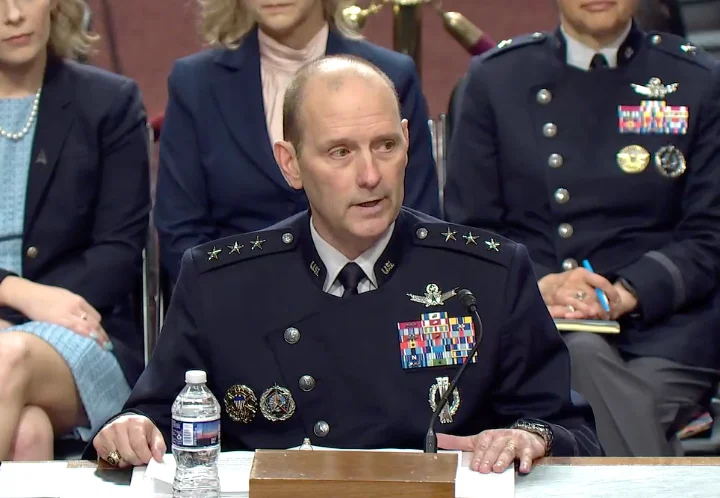

United States Space Force Lt. Gen. Douglas Schiess appeared before the Senate Armed Services Committee (SASC) on Thursday for a high-stakes confirmation hearing, signaling a pivotal shift in the nation’s orbital defense strategy. Nominated to serve as the third Chief of Space Operations (CSO) since the service’s inception in late 2019, Schiess articulated a vision centered on neutralizing the "space-based kill chains" developed by China and Russia while accelerating the deployment of advanced U.S. tracking technologies. His testimony underscored the growing urgency within the Department of Defense to transition from a posture of passive observation to one of active, resilient deterrence in the face of rapidly advancing adversarial capabilities.
During the hearing, Schiess identified the development of Space-Based Moving Target Indication (SB-AMTI) and the capacity to disrupt Chinese military space systems as his foremost priorities. As the current Deputy Chief of Space Operations for Operations, Schiess brings decades of experience to the role, having served as a missileer and a Global Positioning System (GPS) crew commander earlier in his career. His nomination comes at a critical juncture as the Space Force seeks to solidify its role within the Joint Force and secure the funding necessary to maintain a competitive edge in what is now considered a contested warfighting domain.
The Evolution of the Space Force Leadership
The nomination of Lt. Gen. Douglas Schiess marks the next chapter in the leadership of the youngest branch of the U.S. Armed Forces. Established on December 20, 2019, the U.S. Space Force was created to organize, train, and equip personnel to protect U.S. and allied interests in space. The service’s first CSO, Gen. Jay Raymond, focused on the foundational bureaucracy and the transfer of assets from the Air Force. He was succeeded by Gen. B. Chance Saltzman, who introduced the "Competitive Endurance" theory, emphasizing the need to deny adversaries the use of space without creating debris that would render the domain unusable.
If confirmed, Schiess will inherit a service that has transitioned from its "start-up" phase into a fully integrated operational entity. His background is uniquely suited for this transition; his tenure as the commander of Space Launch Delta 45 and his leadership within U.S. Space Command have provided him with a comprehensive view of both the logistical and tactical requirements of modern space operations. His testimony suggested that his tenure would be defined by "integrated deterrence"—a concept that relies on combining space capabilities with traditional air, land, and sea power to discourage aggression.
Countering the Chinese Space-Based Kill Chain
A central theme of the confirmation hearing was the "serious threat" posed by the People’s Republic of China (PRC). Sen. Jack Reed, D-R.I., the SASC’s ranking member, provided a sobering assessment of China’s advancements. He noted that the PRC has successfully built a "space-based kill chain" capable of tracking U.S. carrier strike groups from the moment they depart their home ports. This capability allows Chinese missile systems to be cued in near real-time, significantly increasing the risk to U.S. naval assets in the Indo-Pacific.
Schiess echoed these concerns, describing China’s expansion of tactical space-based intelligence, surveillance, and reconnaissance (ISR) as a primary challenge. He testified that China’s ongoing development of electro-magnetic jamming and other counter-space technologies is "very worrisome." According to Schiess, the PRC is leveraging its ISR efforts to target U.S. forces at greater distances than ever before, utilizing a sophisticated network of sensors and shooters to challenge American power projection.
To counter this, Schiess emphasized the necessity of "Denial of Adversary Kill Webs." In his written responses to the committee, he argued that the Joint Force must aggressively disrupt the link between an adversary’s space-based sensors and their long-range weapons. He advocated for robust electronic attack capabilities that provide "reversible denial"—the ability to temporarily blind or jam enemy networks without permanently destroying satellites, which could result in hazardous orbital debris.
The Strategic Importance of Space-Based Moving Target Indication
One of the most technical and critical aspects of Schiess’s testimony involved the fielding of Space-Based Air Moving Target Indication (SB-AMTI). Historically, the tracking of moving targets—such as aircraft or ground vehicles—was conducted by specialized air platforms like the E-3 Sentry (AWACS) or the E-8C Joint STARS. However, as adversarial surface-to-air missile systems have become more lethal and long-ranged, these manned aircraft are increasingly vulnerable.
Schiess argued that moving these tracking capabilities to space is essential for "saving American lives." By utilizing a constellation of satellites to perform AMTI, the U.S. can maintain situational awareness from a distance that keeps manned platforms out of harm’s way. "SB-AMTI and ground moving target indication… allows us to have our forces farther out and still provide that capability," Schiess testified. He noted that while airborne assets would still play a role, space-based systems would provide a "complementary" and "higher fidelity" stream of information.
The transition to SB-AMTI is already underway. In May 2024, the Space Force awarded SpaceX a contract worth nearly $4.2 billion for the initial fielding of these systems. This followed a series of smaller development contracts awarded to nine different firms, signaling a broad industrial effort to modernize the nation’s ISR architecture. Furthermore, the White House’s $87.6 billion supplemental funding request includes $4 billion specifically earmarked for SB-AMTI and the development of the Space Data Network Backbone—a resilient "internet in space" designed to transmit data across the constellation with minimal latency.
Timeline of Key Space Force Milestones and SB-AMTI Development
To understand the context of Schiess’s nomination, it is helpful to review the timeline of the U.S. Space Force’s evolution and its recent focus on moving target indication:
- December 2019: The U.S. Space Force is officially established as the sixth branch of the military.
- 2020-2022: The service focuses on transferring personnel (Guardians) and assets from the Air Force, Army, and Navy.
- November 2022: Gen. B. Chance Saltzman assumes command as the second CSO, emphasizing "resilient architectures."
- Early 2023: The Department of the Air Force identifies SB-AMTI as a top operational imperative to replace aging legacy aircraft.
- April 2024: The Space Force awards nine firms preliminary contracts for SB-AMTI concepts to encourage competition and innovation.
- May 2024: SpaceX receives a $4.2 billion contract for the initial fielding of the SB-AMTI constellation, alongside a $2.3 billion contract for the Space Data Network Backbone.
- June 2024: Lt. Gen. Douglas Schiess is nominated to succeed Gen. Saltzman as the third CSO.
- July 2024: Confirmation hearing takes place before the Senate Armed Services Committee.
Strengthening the Industrial Base and Commercial Partnerships
Schiess’s testimony also highlighted the growing reliance of the Space Force on the commercial sector. The $4.2 billion contract awarded to SpaceX is emblematic of a broader shift toward "commercial augmentation," where the military leverages the rapid innovation and lower costs of private industry to achieve its goals.
Schiess noted that using automation and high-speed networks to bring data directly to the warfighter is a primary objective. By partnering with companies like SpaceX, the Space Force aims to deploy large "proliferated" constellations—hundreds of small satellites instead of a few large, expensive ones. This approach makes the network more resilient; if an adversary destroys one or two satellites, the overall system remains functional.
However, this reliance on the private sector has also sparked debate within Congress regarding oversight and the security of supply chains. Sen. Deb Fischer, R-Neb., questioned Schiess on the risks of pausing SB-AMTI fielding. Schiess responded that any delay would directly translate to increased risk for U.S. service members in theater, as it would leave a gap in the military’s ability to track threats in contested environments.
Broader Implications for Global Security and Deterrence
The priorities outlined by Lt. Gen. Schiess have significant implications for the future of global conflict. By focusing on "reversible denial" and advanced tracking, the Space Force is attempting to navigate a delicate balance: maintaining the ability to win a high-end conflict while preventing an escalation that could lead to a catastrophic "Kessler Syndrome" event (a chain reaction of satellite collisions).
The shift toward SB-AMTI also signals a change in how the U.S. views the Pacific theater. In a potential conflict over Taiwan or the South China Sea, the ability to track Chinese movements without putting carrier groups or ISR aircraft in range of land-based missiles is a game-changer. It allows the U.S. to maintain a "stand-off" distance while still possessing the "stand-in" information required to conduct precision strikes.
Furthermore, Schiess’s focus on the "Space Data Network Backbone" suggests that the future of the Space Force is not just about satellites, but about data management. The ability to fuse data from multiple sources—satellites, drones, ships, and ground sensors—and deliver it to a pilot or a commander in seconds is what Schiess referred to as "greater fidelity of information." This digital integration is the cornerstone of the Department of Defense’s Joint All-Domain Command and Control (JADC2) initiative.
Conclusion and Path Forward
The confirmation of Lt. Gen. Douglas Schiess as the third Chief of Space Operations appears likely, given the bipartisan support for the Space Force’s mission and his extensive qualifications. If confirmed, Schiess will be tasked with executing some of the most ambitious and expensive programs in the history of the service.
His testimony served as a clear message to both allies and adversaries: the United States is committed to maintaining its dominance in the space domain through a combination of technological innovation, commercial partnership, and aggressive electronic warfare capabilities. As the "kill chains" of the 21st century move higher into the atmosphere, the leadership of Gen. Schiess will be instrumental in ensuring that the U.S. Space Force can protect not only the assets in orbit but also the lives of those on the ground and at sea. The multi-billion dollar investments in SB-AMTI and resilient networks represent more than just a technological upgrade; they are a fundamental realignment of American military power for an era where the high ground is no longer a hill, but the vacuum of space itself.
