

The launch of Kimi K3 by Chinese artificial intelligence firm Moonshot AI, occurring in the late hours, has sent ripples of apprehension through global financial markets. The immediate aftermath saw a significant downturn in semiconductor and artificial intelligence stocks on Friday, reflecting a familiar pattern of market reaction whenever a Chinese entity demonstrates significant progress in the AI landscape. Taiwan’s benchmark stock index experienced a decline of over 6%, Japan’s market closed down 4%, and the Nasdaq composite saw its worst session of the week, sliding 1.5%.
This market volatility underscores the growing concern among investors and industry observers regarding the accelerating pace of AI development in China and its potential to disrupt the established order dominated by Western technology giants. The release of Kimi K3 is being widely compared to the impact of DeepSeek’s R1 model in January 2025, which similarly challenged the prevailing assumption that cutting-edge AI development required astronomical spending, particularly on specialized chips. At that time, Nvidia experienced a substantial market capitalization loss of approximately $590 billion in a single trading session. The current market reaction suggests that the Kimi K3 launch is having a similarly broad, albeit slightly more diffused, impact across the entire AI and semiconductor sector.
Kimi K3’s Performance Benchmarks and Market Disruption
The significance of Kimi K3 lies not only in its performance but also in its accessibility. According to the Artificial Analysis Intelligence Index, an independent composite benchmark that measures model performance across reasoning, knowledge, mathematics, and coding, K3 achieved a score of 57. This places it above prominent models such as Claude Opus 4.8 and GPT-5.5, and competitively close to Claude Fable 5 and OpenAI’s GPT-5.6 Sol. Notably, Kimi K3 not only matches or exceeds the performance of these leading models in specific benchmarks but also does so at a significantly lower cost.
The implications of Kimi K3’s release are amplified by its licensing terms. The full weights of the model are scheduled for release on July 27th under a Modified MIT license. This open-source approach means that smaller research labs and developers will have access to a state-of-the-art AI model at no cost, potentially democratizing advanced AI capabilities and accelerating innovation globally. This move could further challenge the business models of companies that rely on proprietary AI models and high-cost access.
Market Reaction and Analyst Perspectives
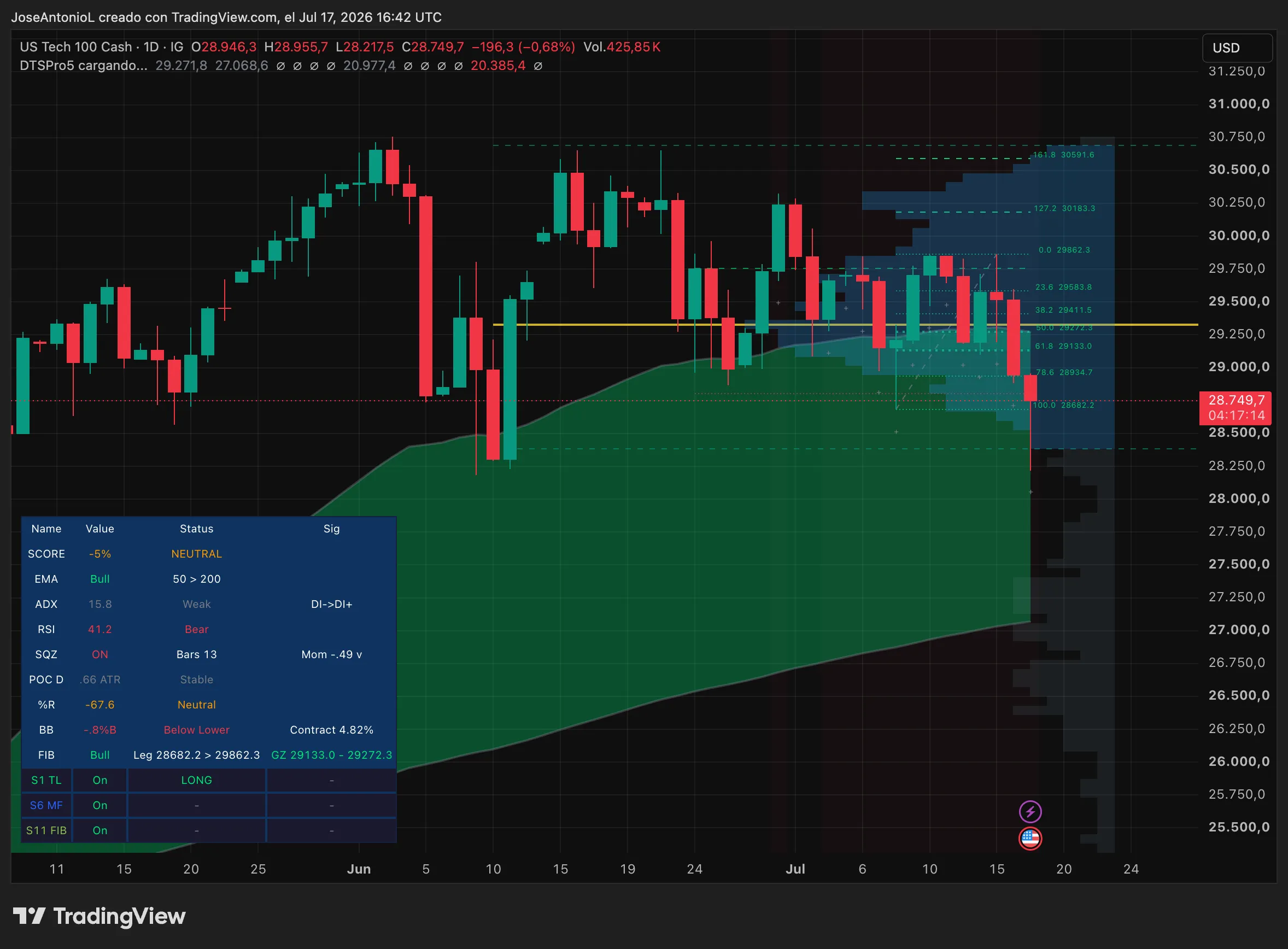
The sell-off in technology stocks was palpable across major exchanges. The VanEck Semiconductor ETF (SMH), a bellwether for the semiconductor industry, fell below its Exponential Moving Average (EMA) support band for the first time since April. This technical indicator, which tracks price trends over preceding months, signals a significant shift in market sentiment. The SMH is now more than 20% below its record high reached in late June, indicating a broad-based downturn in the sector.
Financial analysts, while acknowledging the market’s jitters, largely viewed the Kimi K3 launch as a predictable development in the rapidly evolving AI landscape. Robin Zhu, an analyst at Bernstein, described the release as "confirmatory," suggesting it aligns with existing observations about the accelerating pace of AI innovation and China’s increasing competitiveness. He noted, "At a high level, K3 feels confirmatory of our views that (1) AI [state of the art] continues to evolve rapidly; and (2) China AI can continue to keep pace with global [state of the art], and take some share over time."
Gary Yu, a Morgan Stanley analyst, framed Kimi K3 as a product of consistent, compounding progress rather than an unexpected breakthrough. His assessment, shared globally, indicated that "K3 has received positive feedback globally, signaling an all-round catch-up of Chinese LLMs with U.S. leaders in model size, performance, and pricing." This perspective suggests that the industry has been observing a gradual but steady ascent of Chinese AI capabilities, with Kimi K3 representing a significant milestone in that ongoing trajectory.
Moonshot AI’s Trajectory and Strategic Backing
Moonshot AI, the company behind Kimi K3, is backed by the Chinese e-commerce giant Alibaba. In 2024, Alibaba invested $1 billion in Moonshot AI at a valuation of $2.5 billion. The startup’s valuation has since surged to approximately $31.5 billion, reflecting significant investor confidence in its technological advancements and market potential.
This backing provides Moonshot AI with substantial resources to continue its research and development efforts, further solidifying its position in the competitive AI arena. The company’s strategic partnerships and financial strength are crucial factors in its ability to develop and deploy advanced AI models like Kimi K3.
Precedent and the Shifting AI Landscape
The impact of Kimi K3 echoes the disruption caused by DeepSeek’s R1 model in early 2025. The R1’s release challenged the notion that only well-funded Western labs could produce frontier AI models. This had a direct impact on the stock market, with Nvidia’s valuation taking a significant hit. The current market reaction to Kimi K3 suggests a similar, though perhaps more widespread, concern about the competitive pressures emerging from China.
Furthermore, Moonshot AI is not entirely new to the U.S. developer community. As previously reported by Decrypt in May, the Kimi K2.5 model was found to be powering Cursor’s Composer 2 feature without explicit disclosure. This incident, which was later acknowledged by the Cursor team, highlights that Moonshot AI’s technology has already been integrated into popular developer tools, indicating a deeper penetration into the U.S. market than might be immediately apparent. This prior integration suggests a growing reliance on Chinese AI infrastructure and models among U.S. developers, a trend that may accelerate with the release of Kimi K3.
Broader Implications for the Global AI Ecosystem
The rise of advanced, cost-effective AI models from China has profound implications for the global AI ecosystem. It suggests a potential shift in the technological balance of power, challenging the long-held dominance of U.S.-based AI companies. The availability of powerful open-source models like Kimi K3 could spur innovation in developing nations and smaller research institutions, potentially leading to a more distributed and diverse AI landscape.
For semiconductor companies, the increased efficiency and accessibility of AI models could influence demand for high-end chips. If AI models become less reliant on massive computational power and can be deployed more efficiently, the demand for the most advanced and expensive specialized hardware might change. This could lead to adjustments in production strategies and investment priorities within the semiconductor industry.
The competitive pressure from Kimi K3 also raises questions about intellectual property, ethical AI development, and data privacy. As AI capabilities become more globally distributed, international cooperation and regulatory frameworks will be crucial to ensure responsible and beneficial development of this transformative technology. The market’s immediate panic, while often a short-term reaction, reflects a longer-term strategic recalibration that the global AI industry must undertake in response to these evolving dynamics. The race for AI supremacy is clearly entering a new, more competitive phase, with China emerging as a formidable contender.
