
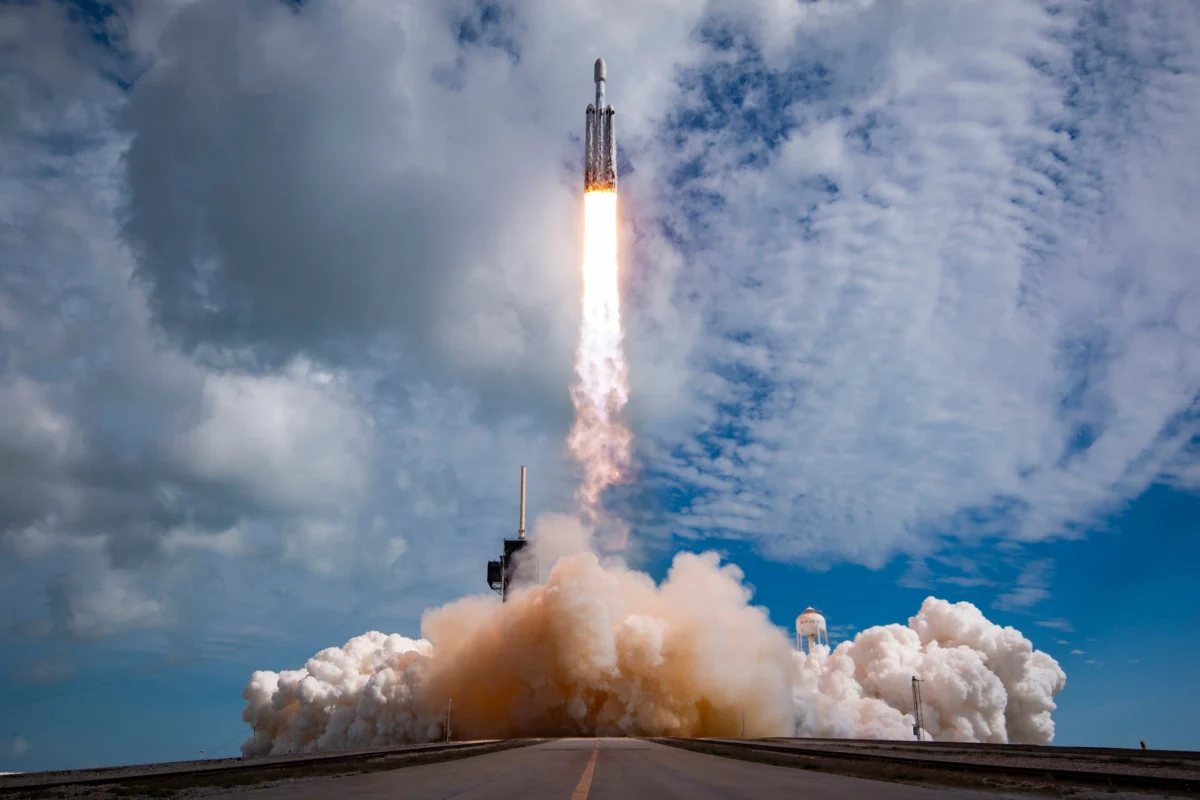

The heavy-lift mission proceeded according to a precise flight profile, with the satellite being deployed into a geostationary transfer orbit approximately 4 hours and 57 minutes after liftoff. Shortly after the deployment, Viasat engineers confirmed that they had successfully acquired signals from the spacecraft, which has been designated ViaSat-3 F3. The satellite is now beginning its several-month-long journey to its final orbital slot over the Asia-Pacific region. This transit will be managed via on-board electric propulsion systems, a method that prioritizes mass efficiency over transit speed, allowing for a larger payload of communication equipment.
A Technical Triumph for the Falcon Heavy
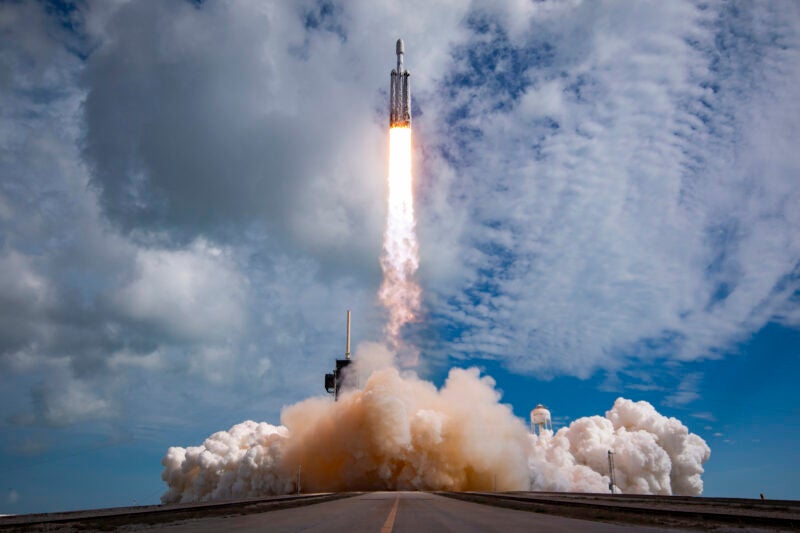
The launch of ViaSat-3 F3 represented another demonstration of the Falcon Heavy’s unique capabilities. As one of the world’s most powerful operational rockets, the Falcon Heavy consists of three modified Falcon 9 first-stage cores strapped together, generating more than 5 million pounds of thrust at liftoff. For this specific mission, the high mass of the ViaSat-3 satellite and the requirement for a high-energy injection orbit necessitated a complex flight sequence.
SpaceX successfully recovered both of the Falcon Heavy’s side boosters, which performed synchronized landing maneuvers back at Cape Canaveral’s Landing Zones 1 and 2. This recovery highlights the continued maturation of reusable rocket technology, which has significantly lowered the cost of access to space for heavy payloads. The center core, as is common with high-energy geostationary missions, was expended to ensure the satellite reached its intended trajectory with maximum fuel reserves for its internal propulsion system.
Viasat confirmed that the satellite’s health is stable. Over the coming weeks, the spacecraft will execute a series of orbit-raising maneuvers. If the timeline remains consistent with previous GEO deployments, ViaSat-3 F3 is expected to reach its final orbital position and undergo rigorous in-orbit testing before entering commercial service by late summer 2026.
The ViaSat-3 Constellation: Scaling Global Connectivity
The ViaSat-3 F3 satellite is the final piece of a three-satellite global constellation designed to deliver a massive leap in bandwidth. Each satellite in the ViaSat-3 class is engineered to provide more than 1 terabit per second (Tbps) of total network capacity. To put this in perspective, a single ViaSat-3 satellite possesses more capacity than the combined total of the entire preceding Viasat fleet.
The constellation is strategically distributed to provide near-global coverage:
- ViaSat-3 F1: Launched in early 2023, this satellite was originally intended to cover the Americas. However, it suffered a significant deployment anomaly involving its large mesh antenna. While the satellite is operational, it currently provides only a fraction of its intended capacity.
- ViaSat-3 F2: Launched in November 2025, this satellite is currently undergoing in-orbit testing. Viasat recently confirmed that the F2’s reflector successfully completed its "bloom"—the critical process of unfolding the massive antenna—without the issues that plagued the first unit. It is primarily focused on serving the Americas and the Atlantic Ocean region.
- ViaSat-3 F3: The satellite launched today is dedicated to the Asia-Pacific (APAC) region. Once operational, it will provide high-speed internet to some of the world’s most rapidly growing markets, including Southeast Asia, Australia, and the bustling maritime corridors of the Indian and Pacific Oceans.
Overcoming Historical Challenges
The successful launch and signal acquisition of the third satellite bring a sense of relief to Viasat shareholders and engineers alike. The ViaSat-3 program has faced significant headwinds, most notably the mechanical failure of the first satellite’s antenna in mid-2023. That anomaly, which involved a failure of the reflector to fully deploy, led to a substantial insurance claim of approximately $420 million—one of the largest in the history of the satellite industry.
In response to the F1 failure, Viasat and its manufacturing partner, Boeing, implemented rigorous design reviews and hardware modifications for the subsequent two satellites. The successful "bloom" of the F2 reflector in late 2025 served as a vital proof of concept that the design flaws had been addressed. Today’s launch of F3 represents the final step in proving the resilience of the modified architecture.
Mark Dankberg, Viasat’s Chairman and CEO, emphasized that the completion of the constellation allows the company to move past the troubleshooting phase and into a period of sustained service delivery. "The third ViaSat-3 satellite will provide secure, flexible capacity for customers in the Asia-Pacific region," Dankberg stated. "Once ViaSat-3 F3 is in service, the completed ViaSat-3 constellation will become a cornerstone of our unified, global, high-capacity network."
Strategic Implications and Market Analysis
The completion of the ViaSat-3 constellation comes at a time of intense competition in the satellite communications sector. The rise of Low Earth Orbit (LEO) constellations, most notably SpaceX’s Starlink, has disrupted the traditional Geostationary Orbit (GEO) business model. LEO satellites offer lower latency due to their proximity to Earth, while GEO satellites like ViaSat-3 offer massive capacity density from a fixed point in the sky.
Viasat’s strategy involves a "multi-orbit, multi-band" approach. By combining the massive throughput of GEO satellites with the low latency of LEO and the global reach of their recently acquired Inmarsat L-band assets, Viasat aims to offer a hybrid service that appeals to high-end enterprise and government clients.
Dankberg noted that the company is shifting its focus toward "sustained reductions in capital intensity." This indicates that while Viasat will continue to innovate, the massive capital expenditure required for the ViaSat-3 program is nearing its end. The company is now looking toward a "common lower mass multi-orbit architecture" that can be adapted more quickly to changing market demands, such as mobile satellite services and sovereign communications capabilities for national governments.
Chronology of the ViaSat-3 Program
To understand the significance of today’s launch, it is necessary to look at the timeline of the program’s development:
- 2015-2016: Viasat announces the ViaSat-3 program, partnering with Boeing to build the 702MP+ platform satellites.
- April 2023: Launch of ViaSat-3 F1. Shortly after, the company reports an antenna deployment anomaly, leading to a significant reduction in usable capacity.
- Late 2023 – 2024: Extensive root-cause analysis and hardware adjustments are made to F2 and F3. Viasat begins integrating Inmarsat operations following a $7.3 billion acquisition.
- November 2025: Successful launch of ViaSat-3 F2. The satellite reaches orbit and successfully deploys its reflector.
- April 29, 2026: Successful launch of ViaSat-3 F3 via SpaceX Falcon Heavy, completing the three-satellite constellation.
- Expected Late Summer 2026: ViaSat-3 F3 enters full commercial service over the Asia-Pacific region.
Impact on Global Connectivity
The deployment of the APAC satellite is particularly significant for the aviation and maritime industries. With over 1 Tbps of capacity, Viasat will be able to offer "at-home" quality Wi-Fi to passengers flying over the Pacific or traveling on cruise ships in the region. This capacity is also critical for government applications, providing secure and resilient communications for defense and disaster relief operations in areas where ground-based infrastructure is either non-existent or compromised.
The "sovereign communications capability" mentioned by Dankberg refers to Viasat’s ability to provide dedicated, secure bandwidth to specific nations. This allows governments to maintain control over their data and communication links without relying on foreign-owned ground infrastructure, a growing priority in global geopolitics.
Looking Ahead
As ViaSat-3 F3 begins its journey to geostationary orbit, the focus for Viasat shifts from orbital delivery to network integration. The company must now manage a complex transition, migrating users to the new high-capacity satellites while optimizing the performance of the impaired F1 unit.
The successful completion of this constellation marks the end of a high-stakes chapter for Viasat. Despite the technical setbacks of 2023, the company has managed to launch and initialize a global network that remains competitive in an increasingly crowded orbital environment. With the three satellites in place, Viasat is positioned to leverage its massive bandwidth to capture a larger share of the global mobility and enterprise markets, even as the satellite industry continues to evolve toward multi-orbit solutions.
For SpaceX, this mission further cements the Falcon Heavy’s role as the premier vehicle for high-mass, high-energy satellite deployments. As the space industry moves toward even larger constellations and more complex orbital infrastructures, the reliability demonstrated by the Falcon Heavy remains a critical asset for commercial and government partners alike.
