
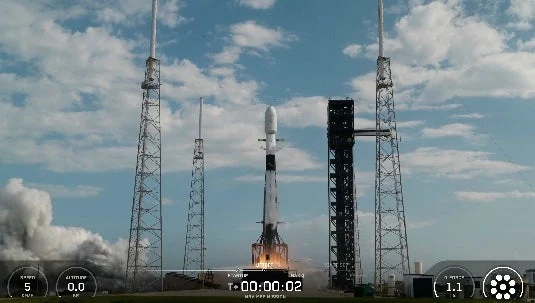

The landscape of orbital infrastructure underwent a significant transformation on Tuesday as a SpaceX Falcon 9 rocket lifted off from Cape Canaveral Space Force Station, carrying a payload designed to end the era of disposable satellites. At 5:15 p.m. ET, the mission, designated MRV-MEP, began its journey to geostationary orbit, marking a pivotal moment for Northrop Grumman and its wholly owned subsidiary, SpaceLogistics. This mission represents the next evolution in space sustainability, deploying the first-ever Mission Robotics Vehicle (MRV) alongside three Mission Extension Pods (MEPs). The launch signals a shift from the traditional model of abandoning multi-million dollar assets when they run out of fuel to a new paradigm of persistent, robotic maintenance and life extension in the harshest environments known to man.
The Launch and Deployment Sequence
The mission commenced under clear Florida skies, with the Falcon 9 booster providing the necessary thrust to carry the heavy servicing suite into a supersynchronous transfer orbit. The flight profile was meticulously choreographed to ensure the safe delivery of four distinct spacecraft. Following the successful separation of the first stage, which returned for a landing on a SpaceX droneship, the second stage took over the task of orbital insertion.
The deployment sequence was engineered for precision, beginning approximately 35 minutes into the mission. The primary payload, the Mission Robotics Vehicle (MRV), was the first to be released from the launch vehicle. Following the MRV’s departure, the Falcon 9 second stage initiated a series of timed releases for the three Mission Extension Pods. These pods were deployed at ten-minute intervals: the first at 45 minutes, the second at 55 minutes, and the final MEP at one hour and five minutes post-launch. This staggered release prevents potential collisions and allows ground controllers at Northrop Grumman’s operations center to establish individual communication links with each asset as they begin their months-long trek to their final operational positions in geostationary orbit (GEO).
Technical Specifications: The MRV and MEP System
The Mission Robotics Vehicle is the centerpiece of this technological leap. Unlike previous servicing vehicles that were designed to dock and remain attached to a single satellite, the MRV is a versatile orbital "mechanic." It is equipped with two sophisticated robotic arms capable of performing complex maneuvers, including capturing, repairing, and refueling satellites that were never originally designed to be serviced. These robotic appendages are the result of a long-standing partnership between Northrop Grumman, the U.S. Naval Research Laboratory (NRL), and NASA. The arms integrate advanced sensors and autonomous algorithms that allow the vehicle to interact with target satellites with millimeter-level precision, overcoming the challenges of zero-gravity physics and the extreme thermal conditions of space.
While the MRV acts as the primary servicer, the Mission Extension Pods (MEPs) serve as external propulsion units. Each MEP is a small, specialized spacecraft designed to be "installed" onto a client satellite by the MRV. Once attached, the MEP takes over the station-keeping and attitude control functions of the host satellite. This is particularly valuable for aging communications satellites that have perfectly functional transponders and electronics but have exhausted their onboard chemical propellant. By providing an additional six years of life, each MEP allows satellite operators to continue generating revenue from existing assets, delaying the massive capital expenditure required to build and launch replacement satellites.
A Legacy of Innovation: From MEV-1 to MRV
The success of the MRV-MEP mission is built upon the foundation laid by Northrop Grumman’s Mission Extension Vehicles (MEV-1 and MEV-2). In 2020, SpaceLogistics made aerospace history when MEV-1 successfully docked with Intelsat 901, a satellite that had been in orbit for nearly two decades. This was the first time two commercial satellites had docked in orbit, and it proved that life extension was not just a theoretical possibility but a viable commercial service. In 2021, the company followed up this achievement with MEV-2, which docked with Intelsat 10-02 while the satellite remained fully operational, ensuring no service interruption for Intelsat’s customers.
However, the MEV series had a limitation: the servicer remained physically attached to the client satellite for the duration of the life extension period, effectively tying up a multi-million dollar vehicle for years. The MRV-MEP architecture solves this by separating the "servicer" from the "propulsion unit." The MRV can now fly to a satellite, install an MEP, and move on to the next client, creating a "hub-and-spoke" model for orbital maintenance. This scalability is essential for the burgeoning space economy, where thousands of new satellites are expected to reach orbit in the coming decade.
Strategic and Economic Implications
The economic impact of on-orbit servicing cannot be overstated. A typical geostationary communications satellite can cost upwards of $200 million to manufacture and another $100 million to launch. When these satellites reach the end of their 15-year fuel life, they are traditionally moved into a "graveyard orbit" and decommissioned. By extending the life of these assets by six years or more, Northrop Grumman is effectively unlocking hundreds of millions of dollars in additional revenue for satellite operators like Intelsat, SES, and Eutelsat.
Beyond the commercial sector, the MRV mission has profound implications for national security. The ability to inspect, repair, and upgrade satellites in orbit is a critical component of "space superiority." Ryan Tintner, vice president and general manager of Northrop Grumman’s Space Superiority Division, emphasized the transformative nature of this technology earlier this year. He noted that the current "toolkit" for dealing with anomalies or failures in space is extremely limited. If a solar array fails to deploy or a sensor becomes obstructed, there is often nothing that can be done from the ground. The MRV changes that, providing a physical presence in orbit that can intervene and fix hardware issues that would otherwise result in a total mission loss.
Environmental Sustainability and Debris Mitigation
The MRV-MEP mission also addresses the growing concern of orbital debris. As the space around Earth becomes increasingly crowded, the risk of collisions rises. By extending the life of existing satellites, the industry can reduce the number of new launches required to maintain global communications networks. Furthermore, the robotic capabilities of the MRV pave the way for future missions focused on debris removal. A vehicle equipped with robotic arms can theoretically capture defunct satellites or large pieces of debris and move them to safer orbits or de-orbit them entirely.
The partnership with NASA and the Naval Research Laboratory highlights the dual-use nature of these technologies. The robotic arms on the MRV are a direct descendant of the technology developed for the Defense Advanced Research Projects Agency (DARPA) Robotic Servicing of Geosynchronous Satellites (RSGS) program. This collaboration ensures that the lessons learned from commercial missions will directly benefit government and military space operations, fostering a more resilient space architecture.
The Future: Toward In-Orbit Assembly and Manufacturing
The successful launch of the MRV is only the beginning of Northrop Grumman’s long-term vision for space logistics. Program leaders have indicated that the capabilities being demonstrated today—refueling, life extension, and robotic manipulation—are the building blocks for more ambitious projects. In the near future, similar vehicles could be used for in-orbit assembly of massive structures, such as space stations, large-scale solar power arrays, or deep-space exploration vessels that are too large to be launched on a single rocket.
In-orbit manufacturing is another frontier that the MRV helps enable. By proving that robots can precisely manipulate materials and components in the vacuum of space, Northrop Grumman is setting the stage for a future where spacecraft are not just serviced in orbit, but built there. This would allow for designs that are optimized for the space environment rather than being constrained by the stresses of a high-G launch.
Conclusion: A New Era in the Final Frontier
As the MRV and its three MEP companions continue their journey to geostationary orbit, the aerospace industry is watching closely. The data gathered during the docking and installation phases of this mission will be vital for refining autonomous systems and robotic controls. For Northrop Grumman, this launch is a validation of years of research and development and a bold bet on the future of space as a dynamic, serviceable environment.
The transition from a "launch and leave" philosophy to one of "sustain and upgrade" is a necessary evolution for the continued expansion of human activity in space. With the MRV-MEP mission, the "limited toolkit" of the past is being replaced by a versatile, robotic workforce capable of maintaining the vital infrastructure that powers our modern world—from global telecommunications and weather forecasting to national defense and scientific discovery. The era of the orbital mechanic has officially begun.
