
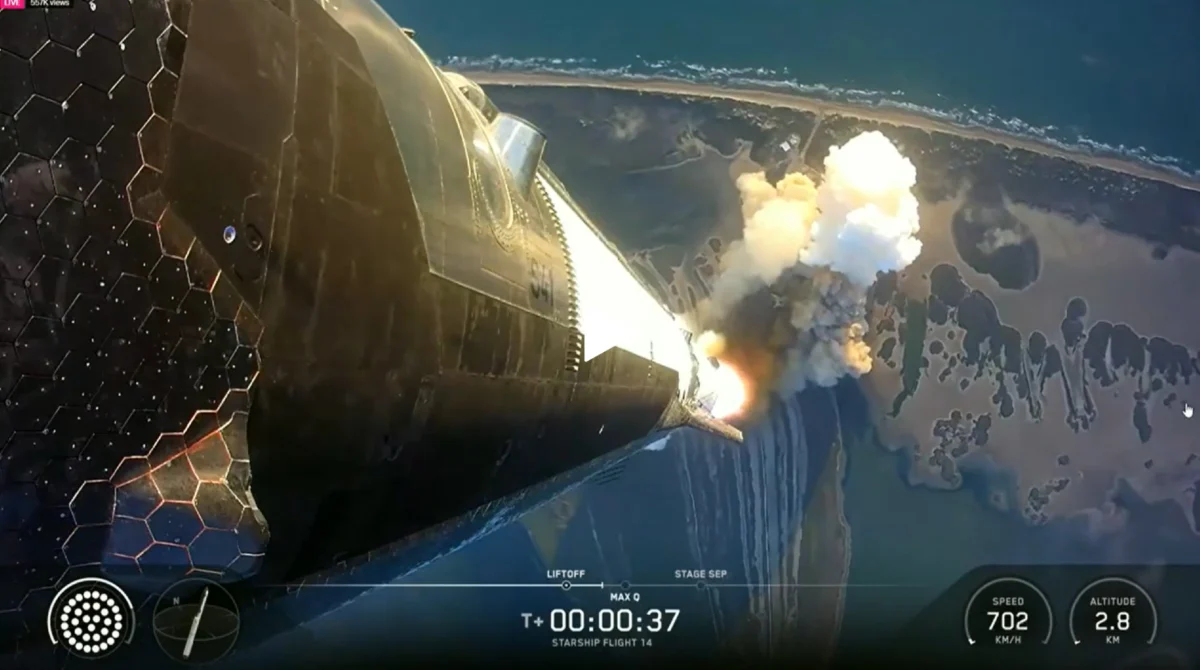

SpaceX achieved a monumental milestone in its heavy-lift launch program on Monday, September 28, 2026, successfully propelling its massive Starship rocket into Earth orbit for the very first time. Executed under the designation Starship Flight 14, the mission achieved several unprecedented technical objectives, most notably the deployment of 26 next-generation V3 Starlink satellites. However, the flight profile did not unfold entirely as originally mapped out on the mission timeline. Mission controllers were forced to execute an early termination of the flight after an engine malfunction disrupted the planned duration. Despite falling short of its projected 10-hour orbital longevity, the mission is being widely evaluated by aerospace analysts as a definitive victory for the private spaceflight sector, proving the fundamental architecture of the world’s largest and most powerful operational rocket system in a true orbital regime.
The launch, which took place from SpaceX’s sprawling Starbase facility located in Boca Chica, Texas, lifted off cleanly at 8:49 a.m. EDT. The towering vehicle cleared the launch mount with its characteristic thunderous roar, driven by a full complement of Raptor engines designed to push the boundaries of reusability and payload capacity. Roughly 26 minutes after clearing the tower, telemetry confirmed that Starship had successfully achieved orbital insertion, marking a historic first for the vehicle configuration. Yet, the ascent was not entirely unblemished. Shortly after liftoff, telemetry indicated a loss of power to one of the vehicle’s primary engines. Faced with an immediate anomaly, SpaceX mission control weighed the risks and elected to proceed with the flight trajectory, prioritizing secondary objectives such as payload deployment and atmospheric reentry data collection.
Chronology of the Mission
The trajectory of Starship Flight 14 followed a carefully choreographed timeline, though external anomalies ultimately forced a premature conclusion. The chronology of the day’s events underscores both the resilience of the flight hardware and the agility of the mission control team in Texas.
Pre-Launch and Liftoff: At 8:49 a.m. EDT, the countdown culminated in the ignition and liftoff of the Starship vehicle from the Texas Starbase launch complex. The vehicle demonstrated nominal performance through the initial phases of atmospheric ascent, clearing Max-Q and executing stage separation as engineered.
Orbital Insertion: Approximately 26 minutes following liftoff, following the anomaly that saw the unexpected loss of power to a single engine, Starship successfully achieved its targeted Earth orbit. This milestone fulfilled a primary long-term objective for the Flight 14 campaign, transitioning the vehicle from suborbital testing to operational orbital capability.
Payload Deployment Window: Operating within orbit, the spacecraft executed the primary commercial objective of the flight. The cargo bay doors opened to release 26 next-generation V3 Starlink satellites into their designated orbital plane, expanding the footprint of SpaceX’s burgeoning high-capacity constellation.
Mission Curtailment and Splashdown: Following the successful release of the satellite payload, mission controllers evaluated the cumulative impact of the earlier engine power loss. To ensure safety margins and gather optimal terminal guidance data, the decision was made to bring the spacecraft down ahead of schedule. After a total flight duration of 3 hours and 9 minutes, Starship reentered the atmosphere and executed a controlled splashdown in the designated target zone of the Northern Pacific Ocean. This truncated the mission by approximately 6 hours and 50 minutes compared to the original 10-hour, six-orbit flight plan.
Payload Significance and the V3 Starlink Architecture
The centerpiece of the Flight 14 payload manifest—the deployment of 26 V3 Starlink satellites—highlights the evolving commercial imperatives driving the Starship development roadmap. While earlier iterations of the Starlink constellation relied on Falcon 9 rockets for deployment, the sheer scale, mass, and volumetric requirements of the V3 satellites necessitate a heavy-lift vehicle of Starship’s caliber.
SpaceX has articulated an ambitious long-term deployment strategy that envisions launching upwards of 100,000 upgraded V3 Starlink satellites into low-Earth orbit. These advanced spacecraft are engineered to deliver vastly superior bandwidth, lower latency, and enhanced direct-to-device cellular capabilities on a global scale. As global demand for high-speed broadband in rural, maritime, and aviation sectors surges, the V3 constellation is intended to serve as the technological backbone of SpaceX’s telecommunications enterprise. Successfully executing the release of these massive payloads during an inaugural orbital flight demonstrates that Starship is rapidly maturing from an experimental testbed into a functional commercial cargo carrier.
Engineering Analysis and Official Perspectives
In the wake of the splashdown, aerospace engineers and industry observers began dissecting the telemetry data broadcast during the flight. The loss of power to an engine during takeoff remains a critical point of analysis for SpaceX’s propulsion and avionics teams. Modern multi-engine rocket systems, such as the Super Heavy booster and the Starship upper stage, are intentionally designed with engine-out capability. This redundancy allows the vehicle to safely continue flight even if one or more powerplants experience anomalies or premature shutdowns.
While SpaceX has not yet released a comprehensive post-flight mishap report, standard industry protocols dictate that engineering teams will spend the coming weeks examining the root cause of the power loss. Questions surrounding thermal stress, fuel feed pressures, and Raptor engine component longevity will undoubtedly form the core of the internal investigation. Nevertheless, the ability of the flight computer and the ground control team to dynamically adapt to the anomaly, continue the mission, and successfully deploy the entire satellite manifest before executing a controlled splashdown is being hailed as a testament to the system’s robust fault-tolerance architecture.
Broader Industry Implications and Future Outlook
The successful orbital insertion and payload delivery of Starship Flight 14 carry profound implications for the global aerospace and satellite communications sectors. For years, the development timeline of Starship has been watched closely by commercial competitors, defense agencies, and international space partners. The United States National Aeronautics and Space Administration (NASA), in particular, holds a vested interest in the vehicle’s progress, as a modified variant of Starship has been selected as the Human Landing System (HLS) for the Artemis lunar missions, intended to return American astronauts to the surface of the Moon.
Reaching orbit on Flight 14 removes a psychological and technical barrier that has shadowed the heavy-lift program. It provides empirical proof that the vehicle can survive the thermal and dynamic stresses of orbital insertion. At the same time, the premature termination of the flight serves as a reminder of the complex engineering hurdles that remain. Achieving full and rapid reusability—the ultimate economic objective of the Starship program—requires not only reaching orbit, but also returning both the booster and the ship intact to the launch site for rapid turnaround and relaunch.
As SpaceX integrates the lessons learned from Flight 14 into its upcoming vehicle iterations, the cadence of flight tests is expected to accelerate. The successful deployment of the V3 Starlink satellites signals that the operational utility of the rocket is beginning to catch up to its developmental promise. With the orbital milestone now officially cleared, the global aerospace community watches eagerly to see how quickly SpaceX can refine its propulsion reliability and extend flight durations on subsequent missions, pushing humanity one step closer to routine, heavy-lift interplanetary transit and global space-based infrastructure deployment.
