
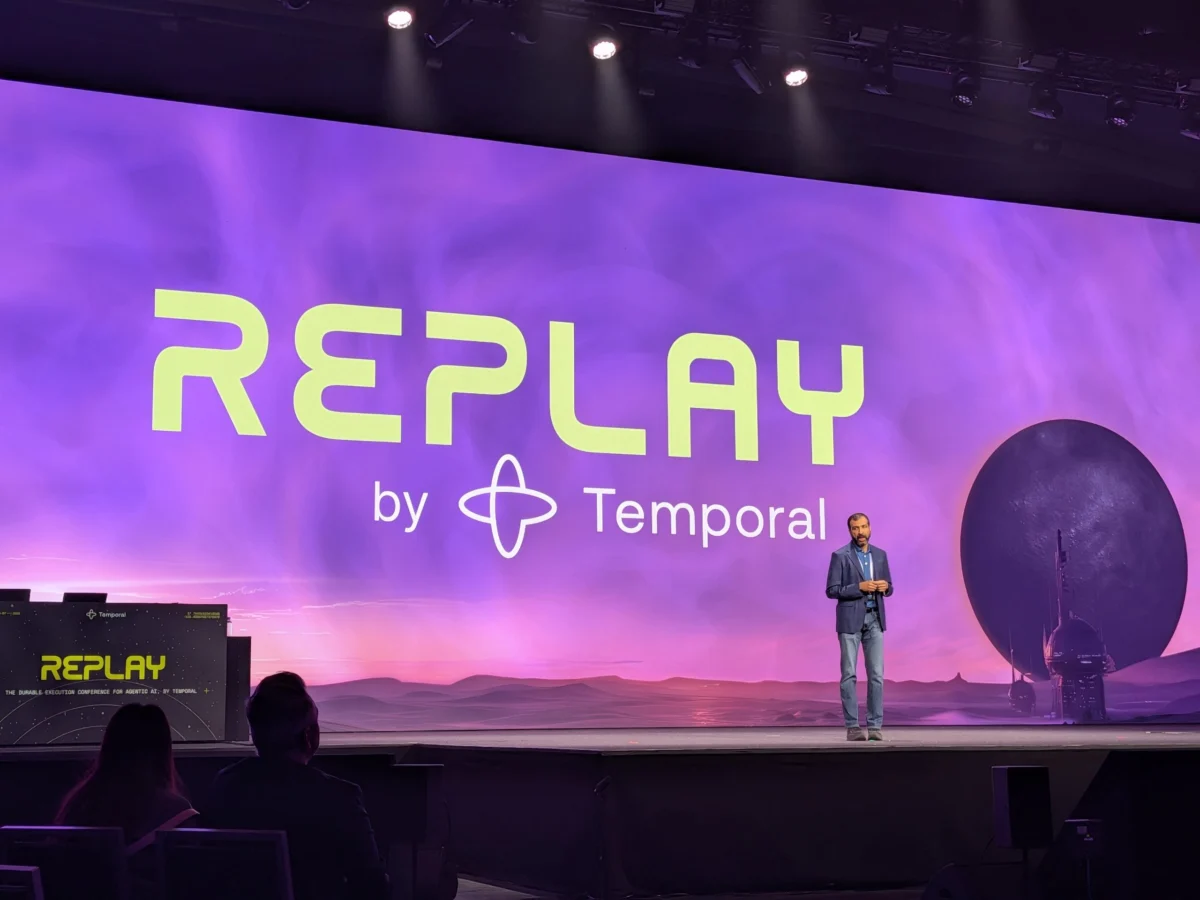

Temporal, a leader in durable execution for software development, has announced significant advancements aimed at bolstering the reliability and scalability of production applications, particularly those driven by artificial intelligence. At its annual Replay 2026 conference in San Francisco, the company introduced new features and highlighted strategic partnerships designed to address the increasing complexity and demands of modern enterprise IT infrastructure. The core message from Temporal’s leadership emphasized a commitment to building robust guardrails for software, enabling developers to deploy complex systems with unprecedented confidence.
The company’s foundational technology, Durable Execution, acts as a fault-tolerant framework by automatically persisting the state of code execution. This ensures that long-running processes can seamlessly resume from their last checkpoint, even in the event of crashes, network interruptions, or system restarts. This capability transforms traditionally fragile code into resilient, crash-proof workflows by meticulously recording every step, thereby eliminating the need for manual, error-prone handling logic. In an era where AI models and large language models are increasingly integrated into critical business operations, such infrastructure resilience is becoming paramount.
"Production applications require a certain level of resiliency, scale, and observability," stated Maxim Fateev, Co-founder and CTO of Temporal, during his keynote address at Replay 2026. The conference, which convened over 2,000 developers and IT professionals, focused heavily on the challenges and solutions for deploying AI at scale. Fateev elaborated on Temporal’s innovative abstraction: "We invented this new abstraction in which we just preserve the full state of code execution all the time. This means that if any process crashes or another type of failure occurs, resurrected processes are executed in the same state and continue executing thereafter." He provided a striking example: "For instance, you can write a function that runs for a year, and we can guarantee that this function will not die, because we preserve its state all the time."
Temporal, established in 2019 and built upon the open-source Cadence workflow orchestration engine originally developed at Uber, has experienced rapid growth. The company reports serving over 1,500 paying customers, including prominent technology firms like Nvidia, Netflix, Snap, and Stripe, alongside thousands of open-source users. This widespread adoption underscores the critical need for reliable workflow orchestration in today’s demanding software landscape.
Key Innovations Unveiled at Replay 2026
The Replay 2026 conference served as the platform for several pivotal announcements that are poised to reshape how developers approach production-ready AI systems. These innovations aim to simplify the deployment and management of complex, stateful applications.
Temporal Serverless Workers: Scaling Without Servers
A significant announcement was the introduction of Temporal Serverless Workers. This new capability allows developers to run standard Temporal Workers on serverless compute platforms such as AWS Lambda. The key benefit, as highlighted by Fateev, is the elimination of server provisioning, cluster scaling management, and the cost of idle compute resources. Temporal automatically invokes a Serverless Worker when tasks arrive and scales it down to zero when the tasks are completed.
This serverless model utilizes the same Temporal Software Development Kits (SDKs) as traditional, long-lived workers. Workflow and activity registrations remain consistent. The fundamental difference lies in the worker lifecycle: instead of maintaining a continuously running process, Temporal triggers the Serverless Worker on demand. The worker initiates, polls for available tasks, processes them, and then exits upon completion. This approach promises significant cost savings and operational efficiency for many use cases.
Standalone Activities: Enhancing Job Processing Durability
Another major revelation was Standalone Activities, a feature designed to empower Temporal Activities to operate independently, rather than being confined solely as steps within a broader workflow. This enhancement directly addresses the need for more durable and debuggable job processing, aiming to eliminate the complexity associated with traditional queuing and retry mechanisms.
With Standalone Activities, developers can leverage the familiar Temporal model for job processing. Crucially, if a use case evolves beyond a single, discrete step, developers can seamlessly integrate that same activity into a workflow without requiring any code rewrites. This offers a flexible path for scaling and evolving application logic. Standalone Activities are currently in public preview for the Go, Python, and .NET SDKs, with pre-release support for Java and TypeScript SDKs, and are fully supported on Temporal Cloud.
Workflow Streams: Real-time Observability for AI
To provide real-time observability into complex workflows, Temporal introduced Workflow Streams. This feature leverages Temporal’s Signal and Update primitives, which are established mechanisms for interacting with running workflows. Signals are asynchronous, reliable messages used for sending data to a workflow without requiring an immediate response. Updates, on the other hand, are synchronous, blocking calls that allow for the mutation of workflow state and the retrieval of a return value, effectively replacing more complex Signal/Query patterns.
Workflow Streams enable developers to receive token batches and application-level updates, facilitating responsive user interfaces, live monitoring, and the implementation of crucial guardrails within AI systems. The design prioritizes real-time user output while adhering to Temporal’s robust reliability model. Workflow Streams are now available in public preview.
Strategic Partnerships and the Future of AI Orchestration
The conference also featured insights into Temporal’s broader ecosystem and its role in the future of AI development. Samar Abbas, Co-founder and CEO of Temporal, alluded to a potential partnership with OpenAI, underscoring the platform’s strategic importance for cutting-edge AI applications.
Venkat Venkataramani, VP of Application Infrastructure at OpenAI, shared his perspective on Temporal’s impact: "Temporal’s durable orchestration framework is critical to handling our massive scale, complex agentic workflows, infrastructure control plane, and data pipelines, reinforcing the platform’s importance for the next generation of AI products." This statement from a leading AI research and deployment company highlights the critical need for robust orchestration solutions as AI systems become more sophisticated and integral to business operations.
The implications of these advancements are far-reaching. As AI models become more integrated into mission-critical applications, the ability to ensure their consistent performance, recoverability from failures, and scalability becomes paramount. Temporal’s focus on providing "guardrails" for software development directly addresses these concerns. The framework’s ability to maintain state across failures and its new serverless and standalone capabilities offer developers a more agile, cost-effective, and reliable path to deploying complex AI-driven systems into production environments.
Contextualizing the Innovation
The evolution of software development has seen a continuous push towards greater reliability and resilience. Early systems often relied on manual error handling and checkpointing, which were prone to human error and difficult to scale. The advent of distributed systems introduced new challenges, such as network partitions and node failures. Workflow orchestration engines like Cadence (and subsequently Temporal) emerged to manage the complexity of long-running, multi-step processes across distributed environments.
The current wave of AI innovation, particularly with large language models and sophisticated agentic systems, introduces an even higher degree of complexity. These systems often involve intricate state management, long execution times, and dependencies on multiple services. Traditional cloud-native architectures, while scalable, can still struggle with the deep statefulness and guaranteed execution required for truly robust AI workflows. Temporal’s Durable Execution directly targets this gap, offering a solution that abstracts away much of the underlying complexity of ensuring fault tolerance.
The Replay 2026 conference itself represents a growing community and an emerging industry standard for durable execution. By bringing together developers, engineers, and thought leaders, Temporal fosters an environment for collaboration and innovation in a critical area of software infrastructure. The company’s trajectory, from its open-source origins to its current position serving major enterprises, indicates a strong market demand for its unique approach to solving complex software reliability challenges.
Broader Impact and Future Implications
The sustained focus on AI development and deployment signifies a shift in how businesses leverage technology. AI is moving beyond experimental phases into core operational functions, demanding infrastructure that can match its potential. Temporal’s contributions are foundational to this transition. By providing the underlying reliability, the company empowers businesses to confidently deploy AI applications that can manage sensitive data, automate critical processes, and deliver consistent user experiences.
The adoption of serverless architectures, as facilitated by Temporal Serverless Workers, aligns with broader industry trends toward cloud-native efficiency. This approach not only reduces operational overhead but also allows development teams to focus more on building business logic rather than managing infrastructure.
Similarly, the flexibility offered by Standalone Activities provides developers with a powerful tool for building and scaling job processing systems. This is particularly relevant for batch processing, data pipelines, and background tasks that are essential components of many AI applications.
The ongoing collaboration with companies like OpenAI suggests a future where Temporal’s orchestration capabilities are integral to the development of advanced AI agents and complex multi-model systems. As AI continues to evolve, the need for robust, fault-tolerant, and observable execution environments will only intensify, positioning Temporal as a key enabler of this technological frontier. The company’s commitment to building "guardrails" for software development is not just about preventing crashes; it’s about enabling the next generation of intelligent, reliable, and scalable applications.
