
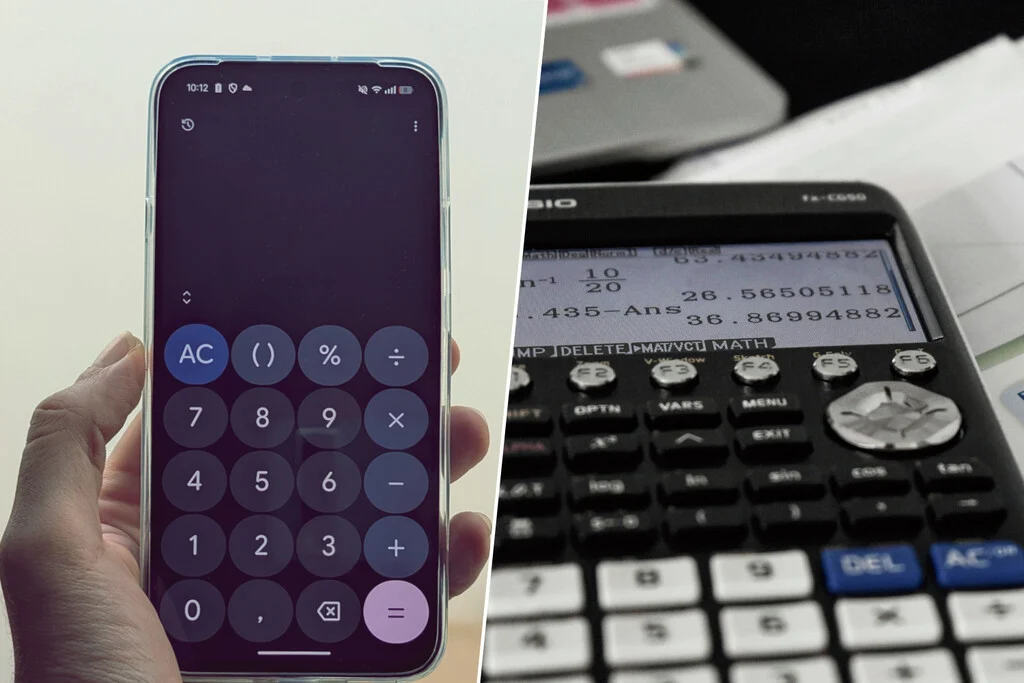

The realms of technology and mathematics are often perceived as domains of unwavering precision, where every calculation yields an exact and irrefutable outcome. However, a curious and frequently viral phenomenon exposes a subtle yet significant divergence: the contrasting results produced when the same mathematical operation is entered into a modern smartphone calculator versus a basic, traditional pocket calculator. This apparent paradox, widely shared in online videos, has led many to question the fundamental reliability of their ubiquitous digital tools. Far from being a flaw in programming or a bug in the system, this mathematical enigma has a logical and fascinating explanation rooted in the distinct architectural and interpretive methodologies of these devices. The discrepancy does not signify a shift in the immutable rules of mathematics but rather reflects how each microprocessor is engineered to prioritize and execute a sequence of instructions. Understanding these underlying mechanisms is crucial to demystifying these differences.
The Foundational Principles: PEMDAS vs. Sequential Logic
The primary reason behind most of these computational misunderstandings lies in the distinct ways a chain of mathematical operations is processed. Modern calculators, including those integrated into smartphones and advanced scientific models, are equipped with sophisticated memory and processing capabilities. They typically employ an "algebraic direct entry system" (A.E.S.), which allows them to store the entire equation before processing it according to a globally recognized mathematical hierarchy. This hierarchy is universally known by acronyms such as PEMDAS (Parentheses, Exponents, Multiplication and Division, Addition and Subtraction) or BODMAS (Brackets, Orders, Division and Multiplication, Addition and Subtraction), depending on regional educational conventions. These mnemonics serve as a standard for the order of operations, dictating that multiplication and division take precedence over addition and subtraction, and operations within parentheses are resolved first. Consequently, a smartphone calculator, adhering to PEMDAS, will execute multiplication before addition.
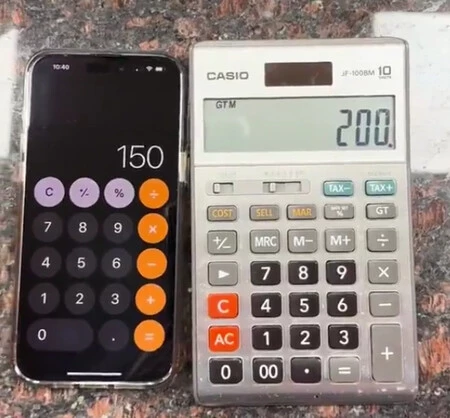
Consider the classic viral example: "50 + 50 x 2". When this operation is entered into a smartphone or scientific calculator, the device first identifies the multiplication operation. Following PEMDAS, it calculates "50 x 2" which equals 100. Only then does it proceed to the addition, adding the initial 50 to 100, yielding a final result of 150. This method aligns with the universally accepted conventions taught in mathematics curricula worldwide, ensuring consistency in complex algebraic computations.
In stark contrast are the basic, "everyday" calculators—the pocket or desktop models that have been ubiquitous for decades. These devices operate on a simpler, "sequential entry logic." Lacking the extensive memory and complex parsing capabilities of their modern counterparts, they do not store the entire formula before calculating. Instead, they process each operation instantaneously as it is entered and the corresponding operator key is pressed. When the operation "50 + 50 x 2" is entered into a basic calculator, the sequence unfolds differently. Upon entering "50 + 50", the calculator immediately performs the addition, displaying 100. Subsequently, when the "x 2" is entered, it multiplies the current displayed result (100) by 2, yielding a final outcome of 200.
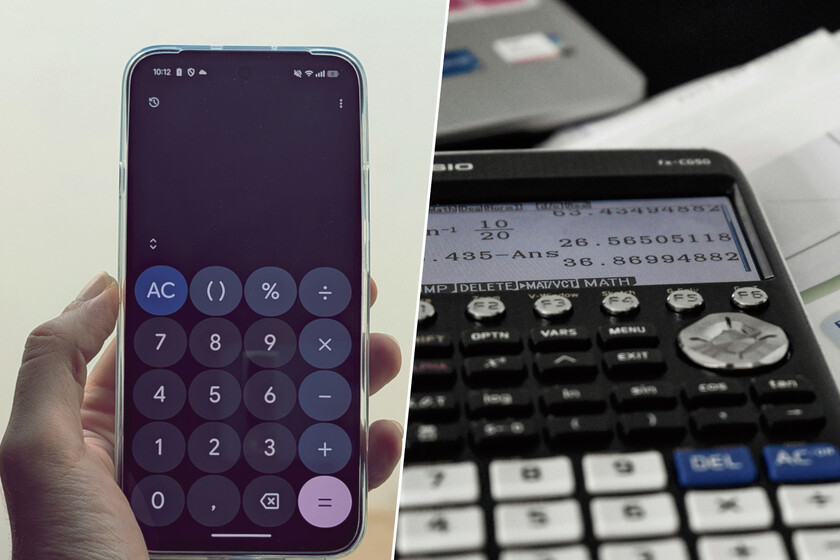
As programming expert David A. Thigpen highlighted, both results are mathematically "correct" within the context of the method employed by each device. The discrepancy arises not from an error, but from differing interpretations of the input sequence. For users seeking to obtain the "basic calculator" result on a smartphone, the solution is simple: explicitly define the order using parentheses or press the equals key after the initial addition to "settle" the sum before proceeding with multiplication. For instance, entering "(50 + 50) x 2" on a smartphone calculator will force it to first calculate the sum within the parentheses, then multiply the result, thereby mirroring the sequential logic’s outcome.
A Brief History of Calculation and Input Methodologies
The evolution of calculation tools provides essential context for these differing approaches. Early mechanical calculators, like Pascal’s Arithmetical Machine (17th century) or Leibniz’s Stepped Reckoner, performed operations sequentially, much like modern basic calculators, albeit through gears and levers. The advent of electronic calculators in the mid-20th century brought speed and miniaturization, but the fundamental sequential input method persisted in many basic models due to hardware limitations and cost considerations.
The rise of scientific calculators in the 1970s, pioneered by companies like Hewlett-Packard and Texas Instruments, marked a significant shift. These devices, designed for engineers and scientists, needed to handle complex equations involving multiple operations and functions. This necessitated the adoption of algebraic logic (A.E.S.) where the entire expression could be entered and then parsed according to the standard order of operations. Some advanced calculators, particularly from HP, even adopted Reverse Polish Notation (RPN), an unambiguous postfix notation that completely eliminates the need for parentheses by requiring operators to follow their operands. While RPN offers clarity, algebraic entry became the dominant standard for its intuitive resemblance to how equations are written. Smartphone calculators, being direct descendants of these advanced scientific models in terms of software logic, naturally adopted the algebraic direct entry system with its adherence to PEMDAS.
Beyond Basic Operations: Implicit Multiplication and Floating-Point Precision
The discrepancies are not limited to the simple addition-multiplication scenario. Another common source of confusion, particularly among scientific and even some smartphone calculators, stems from "implicit multiplication." This occurs when a number is placed directly adjacent to a parenthesis without an explicit multiplication sign (e.g., 2(3+1)). While mathematically understood as multiplication, the priority assigned to this implicit operation can vary.

Many modern smartphones and scientific calculators treat implicit multiplication with the same priority as explicit multiplication, processing it from left to right according to the standard PEMDAS rules. However, certain models, notably some from Casio and Texas Instruments, are programmed to assign a higher priority to implicit multiplication, treating the juxtaposed number and the parenthetical expression as a single, indivisible term. This subtle difference can lead to dramatically different results in specific complex expressions.
Consider the often-debated problem: 6 / 2(1+2).
- A calculator prioritizing explicit multiplication (like many smartphone apps) would interpret this as
6 / 2 * (1+2). Following PEMDAS, it would first solve the parenthesis(1+2) = 3. Then, moving left to right for multiplication and division, it would calculate6 / 2 = 3, and finally3 * 3 = 9. - However, a calculator that assigns higher priority to implicit multiplication might interpret
2(1+2)as a single block that must be fully evaluated before division. In this case,2(1+2)becomes2 * 3 = 6. Then the expression becomes6 / 6, yielding 1.
This specific ambiguity highlights a lack of universal standardization for the precise hierarchy of implicit multiplication relative to division, leading to ongoing debates even within the mathematical community and different implementations by calculator manufacturers.
Furthermore, a fundamental hardware-level factor can also contribute to subtle divergencies in mathematical operations: the representation of numbers themselves. Computers and smartphones typically perform calculations using "floating-point arithmetic," which adheres to standards like IEEE 754. This standard dictates how decimal numbers are converted into a binary format for internal processing. While highly efficient for a vast range of calculations, floating-point arithmetic has a known limitation: it cannot perfectly represent all decimal fractions (e.g., 0.1, 0.2) in binary. Just as 1/3 cannot be precisely represented as a finite decimal (0.333…), some simple decimal fractions become infinite repeating binary fractions.
This inherent imprecision means that over a series of complex calculations, particularly those involving many fractional numbers, smartphone applications can accumulate infinitesimal rounding errors. While often negligible for everyday use, these minute deviations can become significant in fields demanding extreme precision. Financial calculations, for example, where every cent matters, might be vulnerable to such errors.
To circumvent this, some specialized calculators, particularly those designed for financial or scientific applications requiring absolute decimal accuracy, incorporate microchips dedicated to working in "Binary-Coded Decimal" (BCD) format. BCD encodes each decimal digit separately into binary, preserving the exact decimal representation and avoiding the rounding imperfections inherent in standard floating-point arithmetic. This ensures that calculations like 0.1 + 0.2 indeed result in exactly 0.3, without any minute binary approximation.
Implications and Best Practices
Understanding these nuanced differences in calculator logic is not merely an academic exercise; it carries significant practical implications, particularly in fields where precision is paramount. In engineering, where structural integrity or component tolerances are critical, or in finance, where large sums of money are involved, even tiny discrepancies can lead to substantial errors.
For students, this knowledge is crucial for navigating mathematics education, ensuring their calculator results align with classroom teachings based on established order of operations. For professionals, it underscores the importance of not only understanding the mathematical principles but also the operational characteristics of the tools they employ.
To mitigate potential confusion and ensure accuracy, several best practices are recommended:
- Explicit Use of Parentheses: Always use parentheses to explicitly define the desired order of operations, especially when using smartphone or scientific calculators. This removes any ambiguity regarding implicit multiplication or the sequence of operations. For example, instead of
6 / 2(1+2), always write6 / (2 * (1+2))or(6 / 2) * (1+2)to clearly state your intent. - Know Your Tool: Be aware of the specific input logic (algebraic vs. sequential) and any particular conventions (like implicit multiplication priority) of the calculator you are using.
- Verify Critical Calculations: For calculations requiring high precision or with significant consequences, consider performing them on multiple devices or using alternative methods to cross-verify the results.
- Specialized Tools for Specialized Tasks: For highly sensitive applications, such as professional finance or scientific research, opt for calculators or software specifically designed for those tasks, which often incorporate BCD arithmetic or robust error-checking mechanisms.
In conclusion, the apparent conflict between smartphone and basic calculator results is not a sign of mathematical inconsistency or device failure. Instead, it is a testament to the diverse engineering philosophies and design trade-offs that underpin these computational tools. From the sophisticated algebraic parsing of modern devices adhering to PEMDAS, to the immediate sequential execution of simpler models, and even the subtle distinctions in handling implicit multiplication or fractional precision, each approach is valid within its own framework. By recognizing these underlying mechanisms, users can transcend mere confusion and leverage their calculators with informed confidence, ensuring accuracy and avoiding unintended errors in an increasingly digital world.
