

Amazon Web Services (AWS) has announced the preview release of AWS Transform – continuous modernization, a significant new capability designed to tackle the persistent and costly challenge of technical debt in enterprise software development. This new offering, building upon the existing AWS Transform service, promises to provide continuous, autonomous analysis and remediation of technical debt at scale, offering enterprises unprecedented visibility and control over their sprawling codebases. The move positions AWS to further streamline cloud migrations and application modernization efforts, addressing a critical pain point that has historically consumed substantial engineering resources and budget.
The Pervasive Challenge of Technical Debt in Modern Enterprises
Technical debt, often described as the "cost of doing business" in software development, refers to the accumulated complexity, suboptimal design choices, and outdated components within a codebase that hinder future development, increase maintenance costs, and introduce security vulnerabilities. Industry reports consistently highlight the substantial burden technical debt places on organizations. Studies by organizations like Stripe and McKinsey have indicated that engineers spend between 20% and 40% of their time addressing technical debt, diverting valuable resources from innovation and new feature development. The original AWS announcement itself notes that engineering organizations typically consume up to 30% of IT budgets, a significant portion of which is often dedicated to managing this accumulated complexity.
The problem is exacerbated in large enterprises operating thousands of applications across diverse technology stacks, from legacy mainframes to modern microservices. These organizations often struggle with:
- Lack of Visibility: Understanding the true state of their codebase, identifying all instances of deprecated frameworks, end-of-life dependencies, or non-compliant coding patterns.
- Manual Remediation: Relying on manual, app-by-app processes to detect and fix issues, which is slow, error-prone, and unsustainable at scale.
- Fragmented Tooling: Stitching together disparate point solutions for dependency analysis, vulnerability scanning, and code quality, leading to inefficiencies and gaps.
- Rapid Accumulation: The accelerated pace of development, partly driven by AI-assisted coding agents, means technical debt can accumulate faster than human developers can address it, creating a perpetual backlog.
- Security Risks: Outdated components and unpatched vulnerabilities are prime targets for cyberattacks, making proactive remediation a critical security imperative.
This landscape often results in project delays, increased operational costs, reduced developer morale, and a significant drag on an organization’s ability to innovate and respond to market demands. Leaders frequently rely on self-reported team statuses, which often lag reality and mask critical regressions, further obscuring the true state of their technical debt.
AWS Transform: An Evolution in Modernization Strategies
AWS Transform was initially introduced to help enterprises with large-scale migration efforts, particularly in moving applications from traditional data centers to the cloud, and modernizing legacy mainframe and Windows applications. Its core value proposition has been to automate the undifferentiated heavy lifting of software maintenance, such as upgrading Java versions, replacing deprecated frameworks, and updating AWS Lambda runtimes before they reach their end-of-life. The service aims to reduce the manual effort involved in these tasks, allowing engineering teams to focus on higher-value activities.
The introduction of AWS Transform – continuous modernization marks a significant expansion of this vision. It shifts the focus from episodic, project-based modernization to an ongoing, automated process. This evolution reflects a growing industry trend towards continuous everything – continuous integration, continuous delivery, continuous security, and now, continuous modernization. By integrating continuous analysis and autonomous remediation capabilities, AWS aims to provide a holistic solution that not only assists with major migration campaigns but also manages the day-to-day hygiene of an organization’s software portfolio. This strategic move aligns with AWS’s broader commitment to simplifying cloud adoption and empowering developers with tools that enhance productivity and security.
Continuous Analysis: Unveiling the Hidden Debt
A cornerstone of the new AWS Transform capability is its robust continuous analysis engine. Designed to address the pervasive visibility challenge, this feature automatically scans an organization’s code repositories against configurable baselines. Unlike traditional manual audits that can take weeks or even months to complete, AWS Transform – continuous modernization generates detailed findings in hours.
The service comes with a rich set of out-of-the-box policies capable of detecting common sources of technical debt, including:
- End-of-Life Dependencies: Identifying libraries or packages that are no longer supported, posing security and stability risks.
- Deprecated Frameworks: Flagging the use of outdated frameworks that might lack security patches or modern features.
- Outdated Runtimes: Ensuring applications run on current and secure runtime environments, such as specific Java or Node.js versions.
Crucially, enterprises can extend these pre-defined policies with their own organization-specific remediation patterns. This flexibility allows platform teams to codify internal coding standards, preferred libraries, or specific technical debt policies they already enforce. For instance, if an organization has deprecated an internal library in favor of a newer solution, or mandates a particular logging pattern, these rules can be integrated into the continuous analysis engine. This ensures that the system not only identifies generic issues but also enforces unique corporate governance and architectural guidelines across the entire codebase.

The continuous nature of this analysis provides "ground truth" directly from the source code. This means that when a repository deviates from the established baseline, platform teams receive immediate notifications, detailing which components are affected and the extent of the deviation. This eliminates the need for time-consuming status check-ins, manual compliance tracking, and subjective self-reporting, providing an always-current, objective view of the organization’s technical debt landscape. The real-time feedback loop empowers teams to address issues proactively, preventing minor deviations from escalating into major problems.
Autonomous Remediation at Scale: Closing the Loop
Identifying technical debt is only half the battle; remediating it, especially across thousands of repositories, is often the more daunting task. AWS Transform – continuous modernization addresses this by offering autonomous remediation capabilities. Once findings are identified and prioritized, organizations can configure the service to automatically generate pull requests (PRs) for affected repositories.
This automated remediation process leverages out-of-the-box transformations for common scenarios, such as:
- Java Version Upgrades: Automatically updating code to be compatible with newer Java versions.
- SDK Migrations: Facilitating the transition to newer versions of AWS SDKs or other third-party SDKs.
- Library Updates: Applying patches or upgrading to newer versions of various software libraries.
Beyond these standard transformations, organizations can also create custom transformations tailored to their unique needs. This allows for the automated application of complex, organization-specific fixes, further enhancing the system’s utility.
When a remediation campaign is launched, the continuous modernization capability creates individual pull requests for each affected repository. These PRs are accompanied by clear messages, such as: "This repository is behind on your organization’s baseline for [dependency/framework]. Here’s a PR that resolves it." This direct communication notifies the owning development team, providing them with a ready-made solution. Teams then have the flexibility to review and merge the proposed PR, or if they prefer, remediate the issue using their own approach. The continuous analysis engine then automatically detects when the fix is in place, providing objective confirmation without requiring manual sign-off.
A critical aspect of this autonomous remediation is its integration with security. AWS Transform – continuous modernization integrates seamlessly with AWS Security Agent to detect and remediate security vulnerabilities directly at the source-code level. This means that security findings are consolidated into the same prioritized list and flow through the same automated pull-request workflow as other forms of technical debt. This unified approach ensures that security issues are addressed swiftly and systematically, bolstering an organization’s overall security posture and compliance.
A Practical Walkthrough: From Dashboard to Remediation
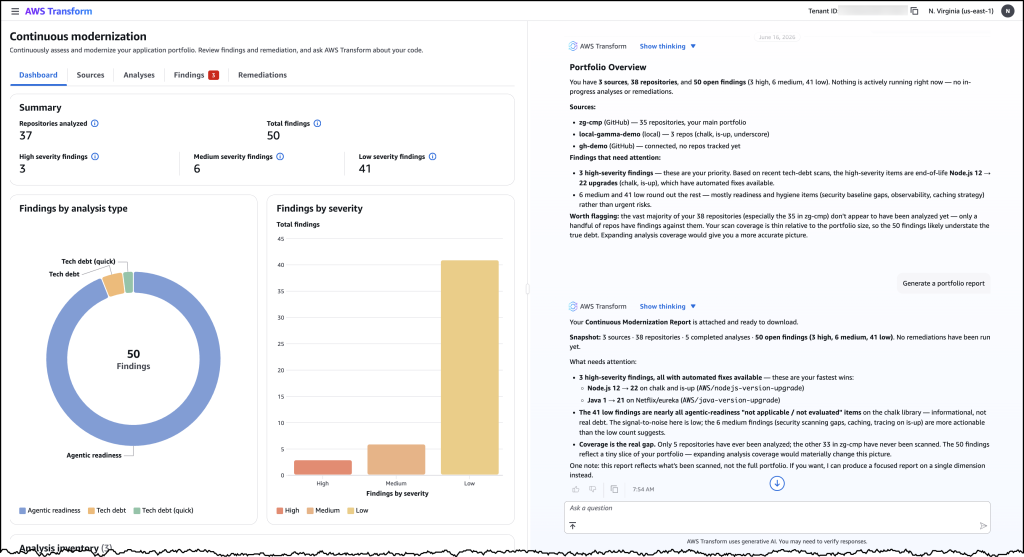
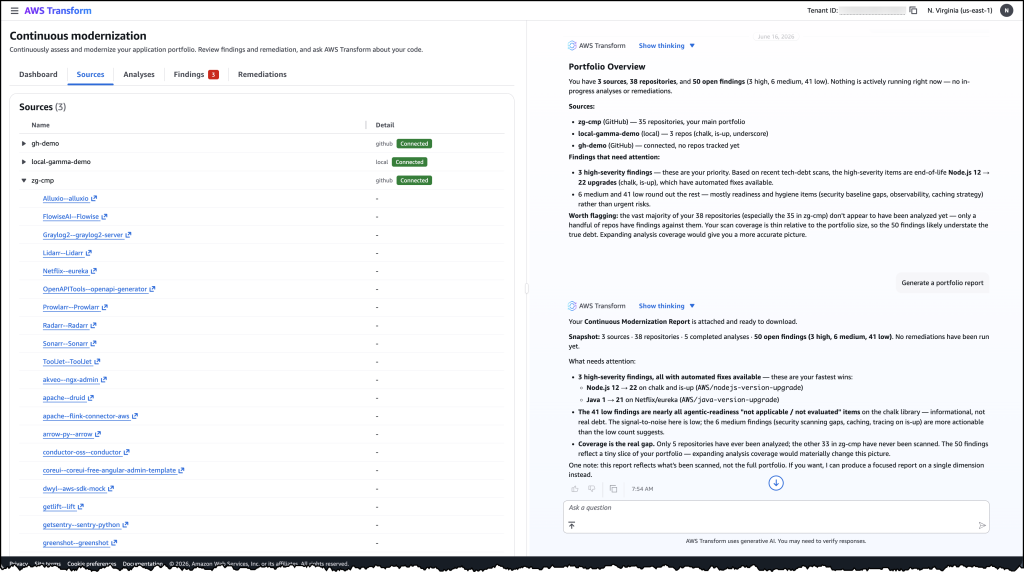
The user experience for AWS Transform – continuous modernization is designed for clarity and efficiency, accessible via the AWS Transform web application. Upon accessing the dashboard, users are presented with a comprehensive overview of their organization’s repositories and their current status against configured baselines.
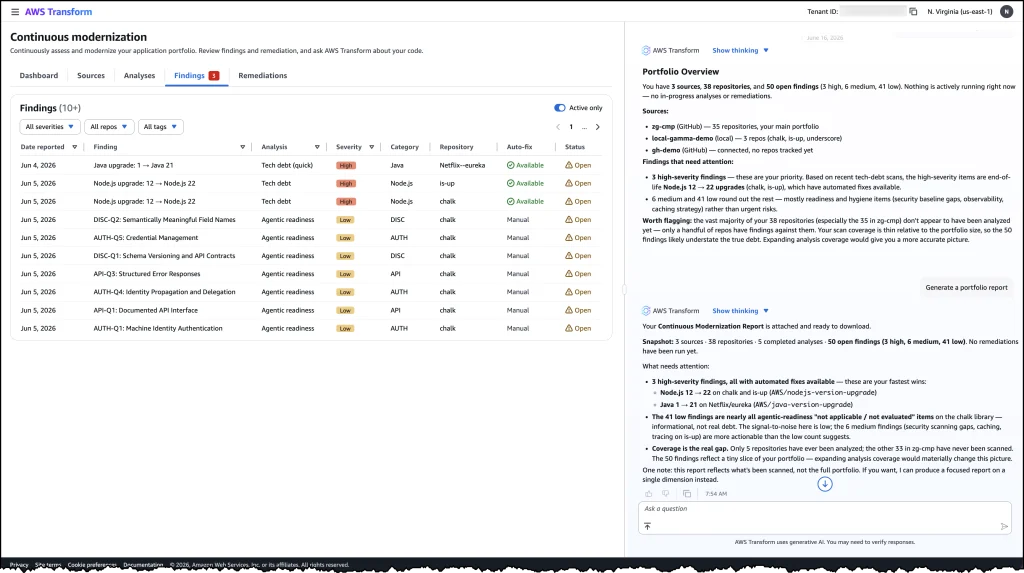
The initial setup involves connecting the organization’s source control system, such as GitHub or GitLab, and initiating an analysis against specified policies. The system then rapidly scans the connected repositories. Within hours, the analysis returns a detailed list of findings, clearly indicating which repositories are behind baseline and by how much. The dashboard provides granular insights, showing the severity of each finding, the number of affected files, and the specific technical debt patterns detected. This immediate and comprehensive visibility allows platform teams and engineering leaders to quickly grasp the scope of their technical debt.
From this detailed view, users can select a group of high-priority findings to launch a remediation campaign. The AWS Transform – continuous modernization capability then autonomously generates pull requests for each affected repository. The progress of these campaigns can be monitored in real-time through the dashboard, providing transparency on which PRs have been created, which have been merged by development teams, and which repositories have returned to compliance. Visual aids, such as the example dashboard images provided in the original announcement, illustrate a portfolio overview of technical debt findings, detailed listings by severity and category, and a clear view of connected repositories. This intuitive interface streamlines the often-complex process of managing and mitigating technical debt across a large enterprise.
Strategic Approaches: Continuous vs. Campaign Modernization
The new capabilities within AWS Transform – continuous modernization support two distinct, yet complementary, approaches to code modernization:
- Continuous Mode: This mode is designed for the ongoing, day-to-day work of keeping codebases current. It focuses on the recurring tasks of upgrading libraries, applying security patches, and enforcing coding standards as baselines evolve. This proactive approach helps prevent the accumulation of new technical debt, ensuring that applications remain healthy, secure, and performant over time. It’s an operational rhythm for maintaining software quality.
- Campaign Mode: For larger, more complex modernization projects, such as migrating from one major framework to another (e.g., Spring Boot 2 to Spring Boot 3) or upgrading a critical runtime version across hundreds of applications, the existing AWS Transform custom capabilities remain the preferred tool. These efforts are typically project-based, requiring more extensive planning, testing, and coordinated rollouts. While continuous modernization handles the routine hygiene, campaign mode addresses the strategic, transformative initiatives.
AWS Transform – continuous modernization is purpose-built for the high-volume, recurring tasks that platform teams manage daily, freeing up developers to innovate while ensuring a clean and secure codebase.
Broader Implications and Industry Impact
The introduction of AWS Transform – continuous modernization is poised to have significant implications for enterprise IT and the broader software development landscape.
- Enhanced Developer Productivity: By automating the detection and remediation of technical debt, developers can spend less time on maintenance and more time on creating new features and delivering business value. This can lead to faster innovation cycles and improved morale.
- Cost Savings: Reducing manual effort in maintenance and preventing the accumulation of technical debt translates directly into cost savings by optimizing engineering resource allocation. Proactive security patching also reduces the risk and cost associated with security breaches.
- Improved Security Posture: The seamless integration of security vulnerability detection and remediation at the source-code level provides a continuous layer of defense, ensuring that applications remain compliant and protected against evolving threats. This is particularly critical in an era of increasing cyber risks.
- Strategic Advantage for AWS: This offering further solidifies AWS’s position as a comprehensive cloud provider, extending its value proposition beyond infrastructure and platform services into core application lifecycle management. It offers a compelling reason for enterprises to deepen their commitment to the AWS ecosystem.
- Competitive Landscape: The move sets a new bar in the application modernization space, challenging existing point solution providers and potentially driving further innovation in autonomous code analysis and remediation tools.
While AWS has not yet released specific customer testimonials for the preview, industry observers anticipate strong uptake from enterprises grappling with legacy systems and rapidly evolving technology stacks. The ability to autonomously manage technical debt at scale addresses a universal pain point that has long plagued software organizations of all sizes.
Availability and Future Outlook
AWS Transform – continuous modernization (preview) is available today. Enterprises interested in leveraging these new capabilities can get started through the AWS Transform web application. Further integration options are noted, including through what is described as "AWS Transform Kiro Power" and via "MCP and skills for integration with your existing coding agents," indicating a multi-faceted approach to accessibility and adoption. Detailed documentation is available on the AWS Transform documentation portal, providing comprehensive guidance for implementation and use.
As a preview release, AWS will undoubtedly gather feedback from early adopters to refine and enhance the service, potentially adding more remediation patterns, policy options, and integrations. The long-term vision for AWS Transform appears to be a holistic platform that not only facilitates cloud migration but also ensures the ongoing health, security, and modernity of applications throughout their lifecycle, making it an indispensable tool for the modern enterprise. This continuous approach to modernization underscores AWS’s commitment to delivering comprehensive solutions that address the full spectrum of challenges faced by organizations operating in the cloud.
